Dieser Artikel ist auch in deutscher Sprache verfügbar: Zum deutschen Artikel.
Is living a risk? In Grünau, we can now observe people living out their real-life model, which centres on the space they need. Just round the corner, however, things are getting rather cramped – at least as far as visiting the health centre is concerned. Music history is being brought back to life at the Gewandhaus. And then there’s another topic that… well, read for yourself.
Hopefully it’s nothing to do with their legs
For the time being, patients at the health centre on Selliner Straße in Grünau will no longer be able to reach their specialists via bus routes 62 and 66. According to Leipzig Transport Services (LVB),
both routes are unable to serve the bus stop due to repair works in the car park there. The LVB states that this change will remain in place until 25 September 2026. The LVB does not specify a replacement stop for the cancelled one in its published construction site information.
The services themselves are not being cancelled. Bus route 62 connects Böhlitz-Ehrenberg with Lausen/Wolkenweg via Burghausen, Rückmarsdorf and Miltitz. Route 66 serves Grünau and runs via, amongst other places, Allee-Center, Schönauer Ring, Kiewer Straße/Kaufland, Lausen, Grünau-Süd and the Grünauer Allee S-Bahn station.
Passengers on route 66 will face a further disruption due to roadworks today. Due to pipework on Gärtnerstraße, the bus will be locally diverted from the Grünauer Allee S-Bahn station to Hermann-Meyer-Straße. The Gärtnerstraße stop will be served instead at Nikolai-Rumjanzew-Straße. According to the latest information, this change will also end on 25 September.
Take a look at smart living today
We’re staying in Grünau – and doing so without a bus. Today, anyone interested can find out about a housing experiment in Grünau that aims to combine reduced land use with flexibly usable flats. The Urban Development and Mobility Working Group of the Leipzig district association of Bündnis 90/Die Grünen invites you to an excursion at 5.30 pm to the “Nukleuswohnen” project at Liliensteinstraße 29–33. The programme includes a guided tour as well as discussions with the operators and trial residents about sustainable and affordable housing in existing buildings.
The basic idea behind ‘Nukleuswohnen’ originated within the Munich housing cooperative Kooperative Großstadt eG and was first implemented in the San Riemo project. Since 2022, the concept has been further developed and researched in collaboration with a team from RWTH Aachen University. In Leipzig, research is now being carried out into how it can be adapted to an existing WBS-70 prefabricated block of flats belonging to the Lipsia eG housing cooperative (as reported by the LZ)
. The term ‘nucleus’ refers to the private core of a flat. In the Leipzig pilot project, such a basic unit is designed for one to two people and covers around 33 square metres, comprising a kitchen-diner, bathroom, balcony and, in most cases, a bedroom. Depending on one’s living situation, additional rooms can be added and later given up again. The ‘Kooperative Großstadt’ therefore refers to it as a ‘breathing house’.
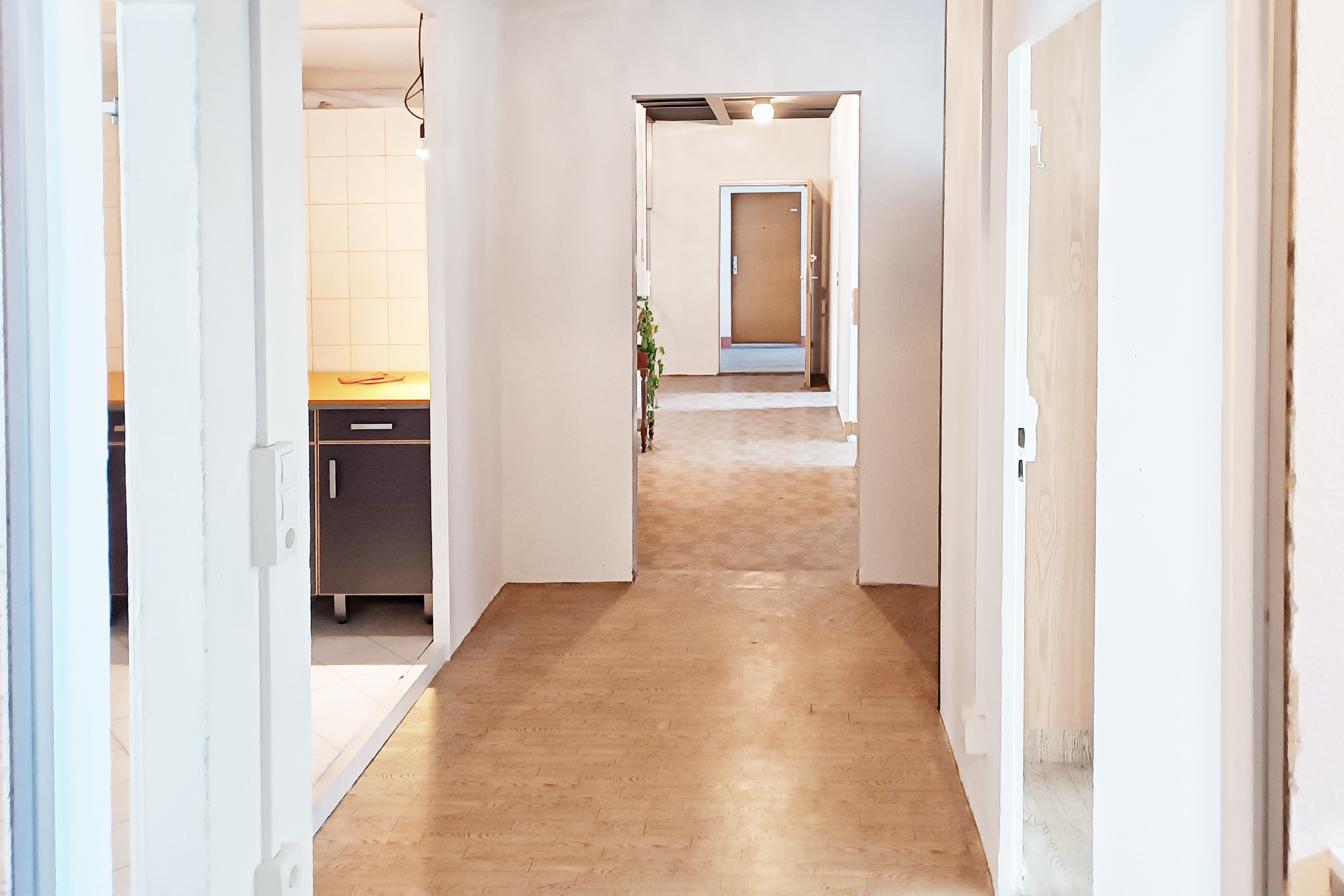
It looks like a conventional flat, but can be adapted to realistic needs just like a Lego doll’s house. Photo: Thomas Köhler
Unlike in a traditional shared flat, the core remains an independent private unit; additional rooms can be allocated flexibly and further spaces shared. The demonstration project in Grünau comprises five basic units, eight individual rooms and communal areas on the ground floor, and offers space for a minimum of twelve and a maximum of 18 people during the trial.
The concept is linked to the idea of ‘sufficient’ living. ‘Sufficiency’ is derived from the Latin ‘sufficere’ and means ‘to be sufficient’ or ‘to be enough’. Whilst efficiency aims to achieve a result using less energy or material, sufficiency asks how much is actually needed. In the context of housing, this means, for example, not permanently allocating more private space than is actually required. The first test flats were occupied on 15 June 2026.
Uncovering treasures at the Gewandhaus
Before we turn our attention back to an architectural topic, let us take a look at a fascinating chapter in music history. A rediscovery project in this vein brings the Belgian ensemble ‘Terra Nova Collective’ to the Mendelssohn Hall of the Gewandhaus today at 8 pm. ‘The Missing Voice’ introduces Pieter Van Maldere (1729–1768), a composer who enjoyed success during his lifetime but is now largely forgotten.
A musician at the Brussels court of Charles of Lorraine, his works were performed in Vienna, Paris and Dublin, amongst other places. In Joseph Haydn’s so-called ‘Quartbuch’, 33 symphonies are attributed to him, of which 18 have survived. The Terra Nova Collective has recorded these in their entirety for the first time on period instruments: more than four hours of music across 57 tracks. The first part of the three-part album series, ‘Symphonies Vol. 1 – Haydn’s Quartbuch Symphonies by Pieter van Maldere’, was released on 4 September 2026 by the Leipzig-based label GENUIN. At the Gewandhaus, a symphony by Van Maldere meets Wolfgang Amadeus Mozart.
Mozart’s Symphony in G minor, K. 550, is performed in its original version without clarinets, before the previously absent timbre takes centre stage in Mozart’s Clarinet Concerto in A major, K. 622, whose Adagio served as a central element of the film score for Sydney Pollack’s ‘Out of Africa’, which also took Hollywood by storm. Vlad Weverbergh conducts the ensemble and performs the solo part on the basset clarinet. The Gewandhaus describes Van Maldere as ‘by no means a marginal figure’ for his time. The concert is part of the ZeitenKlänge Music Festival 2026/27; a performance at the Stadtcasino Basel will follow on 4 October 2026.
Tickets are still available at the box office today.
What should the Westvorstadt look like in future?
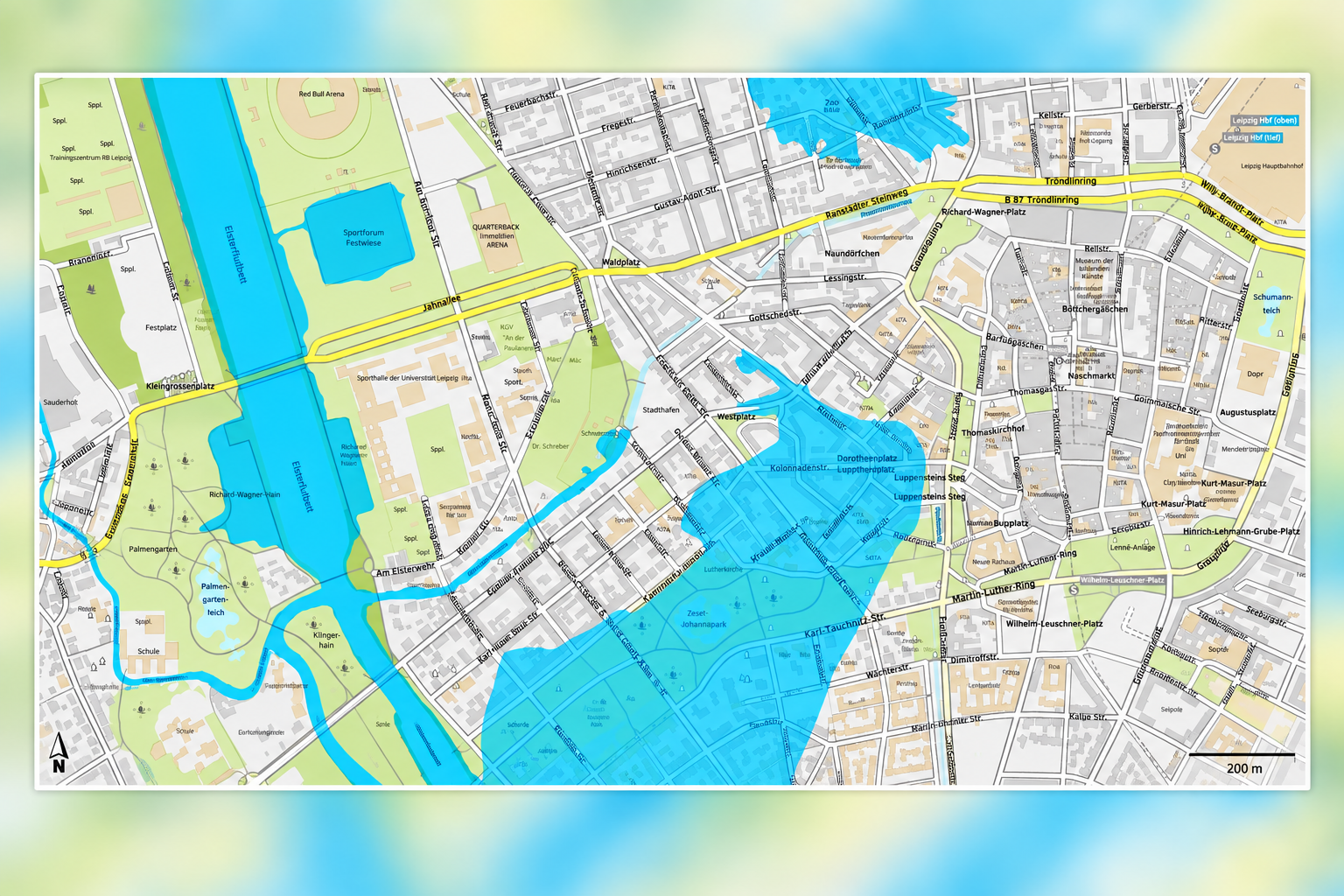
Today marks the end of the public consultation on Development Plan No. 483, ‘Innere Westvorstadt’. And today is the last chance for members of the public to submit comments on the plans for the area between Dittrichring, Zentralstraße, Apels Garten, Martin-Luther-Ring, Karl-Tauchnitz-Straße, Max-Beckmann-Straße and Käthe-Kollwitz-Straße.
The documents are available for inspection at the Town Planning Office in the New Town Hall from 8 am to 3 pm and at the Town Office on Burgplatz from 1 pm to 6 pm, and can be accessed online HERE. Comments can be submitted via the public consultation portal or by email to Stadtplanung.Stellungnahmen@leipzig.de. Comments submitted after the deadline may not be taken into account when the decision is subsequently made.
With this development plan, Leipzig aims to guide the further development of the neighbourhood and safeguard green spaces and open spaces. Among other things, the plan sets out provisions for green spaces within blocks, rainwater management and street trees. To the south of Gottschedstraße, between Bosestraße and Zentralstraße, a public green space with play facilities is to be created, incorporating the ‘Synagogue Memorial’ special area.
At least 60 per cent of the roof areas of main buildings are to be fitted with solar panels, including the associated ancillary areas. Factors under investigation include noise, contaminated sites, air quality, bioclimate, heavy rainfall and stormwater; the plans also include the possible uncovering of the local section of the Pleißemühlgraben, as well as changes to street layouts and traffic routing. The City Council approved the publication of the draft on 2 July 2026.
So können Sie die Berichterstattung der Leipziger Zeitung unterstützen:




There is one comment