Dieser Artikel ist auch in deutscher Sprache verfügbar: Zum deutschen Artikel.
The fact that political parties can fall into crisis, suffer from a drain on their personnel, or mismanage their affairs is neither surprising nor a disaster. For this fate can befall all institutions, associations, organisations and commercial enterprises. Transience is a constant in life on this earth: There is a time for everything … In this respect, dramatic changes and upheavals, such as those we are currently witnessing on the political stage, are nothing out of the ordinary.
In and of themselves, they do not pose a threat to liberal democracy. Rather, they are an expression of the changes taking place within a population and amongst people.
What is, however, extraordinary and historically unprecedented is this: the societies of Central Europe find themselves in the inherently comfortable position of being able to experience and bring about these changes not amidst mountains of rubble, with a population decimated and demoralised by war, but under conditions of peace.
On the one hand, this slows down the necessary processes of change; on the other, there is always the lingering fear that Germany might lose its internal and external peace as a result of the changes now on the horizon – all the more so as the democratic parties that have shaped the political landscape to date, such as the SPD, have lost their capacity to shape the future. They no longer reach out to the people and are primarily concerned with their own survival.
The far-right AfD has been able to exploit this vacuum. It opposes everything that has shaped German society over the past almost 80 years: liberal democracy, the rule of law, cultural diversity, coexistence with people who have fled here or immigrated, the experience that people can free themselves from dictatorship and paternalism through a peaceful revolution and dare to embark on the path to democracy – and the absurdity: it can thereby forge a sense of identity.
Consequently, a peculiar mood has taken hold in German society. Many people see their own country teetering on the brink and in the process of disintegrating:
- We are not pleased when a train carries a few hundred people or vital freight from A to B without incident. We view the railways primarily as a run-down organisation simply because the train is 30 minutes late.
- We do not talk about the fact that hundreds of thousands of refugees have taken on important roles in the service sector of our society over the past 10 years; instead, we allow a climate to develop in public discourse in which every single Syrian or Afghan can be suspected of being a potential knife attacker.
- East Germans turn a blind eye to their own achievements since German reunification, yet feel that their lifetime achievements prior to 1990 are not sufficiently recognised.
Something has gone wrong mentally, which is reflected in the so-called social media in a destructive discourse fuelled by hatred and contempt. To make matters worse, the democratic parties are unable to offer a positive narrative – either in terms of policy or leadership – that sets out how the coexistence of over 80 million people, in partnership with the countries of Europe, is to develop.
Instead, a far-right, right-wing nationalist party such as the AfD is reviving the dangerous myth that all Germans will be better off if the people on whom societal problems are pinned as scapegoats are swiftly removed from the public sphere, be deported, and all Germans are persuaded to embrace ethnic nationalism.
These inhuman intentions are garnished with blue-sprayed Simson beer and free bratwurst. Unbearable heat is hailed as a long-awaited summer’s day, serving to announce that everything that serves climate protection will be thrown in the bin. The tragic thing is that a party like the AfD, caught up in its own hype, is in the wake of the globally active powers and power-holders who provocatively distance themselves from all human and social values.
It is no coincidence that one of these power-holders, the billionaire Peter Thiel, was honoured with the ‘Axel Springer Award’ in Berlin a week ago – a show of solidarity amongst those who, for over a decade, have been fuelling the political climate in Germany and the US, in which a Donald Trump and an AfD can flourish!
If the democratic parties do not simply wish to resign themselves to their decline, then they – and with them all those who do not wish to abandon a free, united, cosmopolitan and culturally diverse society – face the challenge of meeting the need of many people for a hopeful outlook on the future.
This will not be achieved by distancing themselves from the AfD (however important that may be!); nor through policies that merely react to the here and now in a clientelist manner, and certainly not through policies that allow unchecked spending in one area – rearmament – whilst neglecting the policy of peace.
What is urgently needed now is for individual political measures to be embedded within an overarching programme; in other words, the decisions we take today must be embedded in – and derived from – the way we want to live tomorrow. Any forthcoming change must prove to be an improvement in living conditions for those people who do not have the means to compensate for cuts to public services through their own private resources.
One thing is crucial: as many citizens as possible should feel that they are an indispensable part of society, so that, in this way too, the far-reaching social divide in our society can be reduced. This makes fair access to work, income, housing and education – along with the necessary economic framework conditions – the decisive criterion.
All this will only succeed if we place people and humanity, as well as the values that make this possible, at the heart of all politics and all communication. This is how democratic parties can prove their worth in a crisis.
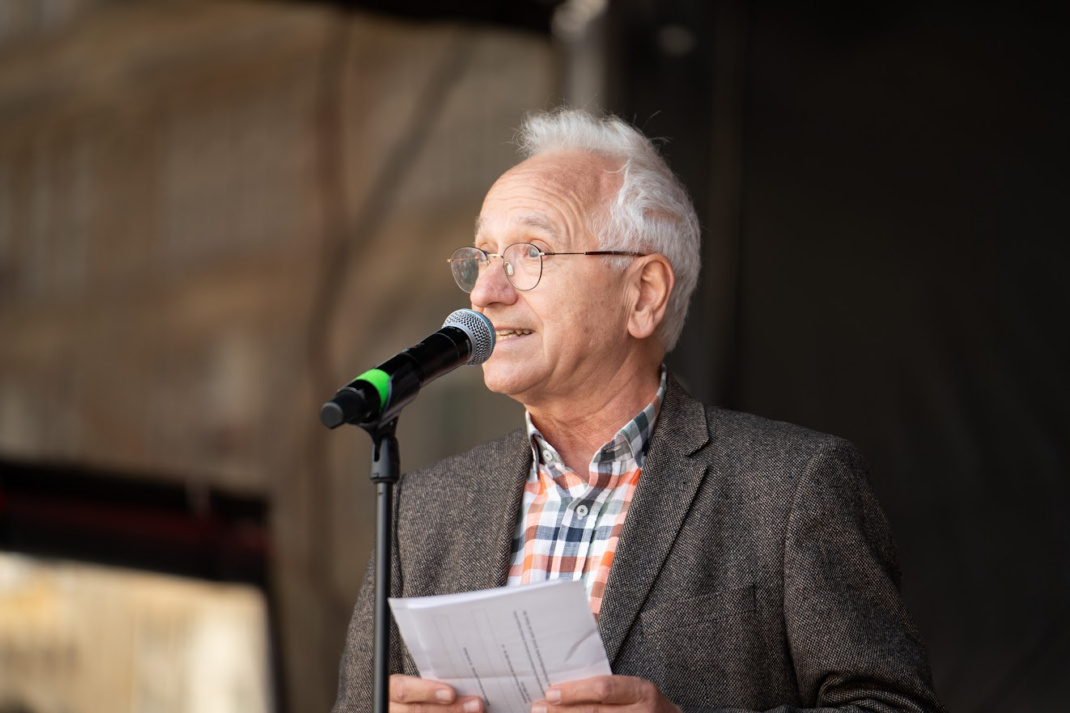
Christian Wolff, born on 14 November 1949 in Düsseldorf, was pastor of St Thomas’ Church in Leipzig from 1992 to 2014. Since 2014, Wolff, a long-standing member of the SPD, has been active as a blogger and adviser on matters relating to the church, culture and politics. He lives in Leipzig and is involved in many areas of public life from a socio-political perspective. Visit the author’s blog: https://wolff-christian.de/
Empfohlen auf LZ


So können Sie die Berichterstattung der Leipziger Zeitung unterstützen:




There is one comment