Dieser Artikel ist auch in deutscher Sprache verfügbar: Zum deutschen Artikel.
He was a star of 20th-century modern literature. He died in 1985 at the age of just 61: yet Italo Calvino’s novels and short stories are as vibrant as they were on the day they were first published. And not just those. Hanser Verlag is constantly unearthing new works and bringing them to lovers of Calvino’s writing in printed form. With a constant stream of new texts and surprises. These can also be found in the articles Calvino published in newspapers and magazines. And it’s not just about computers that write.
For what is today being peddled as ‘artificial intelligence’ by the tech bros in the US was already being discussed by the brightest minds in Western societies back in 1984. And not just any tech fanatics from Silicon Valley or professors poring over cybernetics in mysterious laboratories. It was also a literary topic.
For the authors of the time knew exactly what was in store for literature if computer geeks continued to specialise their algorithms and server performance continued to grow at a rapid pace.
It had long been possible to foresee what was coming. And so, in a lecture at the Associazione Culturale Italiana, Italo Calvino quite clearly reflected on what would happen when computers began to produce literature. For anyone who writes knows full well: all rules and stylistic devices can be copied, narrative patterns and dramatic structures all the more so, especially when it comes to producing the same thing over and over again.
And 90 per cent of annual literary output consists of the same old thing. That is precisely what computers can be taught to do. And Calvino would probably have been surprised that it would still take over 30 years before programmers were finally ready.
Topologies and Labyrinths
In his lecture, Calvino also picked apart the ethereal notions of literature floating on high. Radically, relishfully, quite obviously to the horror of the audience. The fact that he was not the only author at the time to grapple with the fabulous misinterpretations of literature becomes clear when, at the end, he mentions his German fellow writer Hans Magnus Enzensberger, who, in his essay ‘Topological Structures of Modern Literature’, explored labyrinthine narrative from antiquity onwards.
In a sense, Calvino arrives at the optimistic conclusion that literature might still have a future despite competition from computers – if one understands literature as a game, as a challenge to ‘understand the world’ through playful storytelling.
This lecture is not the only gem in this selection, which largely comprises texts that have not yet been published in German. And if this witty lecture already gives one a sense that Calvino is essentially recounting his own experiences as a writer and his deep-rooted aversion to formulaic writing, then one is all the more surprised by the 1983 essay ‘The Written and Unwritten World’, because here Calvino actually explains why he writes and why he chooses narrative models that are, in fact, completely alien to him.
Calvino’s readers are, of course, familiar with the result from relentlessly seductive books such as *Cosmocomics*, *Invisible Cities*, *Mr Palomar* or *If on a Winter’s Night a Traveller*. All books that enchant with their unmistakable narrative style, not least because they make storytelling itself the subject almost every time. And that is something overwhelming, something that overwhelms the author too.
Or should overwhelm him. Experienced readers know this: Those who simply tell stories ‘skilfully and routinely’ produce books that, in the end, are simply boring and no longer surprise us. Partly because they do not challenge us. Certainly not to reflect on how we actually narrate our lives and the world to ourselves.
Full stop. Pause. True.
Impossible books
That is precisely what fascinating literature is all about. Except that Calvino, with his incomparable seriousness, looks at writing from the perspective of the author (and experienced editor).
And in the same essay, he articulates a truth that holds for him: “I confess that a large proportion of the books I have written, and those I still wish to write, stem from the notion that it is impossible for me to write such a book. When I am convinced that a particular type of book is entirely beyond the scope of my temperament and technical abilities, I sit down at my desk and start writing.”
Just imagine that … but it makes perfect sense. This is exactly how texts are created that captivate readers too. Because they practically invite us to look at the world through different eyes. To understand it as one great narrative. For we tell the story of the world to one another. Everyone, every day. Except that most stories are trite, silly and boring. So dreary that one can no longer bear the daily news with its silly and redundant narratives. One wants to run away, because the stupidity being recounted literally gives one a headache.
That’s another reason why we read books, why we go into bookshops full of hope, eagerly wondering whether at least one of the thousands of books might come from the narrative world of Italo Calvino. At least one.
Books one would love to read
In a lecture at the Buenos Aires Book Fair in 1984, Calvino once again addressed his approach to writing. He went into great detail about what might be called motivation. And what strikes at the very heart of storytelling. For why does one actually write?
‘I would now like to move from the general to my own experience as a writer, and I must say that I am driven not so much by the desire to write my book – the book that would be just like me – but by the desire to have before me a book that I would love to read. I then try to identify with the imaginary author of this book yet to be written – an author who might well be very different from me.”
Anyone with reading experience knows that this is actually how the most exciting books come into being – books that sweep us away, not just into another world (which is often not even necessary), but into a different narrative of the world. And with that, into that ‘aha’ moment that reflects us back to ourselves – as beings who narrate their own lives, who often cannot break free from their own skin and their daily routine because they can no longer tell the story of their lives as something mysterious and unsettling, incomprehensible and ambiguous. The writer-narrator encounters his own reader-self. And in doing so opens up worlds that most books do not even hint at. For everything could be quite different.
‘The crisis only ended when I decided not to write the novel I thought I had to write, and which others expected of me, but the novel I myself would like to read,’ writes Calvino, “a book as if from another time and another country by an unknown author, an old tome found in the attic and gnawed by mice, which I would read with the same enthusiasm as when I was a child.”
Is the novel in crisis?
In doing so, he clearly distanced himself from the literary experiments much discussed in the 1960s and 1970s, which he reflected on in 1959 in an article for *Nuovi Argumenti*, which was desperate to know from him whether the novel was in a crisis. Of course it wasn’t. It was simply that the old, ponderous 19th-century ‘professor’s novel’ no longer worked in the wake of the experiences of the dictatorships and wars of the early 20th century.
In Italy, experimentation with new narrative concepts was just as fervent as in France. Behind the supposed ‘crisis of the novel’ lay, in fact, the fundamental need to make a world experienced as hopeless and illogical tangible once more through appropriate narrative concepts.
This was, in fact, a trend that had already begun half a century earlier with writers such as Joyce and Musil. By 1959, Calvino had already published his fascinating trilogy *Our Ancestors*, comprising *The Baron in the Trees* and *The Cloven Viscount*. Novels that had, of course, long since broken with the classical 19th-century novelistic framework and reminded readers that storytelling has to do with imagination – the ability to conceive that things might be quite different from how they are usually reported in the newspapers.
And that authors certainly have more to tell than the events seemingly presented on the visible narrative level. The reader is entitled to be more discerning, to expect ‘cultural, philosophical, scientific and other such stimuli’ – ultimately, an author who quite deliberately takes his readers into the exuberant polyphony of our experience.
The fact that, in France of all places, the ‘nouvelle école’ experimented with the exact opposite – a completely stripped-back form of storytelling – was something Calvino already regarded as a dead end as early as 1959. A fine experiment, an exciting trend that literally deconstructed storytelling.
Heroes of the (Im)possible
Of course, it was an exciting time, when authors worldwide were challenging the seemingly ‘objective novel’ of the past and making readers their accomplices in experimenting with entirely new narrative structures. Structures which were also perfectly entitled to evoke older forms. As with Calvino, who knew from his own experience that readers could not really relate to the realism that was repeatedly peddled as objective. For this ‘realism’ was always conservative. ‘Can there ever be a revolutionary realism?’, asks Calvino.
He does not say ‘No’, but he cannot find any ‘proven examples’. And that would not change until 1985. For literature thrives precisely on overwriting the dictates of ordinary everyday life, extricating the reader from their routine and making them the hero of the (im)possible.
Often with plenty of tears, as in the article ‘Seven Bottles of Tears’, published in 1984, in which Calvino addresses the emotion known as the ‘phenomenology of weeping’. Which is so healing when books truly move readers. And which, far from the unfeeling clamour of the world, reminds us that we are, after all, beings capable of being moved.
Which actually brings us to the very heart of reading with wonder: the deep longing for stories that truly take us by surprise and remind us that we can, in fact, tell the story of our lives differently. If only we have the courage to engage with fascinating new (or very old) stories.
It is a selection of texts that not only brings to mind the storyteller Italo Calvino, but also reminds us that reflecting on literature was once thrilling and exciting. As if the commercialisation of literature has since devoured all spirit and all narrative wit. And left hardly any authors remaining who can reflect on writing and storytelling with such mastery as Calvino exemplifies here.
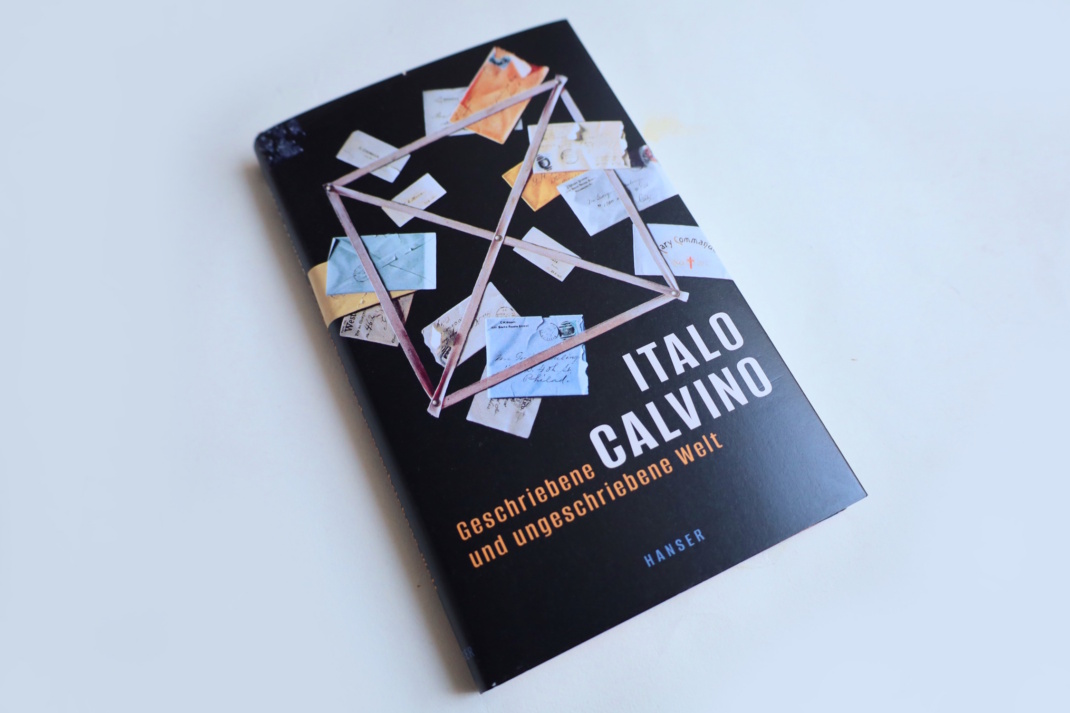
Italo Calvino, *The Written and Unwritten World*,Hanser Verlag, Munich 2026, 24 euros.
Empfohlen auf LZ


So können Sie die Berichterstattung der Leipziger Zeitung unterstützen:





There is one comment