Dieser Artikel ist auch in deutscher Sprache verfügbar: Zum deutschen Artikel.
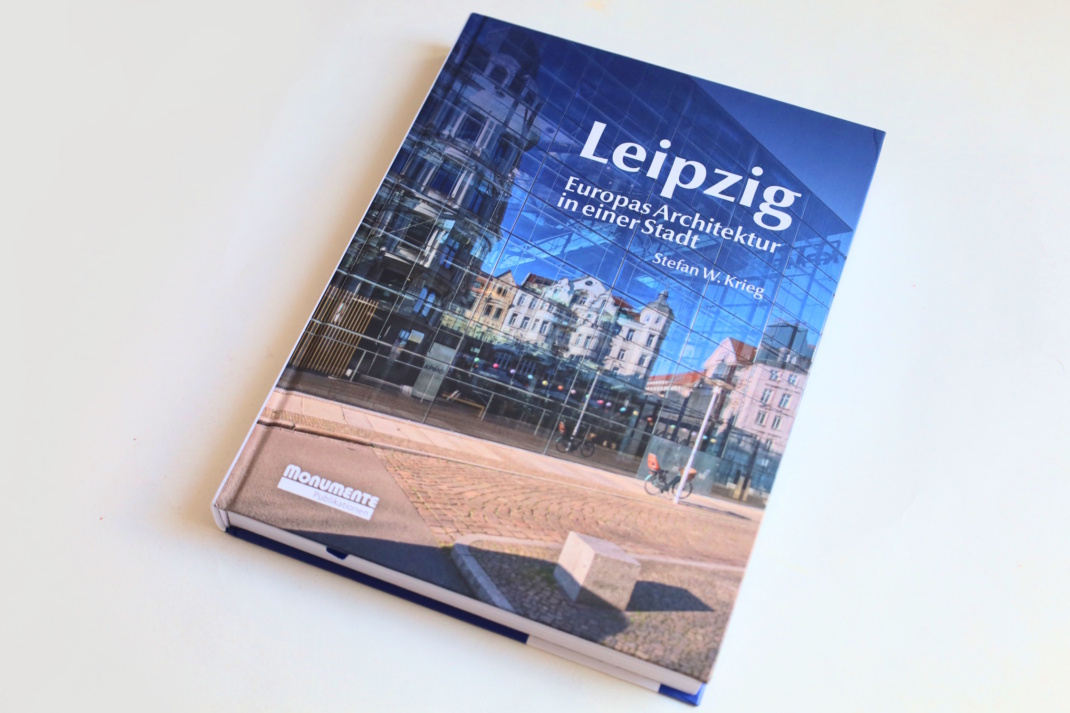
There are already a number of illustrated books on Leipzig’s architecture, most of which focus on specific periods, such as Leipzig’s Gründerzeit era or particular historical landmarks. But how does one view a city when attempting to discover the architectural eras of the past 1,000 or even 3,000 years? And there is certainly something to discover. Stefan W. Krieg knows this from his professional experience, having served as district conservation officer for the City of Leipzig from 1995 to 2022.
The idea for the book actually came from his wife. In the ‘Acknowledgements’, he pays tribute to her suggestion. Her untimely death almost caused the project to fail. That’s when you need people to encourage you, to say: ‘Keep at it. See the project through to the end.’ And he managed it. And now, with this book, he invites readers simply to set off in Leipzig and immerse themselves in – that’s right – ultimately even over 3,000 years of architectural history.
This casually highlights just how much all – truly all – architectural styles of the modern era are part of a long tradition that stretches back not only to the Romans and Greeks, but right back to the ancient Egyptians. A fact that Katrin Löffler had already drawn attention to in her 2025 book *Pyramids on the Pleiße*.
Stefan W. Krieg weaves this into a comprehensive overview of all the architectural styles visible in Leipzig and their borrowings from the pyramid builders of Egypt, the temple builders of Greece and the architects of Rome’s colossal structures.
The Long Shadow of Rome
And it was precisely the Roman Empire, with its influence extending as far as Charlemagne’s Frankish Kingdom, that also shaped the medieval architectural styles which, to the observant eye, can be found in Leipzig too – the Romanesque and Gothic styles. Even though the remains of these medieval structures are rare in Leipzig. Which is only logical.
For centuries, the people of Leipzig, too, built only their churches out of stone. Residential and storage buildings were constructed well into the modern era using perishable local materials: wood, straw and clay. Consequently, in the city centre, it is really only the façade of St Nicholas’ Church that offers this deep insight into history.
But on such occasions, Krieg also turns his gaze beyond the city limits, to smaller towns in the surrounding area, where architectural treasures can often be found that have long since disappeared from Leipzig’s city centre, which has been repeatedly rebuilt.
The constant reinvention of the city, driven by Leipzig’s wealthy citizens, has always had two sides to it – the loss of older buildings and the gain of new, magnificent architectural solutions. And sometimes the wealthy merchants resorted to a bit of trickery, simply fitting their family homes – often dating from the Renaissance – with a new façade to keep up with the latest fashion trends.
It is precisely those buildings that survived the destruction of the Second World War that often offer surprising glimpses deep into the city’s history at their very core, in their cellars and stairwells. Sometimes these traces have survived in unexpected places, as Krieg demonstrates with the examples of the stair tower of the Haus Zur Goldenen Fahne and the neighbouring archway – evidence of the Renaissance buildings that once stood here.
Austere Patterns and Extravagance
But even in his grand excursions into the world of pyramids and columns, Stefan W. Krieg sharpens the reader’s eye for the very deliberate borrowings made by modern architects from the defining architectural elements of the ancient masters. Suddenly, one realises just how strongly Leipzig’s ‘Gründerzeit’ period, too, is shaped by these architectural references. It’s so easy to say in Leipzig: ‘Gründerzeit’. As if it were an architectural era that popped up out of the blue, one that doesn’t fit into the framework of fine architecture.
Even when looking at the preceding eras – from the Renaissance through the Baroque and Rococo to the Classical period – Krieg vividly demonstrates – and illustrates with numerous photographs – how the new architectural styles each time developed directly from the preceding era, sometimes verging on the excessive (such as Mannerism and Rococo), whilst at other times they served as a departure from such architectural excesses and a return to classical models – as was the case with Classicism, the architectural era that preceded Historicism, the defining architectural style of the Gründerzeit.
And Historicism ultimately simply means that architects of this period no longer imposed any constraint on themselves whatsoever to copy the great architectural styles of the past. Or – which was actually still more the rule – to draw inspiration from them.
Sometimes with the courage to devise entirely new solutions, which they were, after all, increasingly forced to do from the mid-19th century onwards, as Leipzig grew into a major city and living and working space had to be created for ever more people in ever shorter timeframes. And often to a standard that astounds today’s developers.
Not to mention the opulent façade ornamentation, which – as mentioned above – repeatedly and delightfully references architectural models spanning some 3,000 years. Or even staged, as can be seen so beautifully at the Imperial Court of Justice building (now the Federal Administrative Court), the University Library or the New Town Hall.
The urge to look up
So if, in the near future, you spot people looking up at the façades with their heads tilted back, they might well be readers of this book, inspired for the first time to really look out for all the details with which architects achieved their effect. And continue to achieve it to this day.
A benchmark, too, for all subsequent stylistic periods, for which Krieg has also found vivid examples in Leipzig – from Art Nouveau through the Reform Style and Neues Bauen to post-war Modernism (which in Leipzig had to contend with the traditionalism of its great role model, Moscow) and Postmodernism, examples of which could already be found in Leipzig before 1989.
Krieb naturally also illustrates the more recent period – from 1990 onwards – with dozens of examples of impressive architecture, even if this era does not yet seem to have established itself as a distinct stylistic canon. Perhaps it is simply a continuation of postmodernism by other means. Sometimes simply the wrong ones, as Krieg notes with reference to the opulently designed large window fronts, which are simply counterproductive in times of global warming.
Every distinct stylistic period is given its own chapter in this book, featuring a knowledgeable introduction to the era and its stylistic references. Krieg then illustrates – with a keen eye for detail – how the architects put this into practice, using a selection of striking, representative buildings. These are also featured on two city maps included in the book’s cover, so that even newcomers to Leipzig can easily find their way around and learn to marvel at the richness of Leipzig’s architecture.
Cities need history that can be experienced
An example of architecture that Krieg, in turn, would like to highlight. After all, similar books could be written about other European cities. Not all of them, mind you, as in many cities – particularly in the West – the bombs of the Second World War wiped out entire layers of architecture. And when the cities were rebuilt after the war, the architects paid little heed to the historic fabric, carving out wide approach roads right through the wastelands of rubble.
Some cities – such as Frankfurt am Main – have only painstakingly reconstructed their historic city centres in recent years. At great expense, of course. But the people of Frankfurt, too, have learnt that it is difficult to feel truly at home in a city whose history can no longer be found in its buildings.
Which is, in fact, one of Leipzig’s attractions: that the majority of the city centre’s buildings survived not only the bombings of the World War but also the neglect during the GDR era, and were lovingly restored after 1990.
Always under the supervision of Leipzig’s heritage conservationists, who experienced their own surprises – at the very latest when they entered the villas and residential buildings from the Gründerzeit era and realised that the architects had not only paid attention to a beautiful façade, but also on clever floor plans and impressive stairwells featuring fascinating paintings or even magnificent columns that make one feel like a king when standing before the splendid vestibule.
However, as all these magnificent buildings are mostly privately owned, there are relatively few photographs of their interiors. Yet even the pictures of doors, balconies and windows alone give the viewer a glimpse, even from the outside, of just how regal life must be within these houses. Whilst Krieg has his doubts about many buildings from the recent past – with their often unstable building materials – as to whether they will still feature in architectural guides in a few years’ time or ever achieve anything resembling listed status.
Perhaps in a negative sense: as a misguided attempt to cut corners in the wrong place.
Stefan W. Krieg, *Leipzig: Europe’s Architecture in One City* , Verlag der Deutschen Stiftung Denkmalschutz, Bonn 2026, €39.90.
Empfohlen auf LZ


So können Sie die Berichterstattung der Leipziger Zeitung unterstützen:





There is one comment