Dieser Artikel ist auch in deutscher Sprache verfügbar: Zum deutschen Artikel.
Anniversaries inspire historians. One such anniversary was the 500th anniversary of the German Peasants’ War in 2024/2025. One of the bloodiest events took place in Frankenhausen, where the crowd of peasants gathered there was mercilessly beaten down by the princes’ mercenaries. It was also here that Thomas Müntzer was taken prisoner. In Martin Luther’s view, he was a rebel. Luther avoided using the word ‘heretic’ at first. But his condemnation of Müntzer as a heretic proved effective.
And from then on, the Protestants too produced their own images of heretics. Using the very same methods by which the Catholics had previously condemned Luther and his followers. This is a pattern that can still be observed time and again to this day, whenever those in power decide to declare small, deviant groups to be renegades and heretics.
There is a pattern to this. And it was precisely this that the Central German historians wanted to examine in greater depth. That is why, from 24 to 26 October 2024, they travelled to the pretty little town of Stolberg in the Harz Mountains. The very town where Thomas Müntzer was born in 1489. In a ‘beautiful conference room’, they spent three days examining the processes of excommunication from the 12th to the 17th centuries. In other words, practically from the Albigensians, Waldensians and Templars right through to the Quakers and Pietists, with a focus on the theological sphere.
However, during this period between the Middle Ages and the modern era, this sphere cannot be separated from the realm of power politics. Katharina Neef sums it up when she writes: “Heresy trials also reflect power relations: heresy always implies that speakers with discursive power can marginalise other actors with fewer resources or less access to them.”
Questionable sources
It is, in fact, always those in power who define who is not allowed to belong. And this has often had bloody consequences, as Markus Krumm demonstrates very clearly in his contribution on the Albigensians. It is virtually inevitable that, in doing so, he must debunk all manner of legends, medieval propaganda and misrepresentations by later historians.
This is also evident in the articles by Marianne Taatz-Jacobi on the condemnation of Thomas Müntzer and those by Jakob Debelka, Aneke Dornbusch and Andreas Lindner on the Anabaptists, as well as in Simon Franzen’s article on the Quakers. The texts used as primary sources for centuries did not, for the most part, originate from the condemned groups themselves, but were penned by their accusers.
This has many consequences, starting with the fact that the labels were often not the self-designations of the condemned group at all, but rather the labels applied by their persecutors. Similarly, the practices that have been handed down do not, for the most part, describe the actual beliefs and rituals of the persecuted group, but stemmed predominantly from the minds of the accusers.
The targeted groups were simply attributed all manner of sinister practices. And it really does require rigorous source criticism to distinguish this enemy propaganda from what the persecuted groups actually intended and did. Or whether they even existed at all. For this, too, becomes clear: that those in power were also quite happy to invent their own heretics when they needed them. As a justification for military excesses, often disguised as a crusade.
The goodwill of the authorities
And so, through the lectures collected in this book, one journeys through half a millennium of heresy-making. And, of course, the problematic way in which Protestant figures dealt with dissenters within their own ranks is not overlooked. This includes Luther’s – and Melanchthon’s – treatment of Thomas Müntzer, whom they continued to persecute with scathing pamphlets even after his execution. For perfectly understandable reasons.
For Luther’s own teachings were still regarded as heresy and could only hold their ground because the new doctrine was protected by the princes. Without this conflict, Luther would not have had to develop his doctrine of the two kingdoms
in the first place. Nor would his fury-fuelled treatise against the ‘robber peasant hordes’ have been necessary.
For the still fledgling Reformation, it would have been extremely dangerous to be held responsible for the peasant uprisings in southern and central Germany. This made the writings of the Wittenberg scholars against the peasants and ‘fanatics’ sound all the more drastic.
And in particular against Thomas Müntzer, who also drew on Luther’s translation of the Bible in his sermons. Martin Luther, too, did not shy away from making a few ‘corrections’ to Müntzer’s writings in order to brand the renegade as an instigator of robbery and murder. The effects of this have been felt right up to the present day in historical scholarship.
Playing on fear
The lectures provide an excellent insight into how the Church’s practice of excommunicating those of different faiths was not only used as an instrument of power to prevent insubordinate schisms from the Church, which alone grants salvation. The instrument virtually took on a life of its own, for it fuelled – no doubt intentionally – a sense of fear, as it were, amongst those who regarded themselves as part of the orthodox Church.
In numerous writings, indictments and interrogation records, one notices that the authors themselves went to great lengths to present themselves as particularly devout and strict. Even when they saw absolutely no grounds for a conviction in the statements of those arrested and tortured.
But power structures functioned just as they do today, even back then: when there is pressure ‘from above’ to deliver a few heretics to the executioner’s axe, then the interrogation simply continues with the utmost rigour. And if the stubborn offender still fails to provide any grounds for his condemnation, they are simply fabricated.
And by this point at the latest, the reader moves beyond the narrative focused entirely on theological heresy trials and is reminded of how even modern societies, in which the Church no longer holds power, produce their own heretics. For the mechanism still works. Even without the Church. It has long since proved itself to be an authoritarian tool used to conduct politics: denouncing, making false claims, painting enemy stereotypes.
Violence in the end
Anyone with access to the necessary media can now denounce others far more easily than was possible in the Middle Ages. And some media outlets are only too happy to play along. They take up the denunciations and, wielding their media power, send people spiralling into hatred, contempt and, ultimately, violence.
For that is usually the end result of ostracism: unbridled violence against people who have been cast out of the community by means of an open letter of condemnation.
The English also experienced just how dangerous this was in the 17th century. They did, admittedly, have their own Anglican Church with rules that Parliament itself had laid down. But it was precisely this that created the basis for casting suspicion on politically unwelcome figures and denouncing deviations from the legally prescribed faith as an attack on the state and the king. This is what Andreas Pečar analyses using the example of the Puritans and Arminians (both labels imposed by others) during the English Revolution.
The method lives on
And one simply cannot shake off the uneasy feeling that the same methods of heresy-hunting are being used again today, unchecked, by authoritarian actors. Heresy-hunting has merely left the confines of the church and is now raging on ‘social media’. Which, of course, was not the subject of the conference in Stolberg. That would simply have gone beyond the scope of the event.
And yet one realises that a topic some 500, 1,000, or ultimately even nearly 2,000 years old has not been exhausted or disappeared. It is still very much present. And the lectures now collected in this book describe in great detail how it functioned between 1200 and 1700 and was repeatedly used to exclude deviant groups.
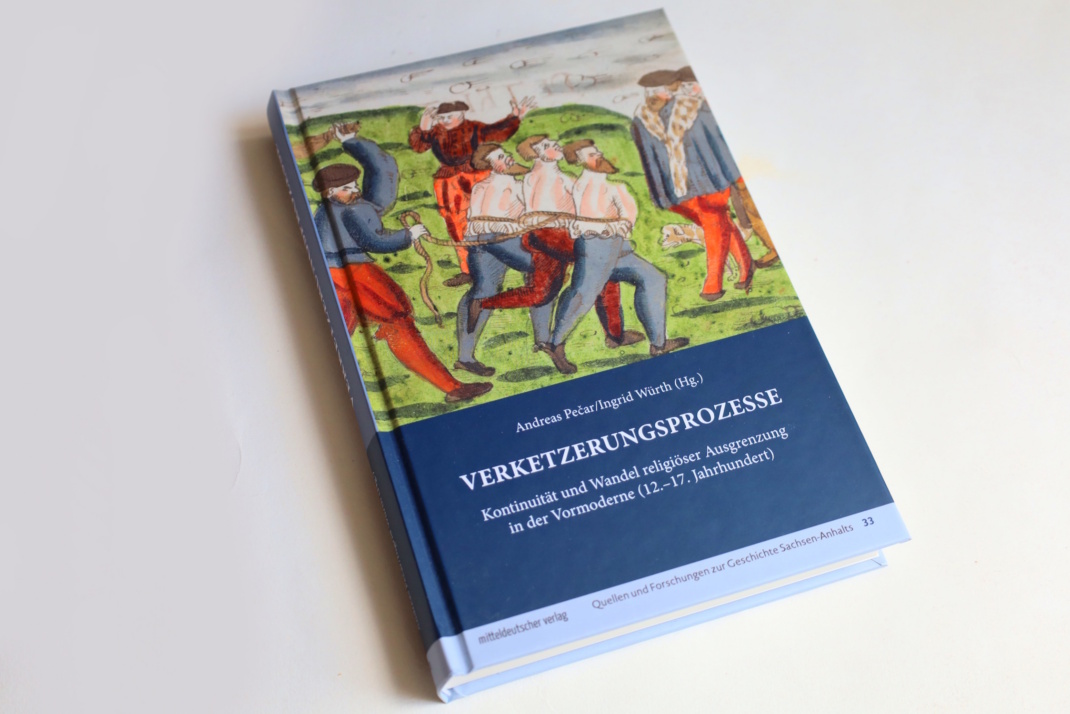
Andreas Pečar, Ingrid Würth (eds.) *Verketzerungsprozesse* (Processes of Heresy), Mitteldeutscher Verlag, Halle 2026, 50 euros.
Empfohlen auf LZ


So können Sie die Berichterstattung der Leipziger Zeitung unterstützen:




There is one comment