Dieser Artikel ist auch in deutscher Sprache verfügbar: Zum deutschen Artikel.
In Germany, there is a long-standing tradition – both within society and in academic institutions, as well as, and above all, in certain sections of the media – of thinking they know better than everyone else. There are certain media outlets and figures who, in their usual manner, regard themselves as being ‘on the right side’ and consequently ‘among the good guys’, but who are quick to pigeonhole those who think differently. It is not quite that simple, however. These groups have evidently completely lost the ability to distinguish between issues and the gift of listening.
In the case of Boualem Sansal, the German media either engage in a know-it-all and untenable prejudgement of the Franco-Algerian writer Boualem Sansal, or they ignore him altogether.
Figures such as writers, artists, musicians, historians, philosophers, physicists or mathematicians … are, first and foremost, human beings and not saints; they are not free from prejudice and contradictions. They are children of their time, the product of their experiences, and they are fallible. They are often surrounded by an uncritical entourage that seeks to capitalise on their status, particularly in the case of well-known and famous figures. This also includes publishers, journalists and cultural managers.
Egotism, a craving for recognition and self-promotion, or claims of ownership or a monopoly over the author: this is all part of the machinery. And Boualem Sansal is no exception in this still-raging public debate, particularly in France, when he ventures into dangerous waters in various contexts, formats and situations.
There are well-known, telling historical examples of this ambiguity among the figures mentioned, particularly in Germany: these include Nietzsche with his ambivalent attitude towards Judaism, his latent and often overt anti-Semitism, and his verbal tirades, including those directed at women. But who would dispute the outstanding significance of his overwhelming philosophy?
Without this giant of philosophy, there would be no modern philosophy, no Heidegger, no Derrida, no Foucault, no Deleuze, no Žižek, no Sloterdijk and many others. And Heidegger himself was entangled in a complex, inscrutable, inexplicable and fateful relationship with Nazi ideology. Nevertheless, his philosophy remains overwhelmingly dominant and, as in Nietzsche’s case, is an essential, globally recognised point of reference.
And what should we say about Wagner and all his political and anti-Semitic antics? A great deal, a very great deal; yet his music is performed and celebrated worldwide, including in Israel with Daniel Barenboim, for example. The son of a Shoah survivor, Jonathan Livny (Chairman of the Richard Wagner Association of Israel), recounts that he owes his love of Wagner’s music to his father, Ernst Löwenstein, a Holocaust survivor.
As the only member of a large, extended family that had been rooted in Germany for generations, his father had survived the Nazi death camps and fled from them. Among his belongings were photo albums, papers and 78-rpm shellac records featuring recordings of Richard Wagner’s works. His father would always have said: “Wagner was a vile anti-Semite, but the music he wrote was divine.” Thus, even as a child, I [Jonathan Livny] learnt to appreciate the music of a genius, even though it was created by such a despicable man. (1)
1) https://wagner-verband-leipzig.de/engl/tl_files/daten de/journal/RWVJournal2012-02.pdf
There are, however, also historical examples of this kind of rupture. One, among many others, is that of Gerónimo de las Casas, who drafted the so-called Laws of India (Las Leyes de India), which he defended and secured before Charles V against Juan Ginés de Sepúlveda, the Aristotle of his time. On the other hand, Las Casas arranged for people from sub-Saharan Africa to be brought to ‘India’ in order to protect the fragile but God-fearing indigenous peoples, thereby introducing slavery on a large scale to the New World. And the list of such ambivalences among many other world-renowned figures is almost endless.
Boualem Sansal in the crossfire
However, the ambivalences described above are by no means part of Sansal’s actions, thinking or writing. The criticism of and demonisation of Boualem Sansal in some media outlets is based on three main areas: a) firstly, on his alleged Islamophobia; b) secondly, on his alleged far-right leanings; and c) thirdly, since early 2026, a new and even more merciless and stigmatising line of criticism has emerged, which has triggered a veritable mudslinging campaign: After twenty-seven years, Boualem Sansal is leaving Gallimard to join Grasset, which belongs to the Hachette Group, owned by the billionaire Vincent Bolloré, who is suspected of having far-right leanings.
In numerous academic papers, and most recently in a lecture at the École normale supérieure de Lyon in March 2025 as part of a conference dedicated to Boualem Sansal, I have sought to demonstrate that Sansal is not an Islamophobe.
He holds a highly nuanced position, grounded in both history and politics, which we may agree with or reject, and which is evident in his novels, such as *The Oath of the Barbarians* (1999/2003) (masterfully translated by Regina Keil-Sagawe); *The Mad Child from the Hollow Tree* (2000/2002); *Harraga* (2005/2007); *The German’s Village* or *The Diary of the Schiller Brothers* (2008/2009) … as well as in his essays such as *Postlagernd: Algeria. An Angry and Hopeful Letter to My Countrymen* (2006/2008); *Maghreb – A Brief History of the World* (2007/2012); ‘Allah’s Fools. How Islamism is Conquering the World’ (2013/2013); ‘A Friendly, Respectful and Admonishing Letter to the Peoples and Nations of the World’ (2021/2022). (2)
2) The first date given for the aforementioned works by Boualem Sansal corresponds to the publication date by Gallimard; the second to that of the German translation.
Algeria’s most significant voice
Boualem Sansal is undoubtedly one of the most important authors of our time and, without a doubt, the most significant voice not only of Algeria, but also of the Maghreb and enlightened Europe. He belongs to a breed of committed and sincere intellectuals who seemed to have been lost in a vain, superficial and media-dominated world such as ours today. Moreover, he also represents one of the most authentic and courageous forms of expression in this utterly shaken world.
He has dared to live in his own country and to openly criticise religious, political, cultural and social practices there. When one considers the danger faced by Algerian critics both abroad and at home, we can describe Sansal’s various critical stances, his resolute commitment to freedom, democracy, human rights, women’s rights and the rights of minorities as heroic. This courageous commitment was honoured with the Peace Prize of the German Book Trade.
His criticism of Islam has, in some instances, ‘received applause from the “wrong side”’ – so the media in Germany report. By contrast, it should be emphasised that all of Boualem Sansal’s observations and assertions – whether historical, political, social, economic, religious and so many other kinds made by Boualem Sansal are always thoroughly researched and well-founded, as can be deduced from the logic of his argumentation, the sources he cites, or the checks we carry out.
However, he always leaves the final word to the reader. For he is very aware of his own subjectivity, despite his aspiration to contribute a grain of truth to the various fields. As a contemporary witness, he wishes to share his experiences in Algeria with his readers.
These are reflections by a citizen, written for a broad audience. All his texts, whether novels or essays, are always ‘political’ in the narrower sense of Derrida, Lévinas or Rancière, understood as an act of public intervention.
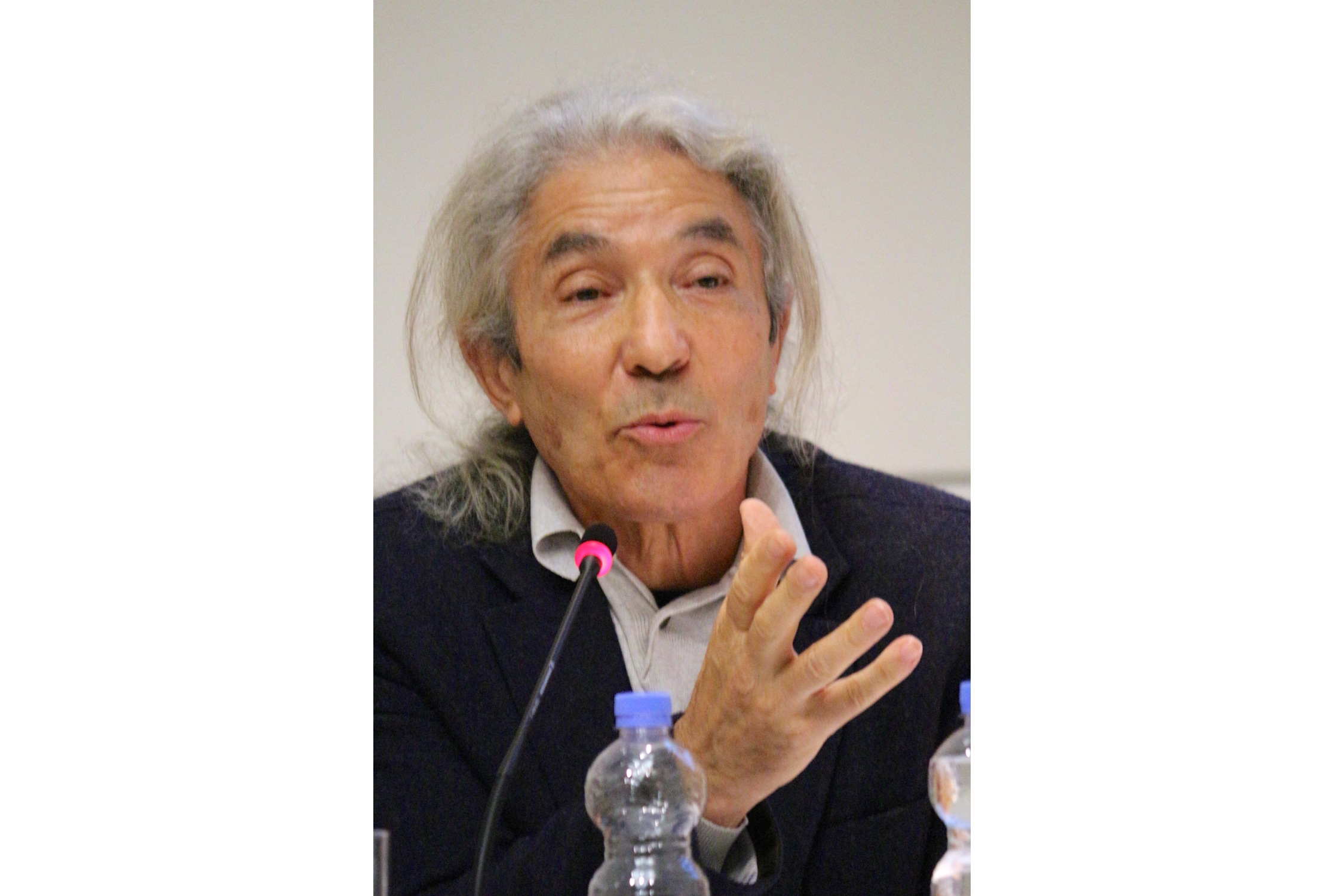
Boualem Sansal in Leipzig. Photo: Alfonso de Toro
The challenge facing the Muslim world
Sansal, as a non-believer and shaped by a clearly Marxist stance towards religions in general, criticises religious Islam insofar as it has been infiltrated by a politically militant and violence-prone Islamism with global ambitions, and is tolerated by religious communities.
But institutions of all kinds are also affected by strategic logistics – Sansal continues. Islamism mobilises huge crowds, trains militias in secret military training camps, imposes its moral code on host societies, and engages in economic and social activities.
Last but not least, it preaches terror. Boualem Sansal calls this the ‘Islamisation of the world (as in *Allah’s Fools*)’, which has learnt to fraternise with the worlds of business, politics and the military.
To free Islam from this: “The only way for this modernisation of Islamic thought to take place peacefully and benefit everyone is to liberate the voice of Muslims, so that everyone can express themselves freely as individuals and as citizens. That is the whole challenge facing the Muslim world’, but Europe, too, should review and amend its policy towards Islam to date.
Boualem Sansal holds the view – which certainly has some merit in specific instances – that European politicians, the media and institutions have not dared to vocally criticise Muslim communities in the wake of acts of violence, whether due to ‘politically correct’ rhetoric, whether to avoid generalisations and the stigmatisation of the Muslim population, whether to prevent the radical right and the far right from gaining ammunition for a policy of exclusion, or whether out of fear of a violent reaction from Muslims …, which he described as a form of self-restraint and a restriction
on freedom of expression, as a kind of self-censorship and, furthermore, as the erection of a ‘Berlin Wall’ that plunged Western countries into a veritable state of shock.
“The image of the so-called ‘Arab street’, which is frequently broadcast on television worldwide and shows crowds burning the flag of a particular – usually Western – country or attacking its embassies, had a terrifying effect on the public. Some no longer even dared to speak in public about Islam, Muslims or Arabs, for fear of being accused of Islamophobia, racism and attempting to provoke conflict between communities.”
The consequence of this misguided tolerance: “Instead of addressing and criticising the shortcomings within Islam head-on and clearly, and defending Islam as a peaceful religion [zu], the necessary criticism of a fanatically propagated religious ideology would be shifted onto Muslims in general, onto the faithful, which leads to an inevitable and fatal conflation that is just as bad as that between Islam and Islamism.”
For “Muslims are responsible neither for the inconsistencies of the religion nor for its exploitation, nor for what feudal Arab regimes and sinister Islamist parties have made of it, which paints such a sad picture of them.”
Islamism and Islam
A further problem is the fluctuating, occasional and selective conflation of ‘Islamism’ and ‘Islam’ as presented by Boualem Sansal, because the boundaries – due to the control exercised over devout Muslims and over the so-called moderate Islamists, whom they have made their weapon of choice – have effectively been dissolved. One reason for this would be the shared reference to the Qur’an.
Sansal goes even further, however, by comparing the radical Islamist system with the Nazi regime – a problematic comparison, as the Islamists have not yet committed a ‘civilisational rupture’. He frequently repeats this thesis, which has caused him much difficulty.
In an interview with Leménager in *Le Nouvel Observateur* (10 January 2008), he made the following remarks: “When I see what the Islamists are doing here and elsewhere, I tell myself that, if they come to power, they will surpass even the Nazis” and “We are living under a national-Islamist regime and are surrounded by terrorism, and we can see quite clearly that the line between Islamism and Nazism is very thin.”
Of course, this statement is too general and undifferentiated and requires some clarification, for it is simply wrong to claim that European societies have not criticised or denounced the acts of terror and violence committed by Islamists; that is by no means the case.
This criticism is relative, because politicians do not always have the freedom to express their opinions and act as they would like to, unlike a writer who is not part of a government or a public institution. Those in positions of responsibility are obliged to maintain a balance in public order in order to prevent racism and attacks on peace-loving Muslim women, who form the majority. Western democracies are taking a firm stand against Islamism.
Furthermore, this radical criticism of the lack of freedom of expression in Europe’s democratic nations poses a specific and additional problem, as it is also a central tenet of, for example, far-right parties in Europe, such as the ideology of the German party AfD (Alternative for Germany).
Their ideological criticism is often lumped together with Sansal’s statements (particularly in academic circles, and not only in Germany but especially in France), to the detriment of the positions advocated by Sansal, due to the applause coming ‘from the wrong side’.
Between the right and the left
The second area, or accusation: that Boualem Sansal shares the arguments of far-right parties. He categorically rejected this characterisation during our conversation. He himself does not feel he belongs to any particular political camp and does not wish to commit himself to one. As far as I understood him, he is someone who could be situated politically between centre-right and centre-left. He emphasised that he has his own agenda, which is neither right-wing nor left-wing, and that he speaks to everyone, regardless of their political persuasion.
Many of these people, some of whom work in the media, have been his friends for decades, and he would never sever ties with them because of their political views, such as, for example, his friend Bruno Retailleau (a strongly right-wing candidate for Les Républicains in the next presidential election, who does not shy away from an alliance with the National Rally) or David Lisnard (Mayor of Cannes) and Hubert Védrine (a Socialist).
He vehemently rejects the characterisation of L’Hachette and Grasset as right-wing or even fascist publishing houses. Nor, he maintains, does Vincent Bolloré belong to the far-right camp, nor does he support the National Rally – contrary to all other widely held views. Furthermore, he emphasised that he could not care less who co-opted or exploited him; he was indifferent to what people made of his views. (3)
3 In: TV5: https://www.youtube.com/watch?v=BKi6ZcTWJMs
I also spoke with Boualem Sansal about his highly controversial concept of ‘refrancisation’ (“re-Frenchisation”), (4) a term which, however, must not be confused with the term “remigration” used by the AfD – a party that can be described as far-right – which is said to aim at expelling even Germans with a migrant background from Germany. (5)
4 He also reiterates this on TV5; https://www.lejdd.fr/sommaire/boualem-sansal-et-philippe-de-villiers-alertent-notre-pays-est-au-bord-de-labime-171237. In his latest book *Die Legende*, he uses the term ‘francisation’ in the sense of ‘refrancisation’ (Kindle, p. 55, position 115) 5 In: https://
https://www.youtube.com/watch?v=LVT1POa83gU
Philippe de Villiers and Boualem Sansal advocate the consistent promotion of French culture everywhere: in schools, in the media, in public spaces, and in the collective consciousness, so that the French world can be rediscovered, or rather so that the French nation can draw upon its historical, philosophical and cultural foundations and thereby regain its former splendour.
However, Philippe de Villiers’ positions, statements and numerous publications fit seamlessly and across the board into the ideology of the AfD. Therefore, the question must also be asked here as to what exactly is meant by this term. For both figures claim that France is on the brink of the abyss.
In his book *Mémoricide et Populicide* (*The Erasure of Memory and the Extermination of the People*), de Villiers goes much further: he speaks of ‘oikophobia’. This is to be understood as the fear of, or hatred towards, one’s own home. By both French and German constitutional standards, de Villiers’ book can unequivocally be classified as a nationalist and far-right work, and it corresponds exactly to the positions of the AfD in Germany.
Democracy and Freedom
When I asked him whether he was not afraid that his reputation and his commitment to democracy and freedom might be jeopardised by his proximity to right-wing media, circles and individuals, his answer was a resounding ‘No!’ For the affection, interest and approval he receives from people, from his readers, are, he says, impressive and moving, and a confirmation that his positions are correct.
His readings are consistently attended by hundreds of people, and in Paris he is surrounded by many passers-by who congratulate him; they take selfies with him when they recognise him on the street. Boualem Sansal, on the other hand, seems to have become, for many in France at present, a bastion of courage and a drive for freedom and justice – a symbol of indomitability and rebellion. Boualem Sansal seems to relish this popularity as compensation for all the attacks; yet, for many, he has become a red rag, a ‘pariah’.
However, Boualem Sansal’s honourable advocacy for freedom and justice is seriously called into question by his own words, as he stated in an interview that in the next presidential elections in France he would “vote for anything but the left-wing party ‘Unbowed France’ […]. According to Boualem Sansal, this means that if, in the second and decisive round – that is, the run-off – the parties ‘Unbowed France’ [La France insoumise; 6 LFI] (6) and the National Rally [Rassemblement National; RN] were on the ballot, he would vote for the National Rally, even though, as an intellectual, he would not normally align himself with any party on the basis of its political platform”.
6 This is what Boualem Sansal says in the interview with TV5 Monde: https://www.youtube.com/shorts/msNy2nxLIkA.
But such a public announcement of his voting preference is very clearly a show of favour towards the RN. He justifies this decision on personal grounds and only marginally on the basis of policy: He felt he had been denied the support of the LFI because he writes against Islam and Islamism and because he denounces all of these. Until his trip to Israel, he would have been the darling of the Left; indeed, he himself had been a left-winger since his student days.
However, the Left had failed completely, and it should admit as much. He would vote for François Hollande again, but that was not an option; Hollande had achieved nothing back then, so he had made a complete break with the Left; the consequence: ‘I’m on the right now! I’m on the right. A bit further to the right’.
The question that arises here is why Boualem Sansal prefers the far right – which seeks to undermine democracy and the rule of law, to leave the European Union and NATO in order to establish a xenophobic, nationalist nation-state, and which is highly Islamophobic and racist – prefers LFI to the so-called ‘far left’, which advocates a programme that, with one or two exceptions, is almost identical to German social democracy and champions the interests of workers and the so-called ‘ordinary people’ in particular.
LFI’s ‘Avenir en commun 2025’ (‘A Shared Future’) programme shares much of what Boualem Sansal criticises and combats in Algeria in his novels, essays and public interventions: corruption, cronyism, nepotism and the abuse of power by the so-called political and economic elites – issues that apply equally, and to some extent, to France and other European states as well.
Chapter 1 of the programme in particular, ‘Power to the People’, could have come straight from Boualem Sansal’s novel *The Oath of the Barbarians*: ‘Convene a constituent assembly to transition to the Sixth Republic – Abolish the presidential monarchy – Eliminate the oligarchy, abolish the privileges of the caste – A republic that enables the participation of the people – A secular republic – The citizens’ revolution in the media […] to protect by law […], and democratically control, the common goods of humanity. Water and air, which make life possible, must be transferred to public ownership’ or ‘Secularism is the principle that guarantees freedom of conscience, the free practice of religion and the equality of all citizens.
It thus enables us to live together and is inextricably linked to popular sovereignty. We must ensure that it is upheld and adhere to the very clear principles laid down in the 1905 Law on the Separation of Church and State. Secularism prohibits the interference of religions in public affairs.
It must neither be confused with state atheism nor claim to organise religions. It must never be used to pillory followers of a particular religion, as has recently been the case with Muslims’ – we find all this, more or less, in *Postlagernd*. Yet this is precisely the opposite of what the RN stands for. (7)
7 In: https://melenchon2027.fr/programme2025/livre
It is hard to imagine that Boualem Sansal prioritises the National Rally simply because it seeks to place the primacy of the French constitution and culture at the heart of the change it advocates, which is an old chauvinistic and politically nativist notion – apparently an ineradicable relic – comparable in Germany to Merz’s slogan of ‘Leitkultur’ or the AfD’s ‘Germany for the Germans’ or ‘We want our Germany back’. Times have simply changed.
It is therefore initially incomprehensible to those who know and appreciate both his novels and his essays that Boualem Sansal intends to cast his vote for the National Rally, as he could just as easily abstain if no party were acceptable to him, especially a party that has been classified as far-right by the Conseil d’État (Council of State). (8)
8 The ‘Conseil National’/‘State Council’ is a higher constitutional body with a wide range of functions, which in Germany would roughly correspond to the Federal Constitutional Court, the Federal Administrative Court, the Federal Labour Court or the Federal Court of Justice.
Personal grievances
It is clear from Boualem Sansal’s statements that he does not vote for the National Rally on the basis of its policies, but rather out of a sense of personal grievance, stemming from his experience of having been let down by the political left, and from the attacks by the so-called ‘left-wing media’ (by which he means, for example, *Le Monde*) and the ‘left-wing intellectuals’, as he terms them: in other words, an emotional decision.
The final area concerns Boualem Sansal’s move from Gallimard to Grasset, which Sansal has repeatedly described as a ‘perfectly normal and everyday occurrence’ that has taken place countless times in the relationship between publishers and authors, and which also involves financial considerations. He therefore does not understand why the media (particularly the ‘left-wing media’ mentioned above) have made such a big deal of it.
However, such a move had enormous potential for conflict and media attention from the outset, not least due to statements from both sides. Personally, I find Antoine Gallimard’s departure extremely regrettable, even though I am aware of, understand and respect Boualem Sansal’s reasons for moving to Grasset, a publishing house which, until Olivier Nora’s dismissal – an event that also led to the departure of over two hundred renowned authors – was a global publishing house.
This raises the legitimate question of why the media, intellectuals, writers and others did not also label these authors as ‘right-wing’. After all, even under Olivier Nora, Grasset belonged to the Bolloré Group. One can only hope that, under the leadership of Jean-Christophe Thierry Grasset, it will remain an independent, liberal and cosmopolitan publishing house.
However, we must also consider what I know from my own experience: that Antoine Gallimard, both on his own and together with the German Federal President Frank-Walter Steinmeier, campaigned vigorously and in an exemplary manner for the release of Boualem Sansal, as we from the ‘Leipzig Initiative for the Release of Boualem Sansal’ in a video message during the event on 1 July 2025 in the ballroom of the Old Town Hall. (9)
9 Dr Thorsten Ahrendt chose this venue and this date for the event because of its special symbolic significance. This is because the Haus des Buches organised the first solidarity event in Germany calling for the immediate release of Boualem Sansal on 3 December 2024. Following this, the ‘Leipzig Initiative for the Release of Boualem Sansal’ was founded and, together with the Haus des Buches, collected approximately 28,000 signatures by July 2025.
The date of today’s event refers to the major event, again organised by the ‘Leipzig Initiative for the Release of Boualem Sansal’ in collaboration with the Haus des Buches at the Old Town Hall on 1 July 2025, which was supported by several government bodies, Leipzig City Hall and numerous figures from the worlds of politics, culture and academia. All the translated texts from the French version ‘La Légende’ (no German translation is available), which were recited that evening, were translated by me and are – for legal reasons – a summary in my own words. My translations of the questions and comments addressed to Boualem Sansal are also my own work.
What is certain, however, is that Olivier Nora’s dismissal cannot under any circumstances be attributed to Boualem Sansal, as this was an internal issue stemming from latent and open tensions at L’Hachette, exacerbated by the influence of the conservative political camp (e.g. the former president, Nicolas Sarkozy – who has since been convicted of membership of a criminal organisation, illegal campaign financing, corruption and bribery – a close friend of Vincent Bolloré).
The reasons behind the split with Antoine Gallimard’s former friends and partners are, even for those in the know, more than complicated and, in some respects, so inscrutable that the utmost caution is called for. Here, too, it must be made clear that money is not believed to have played a primary role in this change, as Boualem Sansal has stated publicly on several occasions – and has confirmed to me once again in conversation.
Conclusion
For me, one thing is certain: Boualem Sansal is a deeply freedom-loving and peace-loving person and writer, a sincere democrat who fights not for himself alone, but for a better world for everyone. That is why he believes he can allow himself to speak to everyone, regardless of where the individual stands politically.
Through his public statements and in his writings, such as *Literature Instead of War* (2010); *Boualem Sansal. Speech on the Occasion of the Awarding of the Peace Prize of the German Book Trade* (2011); ‘World Writers’ Gathering for Peace. The Strasbourg Appeal’ (2012); ‘Allah’s Fools. How Islamism is Conquering the World’ (2013); ‘France – Algeria: Resilience and Reconciliation’ (2020); and ‘A Friendly, Respectful and Admonishing Letter to the Peoples and Nations of the World’ (2022), he has demonstrated his undeniable commitment to freedom and peace.
Most recently, on 29 July, he penned an “Open Letter to Mr Abdelmadjid Tebboune, President of the New Algeria”, which appeared in the prestigious journal “La Nouvelle Revue Politique”, in which he calls for a free and just Algeria.
Boualem Sansal takes the view – and certainly not without reason – that Europe is undergoing an Islamist Islamisation that threatens the foundations of the European and French systems of values and culture, and that Europe is in the process of destroying democracy and itself. However, such positions – which are exploited by far-right parties with serious consequences – should be regarded as problematic, and this is where the problems and home-grown misunderstandings begin.
I do not share many of these views in this form, and yet the exchange with Boualem Sansal, as well as the opportunity to listen to him and understand him, was productive and instructive. It would be sensible to distinguish between the ‘public Sansal’ and the ‘writer and essayist Sansal’, not in order to obscure his responsibility.
This would allow one to see how thoroughly he substantiates his views on ‘Islamist Islamisation’ in Europe from historical, political, economic and religious perspectives – something that is not possible in many interviews and conversations, leading to generalisations.
Boualem Sansal’s humanity, sincerity and authenticity become clear to everyone when, for example, he encourages his fellow prisoners to recite poems with him; later, with his support, they even go on to write their own poems based on the principle of the Surrealist ‘automatic writing’ (“écriture automatique”), which serve as a source of strength, hope and resistance, but also as a means of preserving memory. Or those heart-rending passages in which he describes his complete mental and physical breakdown, as well as his helplessness and suffering, when his wife, prevented by illness, is unable to visit him in prison on two consecutive Tuesdays, leaving him in a state of complete bewilderment and panic at the hands of the authorities.
This is the most important thing we were able to learn and experience during the discussion and the presentation of his book, held on 1 July at the invitation of the director of the Literaturhaus Leipzig, Dr Thorsten Ahrendt, on 1 July in a very well-attended venue – despite the absence of public transport and a thunderstorm – were able to learn and experience: Boualem Sansal opened his heart to us and shared with us the tragedy of his ordeal, from his arrest to his release.
Beyond what was said, it is heartening to know that Boualem Sansal has signed a contract with three publishers, which allows us to look to the future: with CERF (a religiously oriented publisher), with whom Boualem Sansal will soon publish a book entitled ‘Essai sur la démocratie’ (Essay on Democracy); then with Le Cherche-Midi (Editis), where he will present a portrait, the subject of which has not yet been decided; and finally with Grasset, where he will publish his new novel – featuring a highly gripping story and now almost complete – next year.
Empfohlen auf LZ


So können Sie die Berichterstattung der Leipziger Zeitung unterstützen:





There is one comment