Dieser Artikel ist auch in deutscher Sprache verfügbar: Zum deutschen Artikel.
How should the development of Wilhelm-Leuschner-Platz proceed from here? The city is presenting its building plans today. The Monument to the Battle of the Nations is being turned into an open-air cinema, whilst a film by Birk Poßecker takes us on a journey to the east of Leipzig. The state parliament is discussing funding for Saxony’s local authorities. And because even the council offices need a break now and then, they’ll be closed today.
Citizens’ service centres remain closed today
Anyone planning to visit a Leipzig citizens’ advice bureau today will need to make alternative arrangements: the offices will remain closed for the entire working day. According to the city, the reason for this is an “all-day staff meeting”. The citizens’ helpline is also affected by this closure.
The switchboard number 0341-115 is also not manned today. The closure applies city-wide and is therefore not limited to individual locations or specific opening hours. From Thursday, 27 August, all services are expected to be available again at their regular times.
Despite the on-site restrictions, residents can still make use of the online services already offered by the Citizens’ Service Office today. According to the city, this means that for many matters, there is no need to visit in person. However, not every service provided by a citizens’ office
can be fully replaced in this way. For example, with regard to the online certificate of residence, the city expressly points out that a certificate of residence does not replace a registration or change of address.
An overview of the locations and regular opening hours is available ONLINE HERE
on the city council’s website.

The citizens’ offices are closed today due to a staff meeting. Photo: City of Leipzig / fizzy mint
Visions for the derelict site on the Ring
Leipzig residents can find out today, right on the spot, what the future holds for Wilhelm-Leuschner-Platz. The city is presenting its development plans at the neighbourhood event ‘Let’s meet’. From 2 pm to 6 pm, anyone interested can find out about the planned changes and join in the discussion on the southern part of Wilhelm-Leuschner-Platz.
The Forum Recht Foundation will also be taking part with its own stand. It will be providing information about its work and its plans for its future premises there.
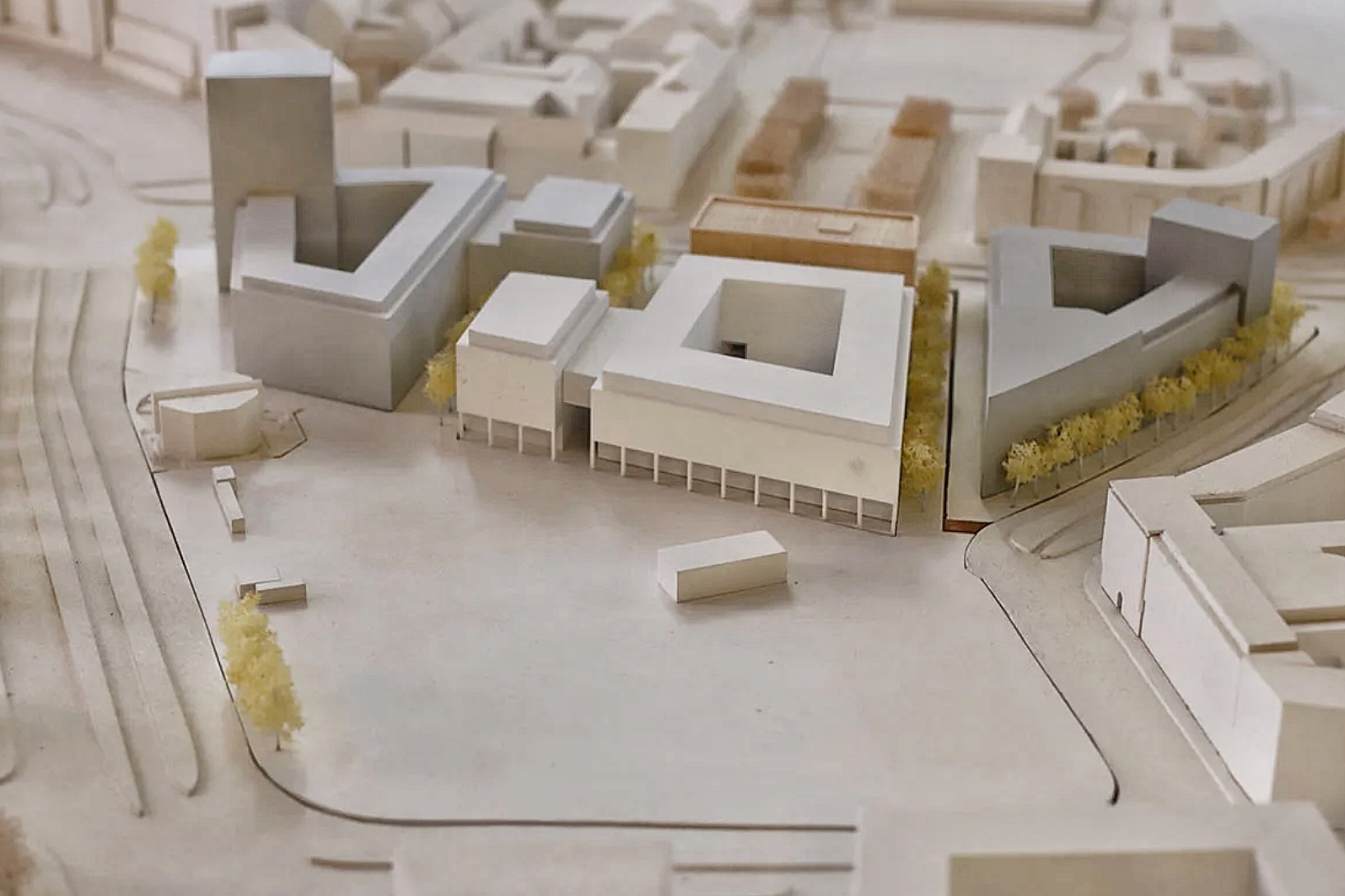
This, or something similar, is what the Leuschnerplatz development, including the future Forum Recht, could look like (earlier design). The city is presenting the current building plans this afternoon. Photo: City of Leipzig
Today’s Leuschnerplatz
gives little indication of just how densely built-up this part of Leipzig’s inner suburbs once was. Until the destruction of the Second World War, there was a distinct urban quarter here, complete with a market hall, hotels and restaurants. Originally, only a much smaller area in front of today’s City Library was referred to as a ‘platz’. It had emerged from the former fortress glacis in front of the Peterstor, where the Leipzig architect Johann Carl Friedrich Dauthe laid out an esplanade in 1778.
Particularly in the late 19th century, the area developed into a metropolitan business, market and entertainment district. Among the striking buildings was the Panorama, erected on Roßplatz in 1883–84. The rotunda was initially used to display dioramas, whilst the ground floor housed one of Leipzig’s largest restaurants. The surrounding area included, amongst other things, Café Bauer (with its own riding hall, breakfast served from 6 am to 2 pm and a good 200 local, national and international daily newspapers and magazines), a cinema, as well as other commercial and social venues.
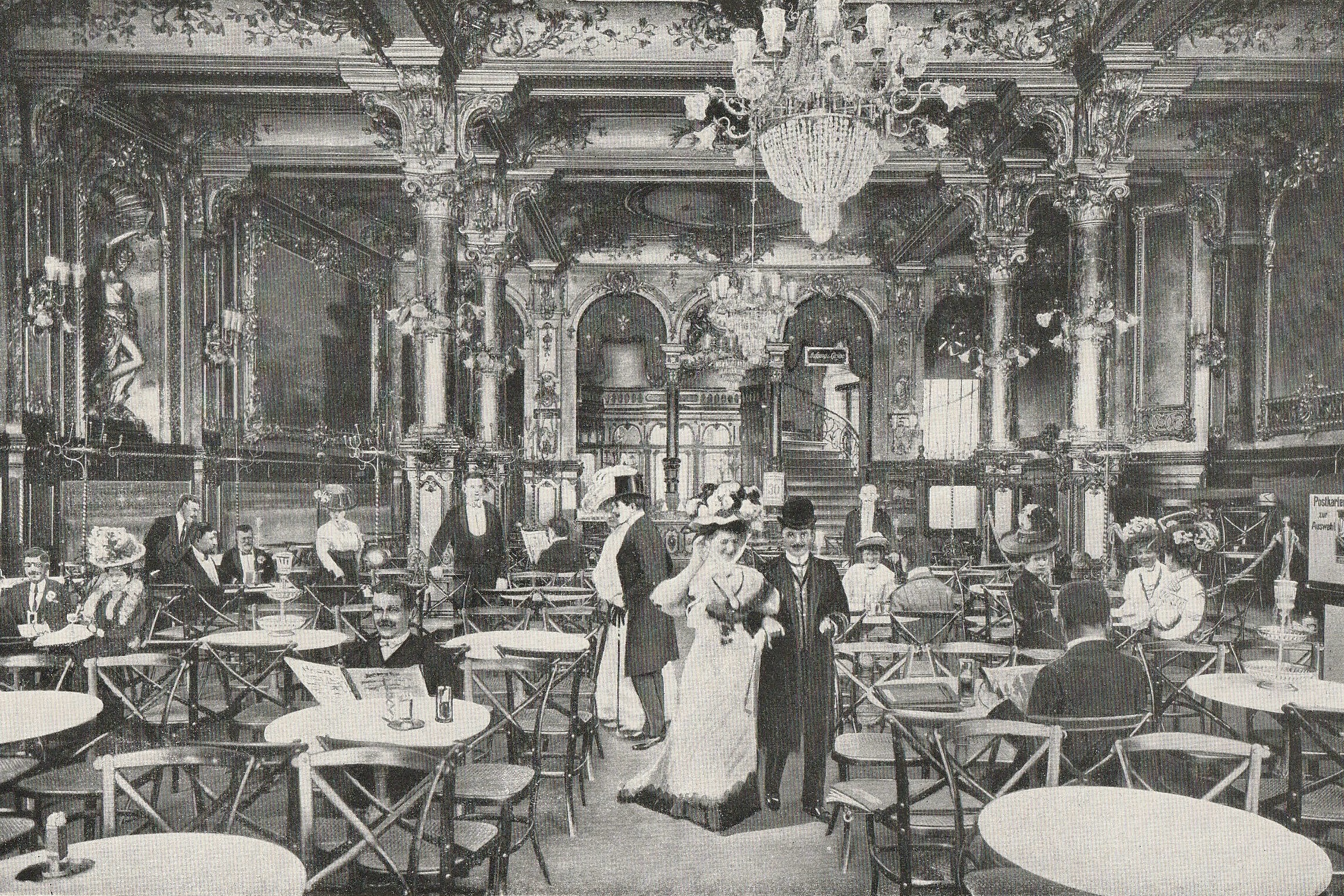
The multi-storey Café Bauer was open day and night. The image is taken from a menu. Source: Benjamin Weinkauf Collection
A central eye-catcher was the market hall
designed by City Planning Director Hugo Licht. The building opened in 1891; covering some 7,500 square metres, it provided space for hundreds of market stalls. Its 34-metre-high clock tower was visible from afar. The buildings surrounding Königsplatz also shaped the cityscape. On Peterssteinweg were, amongst other things, hotels and the department store owned by the Jewish merchants Moritz and Julius Ury. It was devastated during the November pogrom of 1938.
Not to be forgotten: the café and roastery run by Richard Poetzsch, a pioneer in coffee production and trade. A native of Leipzig, he ran a mail-order business from 1910 onwards, with his own large-scale roastery in Hamburg.
The south side of Königsplatz was dominated by the Old Grassi Museum, which today houses the city library. The square itself was also used extensively. It hosted weekly markets and fairground attractions, as well as the Leipzig Small Fair
until 1907. Between 1921 and 1932, a large temporary textile exhibition hall occupied almost the entire area at times.
The heavy air raid on 4 December 1943 almost completely destroyed the buildings on Königsplatz. Large parts of the neighbouring district to the east, between Brüderstraße, Markthallenstraße and what is now Grünewaldstraße, were also lost. The damaged market hall could initially still be used to some extent, but was completely demolished in the 1950s. With the subsequent clearance, not only did the ruins disappear, but so too did the former street layouts and property boundaries.
Königsplatz – which was renamed Wilhelm-Leuschner-Platz after the end of the war – and the destroyed neighbouring neighbourhood were thus spatially absorbed into the large open space known by that name today, which for decades was one of Leipzig’s largest war-ravaged wastelands.
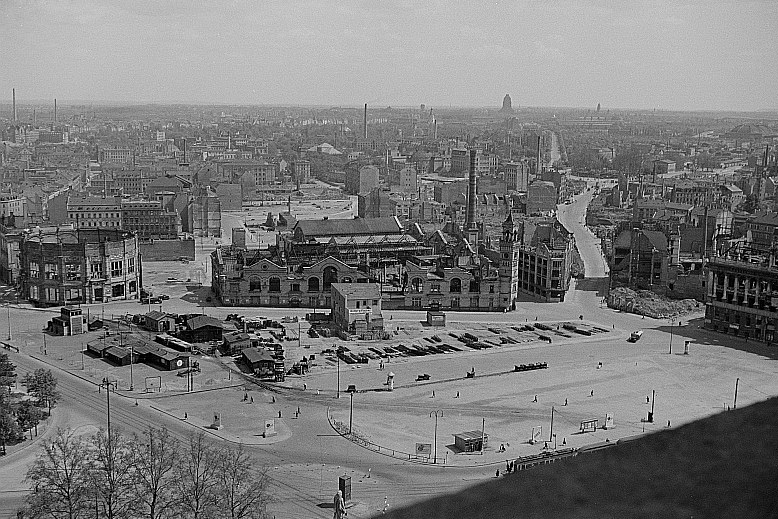
A view from the Town Hall tower of the site of what is now Leuschner-Platz, taken in 1950. The rubble has largely been cleared away, but the ruins of the Central Market Hall still stand. Photo: Roger and Renate Rössing / Deutsche Fotothek
At 2 pm, to coincide with the presentation of the development plans, environmental groups are calling for a rally, also on Leuschner-Platz, to warn against the environmentally harmful sealing of the site and to demonstrate against the threat of tree felling.
Open-air cinema at the Monument to the Battle of the Nations
At 91 metres high, it is the largest monument in Europe: the Monument to the Battle of the Nations in south-east Leipzig, right on Prager Straße. Today, thanks to its sheer scale, it will also become the tallest open-air cinema. The Schaubühne Lindenfels theatre and the Battle of the Nations Monument Foundation are organising a pop-up cinema at the foot of this colossal monument at 9 pm, with the steps serving as the seating area, offering a perfect view of the screen.
The programme features “HÜTTEN SIND FÜR ALLE DA” by Birk Poßecker. Over a period of three years, the filmmaker has portrayed a Leipzig neighbourhood and its contrasts, stories and personalities. The documentary focuses on the east of Leipzig and its residents.
Amongst other things, the film features autonomous squatters, sprightly senior citizens in the middle of a gun-free zone, and a Persian carpet shop. With a trashy-romantic VHS vibe and snapshots in which the boundaries between past and present blur, the film also addresses the conflicts that characterise trendy neighbourhoods: gentrification, inequality and racism.
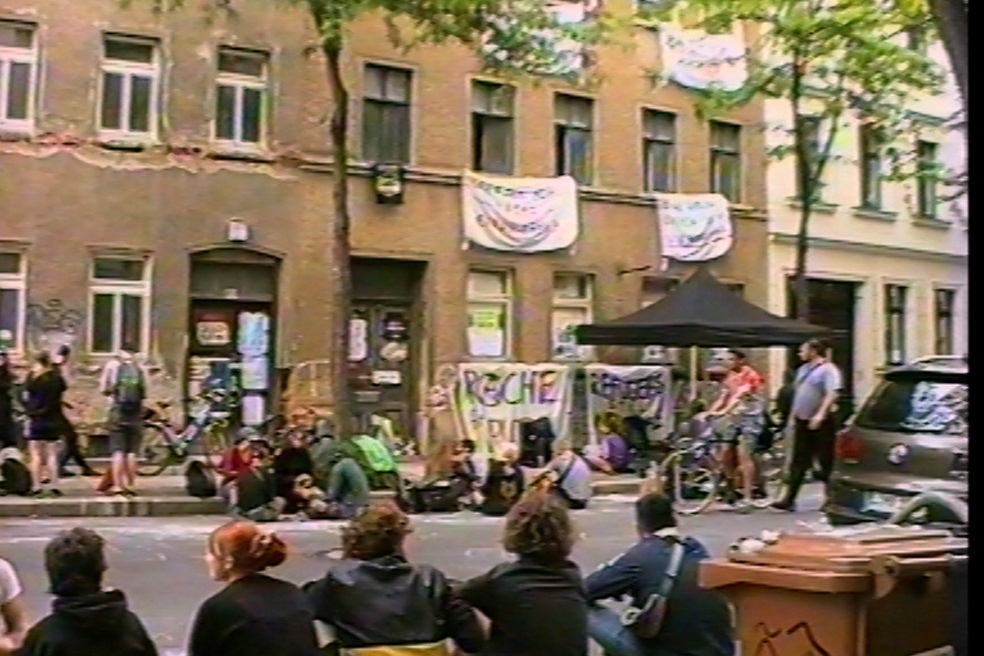
The documentary links these different ways of life with the hope that the people living here will continue to have a place in the neighbourhood in the future. “HÜTTEN SIND FÜR ALLE DA” was made in 2023 and runs for 91 minutes. It will be screened in the original German language with English subtitles.
Tickets cost 10 euros and are available at the box office. According to the organisers, cushions will be laid out on the stone steps. However, anyone who would prefer to sit on their favourite cushion from their balcony is, of course, welcome to bring it along. Tomorrow, on Thursday (also at 9 pm), there will be another screening of the film at the same venue.

State Parliament debates funding for local authorities
The summer recess is over – including for the Saxon State Parliament. Today, everything there revolves around money – a precious commodity, but one that is in short supply. The 32nd plenary session begins at 10.00 and will deal, amongst other things, with the 2027/2028 dual budget. Under agenda item 1, Members of the State Parliament will consider the 2027/2028 Budget Act, printed paper 8/7500, together with the 2027/2028 Budget Accompanying Act, printed paper 8/7501. The bills are then to be referred to all nine specialist committees, with the Budget and Finance Committee taking the lead.
The towns and municipalities of Saxony are also likely to be eagerly awaiting the second item on the agenda. This concerns the ‘Sixth Act on Financial Relations between the Free State of Saxony and its Local Authorities’, Parliamentary Paper 8/7502. Whilst local authority allocations are set at around 8.1 billion euros in 2026, they are expected to rise to almost 9 billion euros in both 2027 and 2028.
The plenary session is open to the public. According to the State Parliament
, interested members of the public may watch the proceedings from the visitors’ gallery without prior registration; however, they will need a photo ID to gain access to the building. In addition, on plenary days between 9.30 am and 6.30 pm, 90-minute guided tours for visitors are offered at half-hourly intervals, which also include a visit to the visitors’ gallery. The debate can also be followed HERE ONLINE via a live stream
with subtitles.
Whilst the budget deliberations are still underway in parliament, trade unions and civil society organisations intend to influence the debate outside the state parliament. From 12 noon to 2 pm, DGB Saxony
and its alliance partners are hosting an event on the Elbe side of the state parliament entitled ‘Dialogue on the Double Budget – Setting the Right Course’. The organisers describe the event as an “open-air dialogue with MPs on the double budget”.
A long table is to be set up outside the parliament building, where clubs, associations and projects can discuss their demands and the fiscal priorities of the forthcoming double budget with MPs from the democratic parties.

n the plenary chamber of the Saxon State Parliament. Photo: SLT/Stephan Floss
Licence information: The photograph of what is now Wilhelm-Leuschner-Platz, taken in 1950, is by the Leipzig-based photographer couple Renate and Roger Rössing. The photograph is made available for free use via this link on Wikimedia Commons by the Deutsche Fotothek. The image has been slightly cropped for use on this portal, but has not been altered in any other way.
Empfohlen auf LZ


So können Sie die Berichterstattung der Leipziger Zeitung unterstützen:





There is one comment