Dieser Artikel ist auch in deutscher Sprache verfügbar: Zum deutschen Artikel.
It is just a few steps away from the hustle and bustle and street noise of the big city: the Old St John’s Cemetery, situated directly behind the Grassi Museum, has led an almost enchanted existence for centuries. Now Leipzig’s oldest municipal cemetery, an important testament to the city’s history, is to undergo extensive refurbishment and renovation. Work on this is now getting under way.
Extensive works – restricted access until November
The package of measures, which the city has now announced and whose implementation is set to begin in the coming days, includes the repositioning of 22 historic gravestones at their original sites, the refurbishment of the main access road, and the realignment of the former main path in Sections III and V of the cemetery.
In addition, the planting of ground cover plants is planned as part of the repositioning of the gravestones. Trees in Section V, trained to grow in a pyramid shape, are to replace old trees and help restore the historical layout of the paths so that it is more easily recognisable.
According to the city, the repositioning of gravestones and the refurbishment of the main access road are expected to be largely completed by November 2026. The costs, estimated at a total of 150,000 euros, will therefore be largely (130,000 euros) funded from the tourism promotion fund. Access to the cemetery from Täubchenweg will not be possible whilst the renovation work is underway, but those wishing to visit can still enter the site via Prager Straße. Over the coming weeks, the stability of the northern and southern perimeter walls will also be assessed. A phased renovation of the cemetery wall is expected to take place in the coming years.
Established in the late 13th century
The Old St John’s Cemetery is regarded as an important testament to the town’s cultural and urban history. Its origins date back to the year 1278: at that time, a cooperative of lepers purchased a plot of land in front of the Grimma Gate from a merchant named Walther for five marks of silver. The church built there shortly afterwards, dedicated to St John, and the hospital of the same name are first mentioned in documents dating from 1305. For a long time, only victims of epidemics were buried here.
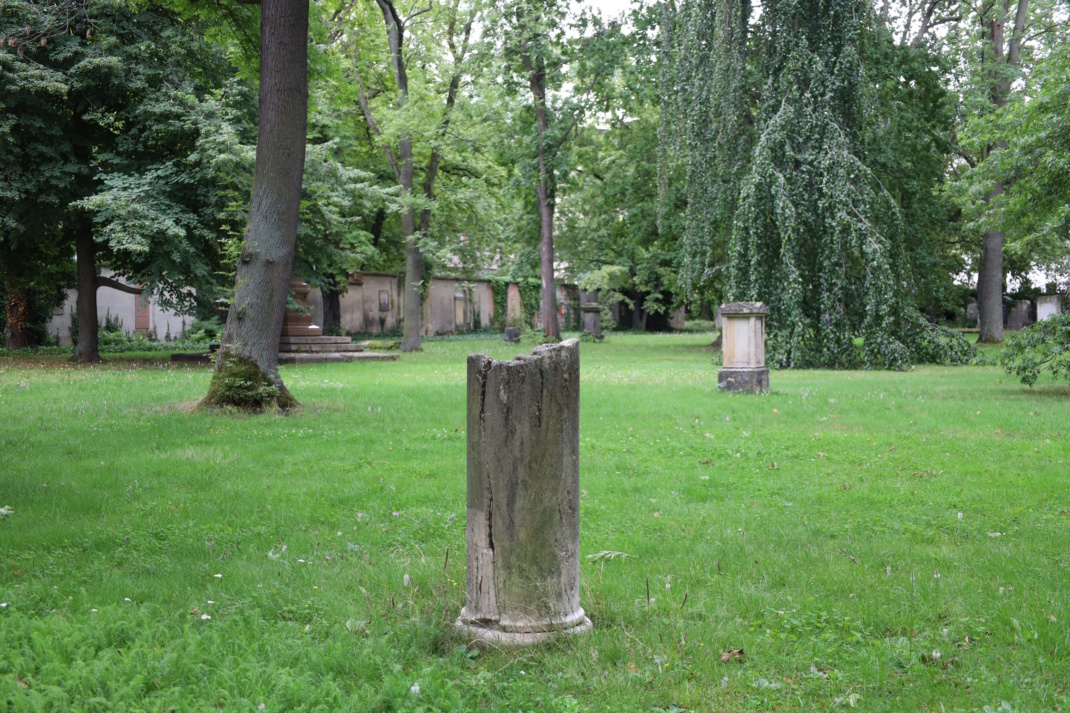
The former Section I of the Old St John’s Cemetery, where St John’s Church once stood. Photo: Ralf Julke
In 1476, the cemetery was expanded and, from 1536, was declared the sole burial ground for Leipzig by decree of Duke Georg the Bearded of Saxony (1471–1539). The sovereign’s intervention was likely prompted above all by the catastrophic hygiene problems caused by burials within the city centre.
More than 257,000 burials and famous names
Today, the Old St John’s Cemetery, where the last burial took place on 22 December 1883, is a museum park. Sections III, IV and V have largely been preserved. Over the centuries, up to 1834, more than 257,000 burials can be documented: residents of Leipzig, non-residents, victims of epidemics and war casualties.
Among the prominent figures who found their final resting place here are such illustrious family names as Dufour, Grassi, Harkort, Apel and Frege, as well as Johanna Rosina Wagner and Johanna Rosalie Marbach (née Wagner), the mother and sister of Richard Wagner. Also buried here are, amongst others, artists such as Franz Matthias von Treuenfeld and Karl Theodor Küstner, as well as Goethe’s childhood sweetheart, Anna Katharina ‘Käthchen’ Schönkopf.
400 gravestones represent various artistic styles and a wide variety of death symbolism typical of their respective eras. A so-called lapidarium houses gravestones from the New St John’s Cemetery, now known as Friedenspark.
Empfohlen auf LZ


So können Sie die Berichterstattung der Leipziger Zeitung unterstützen:





There is one comment