Dieser Artikel ist auch in deutscher Sprache verfügbar: Zum deutschen Artikel.
What happens to information when a feasibility study turns into a technical discussion – and that technical discussion subsequently turns back into a written response from the authorities? A small communication experiment arose quite by chance in connection with the planned boat crossing between Lake Cospuden and Lake Zwenkau. It shows that the feasibility study, the technical consultation and the communication report by no means provide the same kind of information. The differences only become apparent when they are compared.
It all began with 219 pages: the feasibility study for the ‘Neue Harth’ boat passage was completed at the end of 2025. It examines various options for connecting Lake Cospuden and Lake Zwenkau by boat. A ship railway emerged as the preferred option. Under this plan, boats and their passengers are to be transported overland between the two lakes in a water-filled trough.
Nothing has actually been built yet: the focus is currently on further planning of the preferred option. After all, the costs involved amount to around 93 million euros – a not inconsiderable sum of public funds. And all this is taking place at a time of social uncertainty and dwindling political trust – a highly sensitive starting point for planning a multi-million public project.
The more closely the study was examined, the more questions arose: Why does the region need this connection at all? Who decides on it? Why is ‘demand/tourism’ given a 50 per cent weighting in the assessment of the options, whilst ‘sustainability’ is given only 10 per cent? How were nature conservation organisations involved? What are the technical and economic risks? And what would be Plan B if the ship-rail link cannot be realised?
The discussion with the Department for Urban Greenery and Waterways
This led to a discussion on 17 August lasting around 90 minutes with Angela Zábojník, Head of the Waterways Development Department at the Office for Urban Greenery and Waterways and Head of the Water Tourism Development Working Group in the Leipzig Neuseenland, as well as her colleague Karen Weinert.
Both are deeply involved in the project from a technical perspective. This was evident throughout the discussion. Over the course of an hour and a half, they explained the current state of planning, clarified the assumptions of the feasibility study, corrected misunderstandings, identified uncertainties and answered questions. It was not a discussion that sought to sidestep critical questions. On the contrary: their willingness to explain complex interrelationships and to acknowledge the limits of current knowledge made the discussion highly informative.
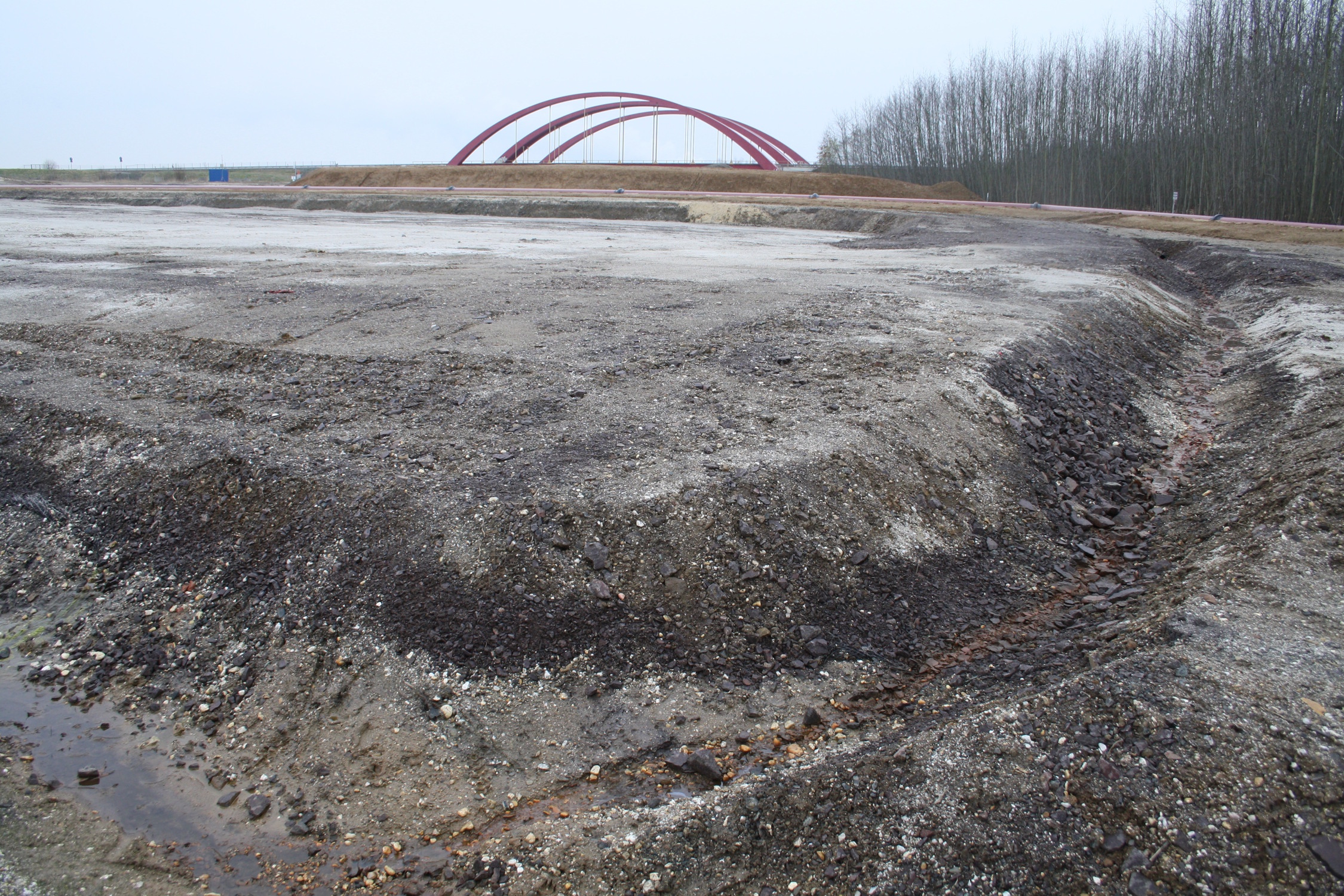
The site at Lake Cospuden with its heavy ballast, where the Harth Canal was still planned in 2016. Archive photo: Ralf Julke
However, the interview was not authorised for publication by the City of Leipzig’s Communications Department. The formal procedure for a press interview would have had to go through the department beforehand. However, the participatory and citizen-journalism-based investigative context was known; contact with the relevant department had been established via the ‘Grüner Ring’. LZ publications and an in-depth analysis of the study had already been mentioned previously.
For the purposes of this article, however, this formal conflict is of secondary importance. Instead, the City of Leipzig’s Communications Department offered to answer in writing the eight questions that had already been submitted prior to the interview. The answers have been available since 29 September and thus reflect the city’s current official position on these eight questions.
The serendipitous experiment
This presented an unusual opportunity: the same questions, the same project, almost the same timeframe – but different forms of communication. Three levels of information are thus being compared: the public feasibility study, a 90-minute discussion with two subject matter experts, and the city’s written responses to the same eight initial questions.
First, a surprise: anyone expecting that it was only the expert discussion with Zabojnik and Weinert that brought problematic or previously concealed aspects of the ship railway to light will be disappointed.
The feasibility study itself is quite open in key areas. It makes it clear that the high planning, construction and operating costs can only be justified if there are corresponding benefits to the regional economy. The appeal to water-based tourism – that is, the boat passage alone – is simply not enough to achieve this.
The striking evaluation matrix is also publicly available. ‘Demand/tourism’ accounts for 50 per cent, technical feasibility for 15 per cent, sustainability for 10 per cent, cost trends for 20 per cent and other criteria for 5 per cent. Nature conservation, difficult ground conditions and cost risks are also addressed. According to the study, some items relating to future operating and maintenance costs cannot yet be reliably quantified at the current stage of planning.
Much of the supposedly sensitive information had therefore long been accessible. So why spend 90 minutes speaking to experts at all?
The added value of the discussion
This is precisely where the particular value of the exchange with the experts became apparent.
For example, the study mentions a figure of up to 400,000 additional visitors per year. During the discussion, it became clear how such a figure should be understood: not simply as a political target to attract as many additional people as possible to the lakes, but in the context of the question of what level of demand would be required to generate the corresponding regional economic effects.
Something similar happened with the evaluation matrix. Its figures are set out in black and white in the study. During the discussion, it became clear that such weightings are the result of a process of work and consultation, and that they were the subject of heated debate and negotiation.
In the process, the two experts also corrected the questioner. The exaggerated assumption that nature conservation aspects were not included in the assessment at all thus proved to be incorrect. Nature conservation is reflected in particular in the ‘sustainability’ category, with a 10 per cent weighting.
This is perhaps an underestimated function of a good discussion: it does not merely provide additional information. It can also clarify criticism and correct the questioner.
With regard to follow-up costs, operational organisation, potential bottlenecks and the status of further planning, it also became clear what can already be answered with certainty – and what still needs to be addressed in future planning stages. The 90-minute discussion therefore brought to light not so much sensational new facts as interrelationships, uncertainties and questions that had previously remained unanswered.
Eight questions are being put forward once again
Following the Communications Department’s decision not to authorise the discussion as an interview, the City of Leipzig answered the eight initial questions in writing. These constitute the city’s authorised information and are therefore first reproduced verbatim and then compared with the study and the expert discussion.
1. Why is the boat passage necessary in principle? Is it essential?
Communications Department: This is the continuation of a politically set development objective in the Leipzig Neuseenland; in other words, the region is very keen to press ahead with the project. The boat passage is intended to promote tourism, participation, quality of life, structural change and regional value creation, and to enable a better experience of the lake landscape and link existing tourist attractions. Following completion of the feasibility study, further planning is initially required regarding technical feasibility and implementation. With the feasibility study now available, the Leipziger Neuseenland steering group has decided to first secure funding for the subsequent planning phases.
This clearly illustrates the objectives the city associates with the project.
Furthermore, the expert discussion with Zábojník and Weinert helped to put the contentious question of ‘existential importance’ into perspective: a tourist link is not existential in the sense that the region could not survive without it. Rather, the decisive factor is the political assessment of what benefits are expected from it and what level of expenditure appears justified.
2. What are the decision-making bodies in this process?
Communications Department: The central decision-making body is the Leipziger Neuseenland Steering Group. It comprises decision-makers from local authorities, districts, government departments, the redevelopment company and other institutions. A representative appointed by the nature conservation organisations also sits on this body. The feasibility study was commissioned by the Grüner Ring Leipzig, represented by the City of Leipzig.
During the discussion, another important distinction regarding public participation emerged: the continuation of the planning process does not yet mean that the specific implementation has been decided in every detail. This led directly to the next question: what exactly is still open to discussion – and where, therefore, can public participation still make a difference?
3. Why is the boat passage necessary now, at a time of financial and social instability?
Communications Department: See the answer to question 1.
This question was not addressed in isolation in the same form during the expert discussion. It is therefore not possible to identify any loss of information between the discussion and the written response. The only thing that can be established is that the specific question of ‘why now, of all times’ remains unanswered.
4. Conflicts with environmental organisations have already come to light in the past during the WTNK process. Why were neither nature conservation aspects nor the statements of the environmental organisations taken into account in the feasibility study?
Communications Department: A representative of the nature conservation organisations, jointly appointed by them, is a member of the Leipziger Neuseenland steering group. The environmental organisations were not directly involved in the preparation of the feasibility study. The reason for this is that a feasibility study should first examine whether a route is technically feasible at all, under what conditions and with what benefits.
Zábojník and Weinert also clarified an important point: the absence of direct involvement by the organisations does not mean that nature conservation played no role whatsoever in the study. It is precisely this back-and-forth that highlights the value of dialogue: what began as a simple criticism has given rise to two more precise questions – How were nature conservation concerns taken into account? And when will organised nature conservation interests be directly involved?
5. Who developed the boat passage options and the evaluation matrix?
Communications Department: The contractors ICL Ingenieur Consult, Project M and CDM Smith developed the options. These were discussed and revised with experts, regional stakeholders and working groups.
This answers part of the question. However, no written response has been provided regarding the development process of the evaluation matrix, which was also explicitly enquired about. It was precisely here that Zábojník and Weinert were able to draw connections: the criteria and weightings, too, are the result of a process of collaboration and consultation.
The bare figures – ‘50 per cent tourism, 10 per cent sustainability’ – simply convey a different message to the additional information explaining how such weightings are arrived at. The written response does not address this. In the technical discussion, however, this development process was explained in greater detail; the discussion as a whole was not subsequently authorised for publication.
6. What are the key advantages of the ship-rail link as the preferred option?
Communications Department: The key advantages of a ship railway are: fewer challenges with the existing ground conditions, use for passenger ships and thus broader participation, tourism and economic benefits, and integration with existing infrastructure at Belantis and on the north bank at Zwenkau.
This is concise and informative. During the longer technical discussion, the arguments put forward by Zábojník and Weinert sometimes diverged significantly and were explained in different contexts. The written response effectively summarises these points here, rather than reducing the information. This, too, forms part of the outcome of this small experiment.
7. Do you also see any limitations that might still argue against the ship railway?
Communications Department: As already described, further fundamental planning is required on the basis of this feasibility study.
The statement is factually correct, but remains significantly more general than the feasibility study itself. Among other things, the study addresses conflicts relating to nature conservation, difficult ground conditions – particularly in the vicinity of the motorway bridge – and cost issues.
During the expert discussion, the expertise of Zábojník and Weinert proved particularly helpful in this regard: not every unanswered question constitutes a counter-argument against the project. Some simply cannot yet be conclusively answered at the current stage of planning. That is an important distinction.
A lack of knowledge is not automatically a shortcoming. However, for a public debate, it is helpful to know where that knowledge ends. For before further planning stages costing millions are embarked upon, it should be clarified which outstanding issues actually belong in the next planning phase – and which should already have been addressed in a feasibility study.
8. If the ship-rail option were not feasible, what would be pursued as Plan B?
Communications Department: As part of the feasibility study, numerous options were examined, of which the ‘ship railway’ was assessed as the preferred option.
This, too, is factually correct. However, the question asked was aimed at something else: what will happen in future if the option now favoured turns out to be unfeasible? During the technical discussion, this distinction was clarified through follow-up questions. Even in the discussion, there was no indication of a specific Plan B that had already been established. And this is precisely where something begins that, by its very nature, is difficult for eight written responses to address.
The next question is missing. After all, communication about a complex project does not consist solely of conveying as much information as possible. A study can provide information. A website can provide information. A public authority can answer eight questions in writing – and, as can be seen here, in some cases very precisely.
Public discourse and participation are, nevertheless, something else entirely.
For the figure of 400,000 additional visitors might well be followed by the question: Do we actually want 400,000 additional visitors at all? The weighting of 50 per cent for demand and tourism raises the question: Who decided that this criterion is so important? The statement that environmental organisations were not directly involved in the preparation of the study prompts the question: When are they to be involved – and which decisions are still open at that point?
And the response that various alternatives have already been examined naturally leads to the question: Right – but what is Plan B now? This is how dialogue works: information → question → answer → objection → clarification → possible correction → understanding.
The 90-minute discussion with Angela Zábojník and Karen Weinert demonstrated precisely this process. Its particular value did not lie in eliciting the most spectacular statements possible from two specialists. Rather, it allowed two experts to explain their knowledge, put it into context and apply it in response to questions – whilst also correcting the questioner. This is something fundamentally different from a mere information channel.
Information does not in itself constitute participation
Perhaps this also holds a lesson for participatory processes. Public authorities can publish extensive documentation. Citizens can submit comments. Both sides have thus exchanged information in different directions. But this does not necessarily lead to understanding.
Information requires only a channel, whereas participation requires feedback. And that is precisely why the timeline of this case is so interesting. First, there was the public feasibility study. Then, this knowledge was explored in greater depth during a 90-minute expert discussion through questions, explanations, objections and corrections. Subsequently, the same eight initial questions were answered once again via the institutional communication channel.
Ideally, one would expect: study → expert discussion → even more precise official information.
In fact, the pattern that emerged here on several occasions was: study → in-depth dialogue → institutional consolidation.
Consolidation does not always imply a loss. Some of the city’s responses do an excellent job of consolidating existing knowledge. In other cases, however, the official responses fall short of what the public study had already revealed or what had become clear during the discussion.
Remarkably, the information process does not move exclusively forwards, but in some instances even backwards.
This does not imply any specific intention on the part of the Communications Department, nor does it allow for a general statement to be made about public sector communication. The comparison initially merely shows what happens to information in this specific case when an open expert discussion is subsequently replaced by authorised written responses.
What remains of the dialogue
It is therefore noteworthy what Zábojník himself said at the end of the expert discussion about the value of such an exchange:
“It is also important that the public asks questions. […] And ultimately, every discussion always gives us food for thought. Nothing is ever for nothing; we always take something away from it. […] I believe civic engagement is important; it also demonstrates an interest in the region.”
That is precisely what happened in this discussion. The feasibility study was scrutinised; answers led to new questions; individual assumptions were corrected; and other outstanding issues were clarified. This gain in insight arose precisely through the feedback during the expert discussion – not through the subsequent mere provision of authorised information.
And so the dialogue brings us back once again to the starting point: the feasibility study itself. It cost around 250,000 euros. A further 1.3 million euros or so is on the table for the next planning stages. At the same time, the critical examination of the study has now brought some fairly specific unresolved questions to light.
What will happen to these? Will they be subject to a further independent expert review before planning continues, and will the existing study be revised where necessary? Or will they only be addressed in the next planning phase?
Empfohlen auf LZ


So können Sie die Berichterstattung der Leipziger Zeitung unterstützen:




There is one comment