Dieser Artikel ist auch in deutscher Sprache verfügbar: Zum deutschen Artikel.
When you follow the discussions coming out of the Saxon countryside, you get the impression that most Saxons are against the energy transition and the expansion of renewable energy. And the Minister-President seems to be their mouthpiece when he raves about coal, natural gas and nuclear power. But this impression is misleading. It is the vocal minority who are shaping the debate. But the majority view is entirely different, as a survey commissioned by the Ministry of Economic Affairs now shows.
After all, most Saxons are not entirely unaware of the role the energy transition plays in security of supply, the state’s competitiveness and independence from fossil fuel imports in geopolitically uncertain times. “Wars
, crises and conflicts between major powers show that we must become less dependent on fossil fuel imports,”, emphasises Minister for Economic Affairs Dirk Panter. “A secure, affordable and climate-friendly energy supply is a crucial competitive factor for Saxony as a business location.”
And the minister stresses that there is considerable pressure to act on expanding renewable energy. Saxony continues to generate too little electricity from renewable sources – even compared with other eastern German federal states. The expansion of wind and solar energy is therefore just as necessary as the development of an efficient infrastructure. This includes storage technologies, modern electricity grids and, in the long term, hydrogen-compatible gas-fired power stations at former coal-mining sites, in order to ensure security of supply even during transitional phases.
The survey results
The representative survey commissioned by the Saxon Ministry of Economic Affairs has once again confirmed that the energy transition in Saxony is largely met with approval. A majority of 56 per cent have a generally positive view of renewable energy, whilst 14 per cent reject it. At the same time, a significant proportion of the population (28 per cent) remain undecided.
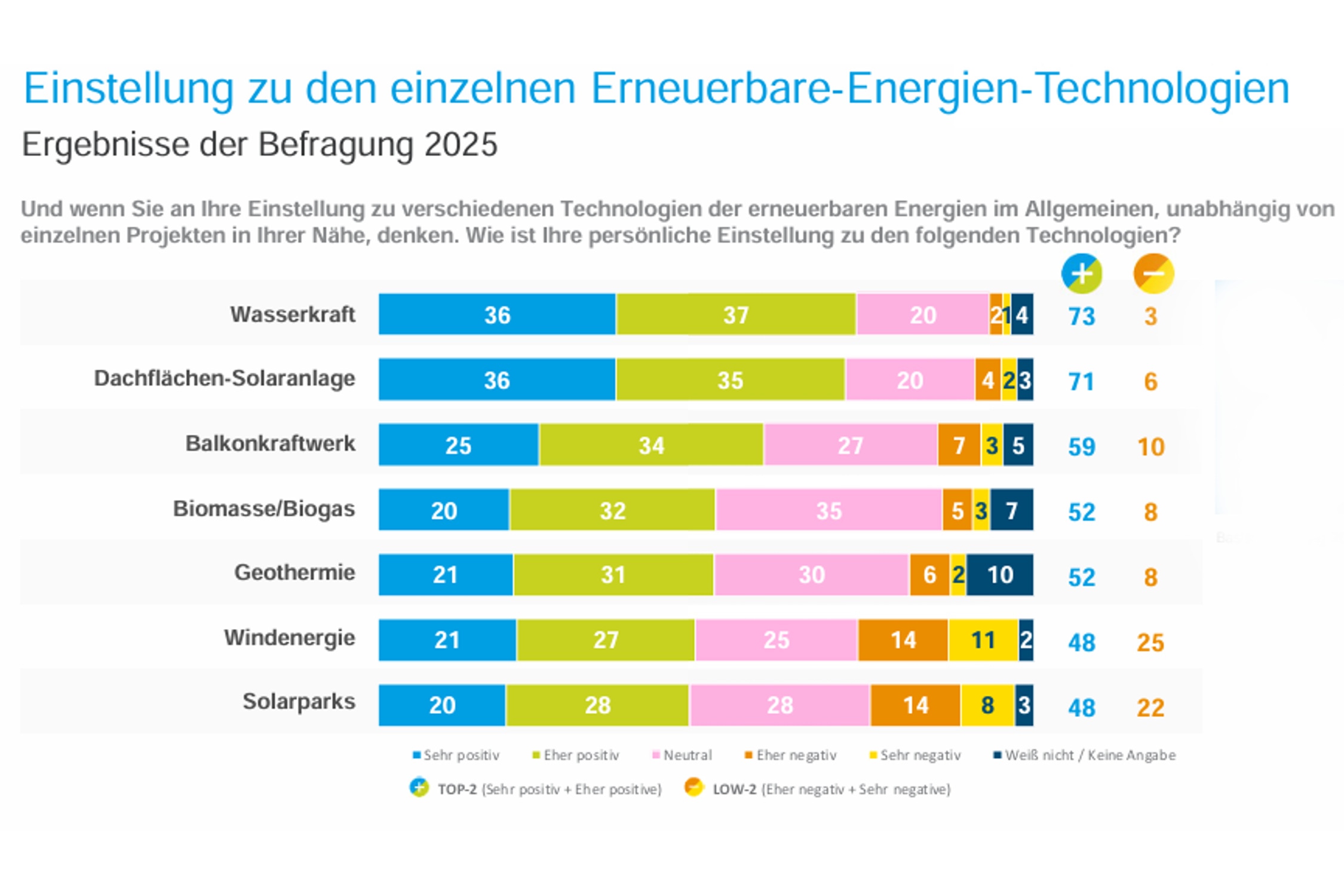
Respondents’ attitudes towards various renewable energy technologies. Graphic: Free State of Saxony, SMWA
According to the Ministry, this makes it clear: “There is fundamental support, but it is not robust as long as the specific implications remain unclear or are perceived as detrimental. Acceptance arises above all where the benefits are immediately apparent – for example, through financial participation by local authorities, economic stimulus or noticeably lower energy costs.
This ambivalence is particularly evident in people’s immediate living environment: no form of energy is accepted there without reservation. Although renewable energies fare better than conventional technologies, they are more frequently at the centre of conflicts due to specific expansion projects.”
This means that the expansion of renewable energies must be justified. Local stakeholders must be brought on board.
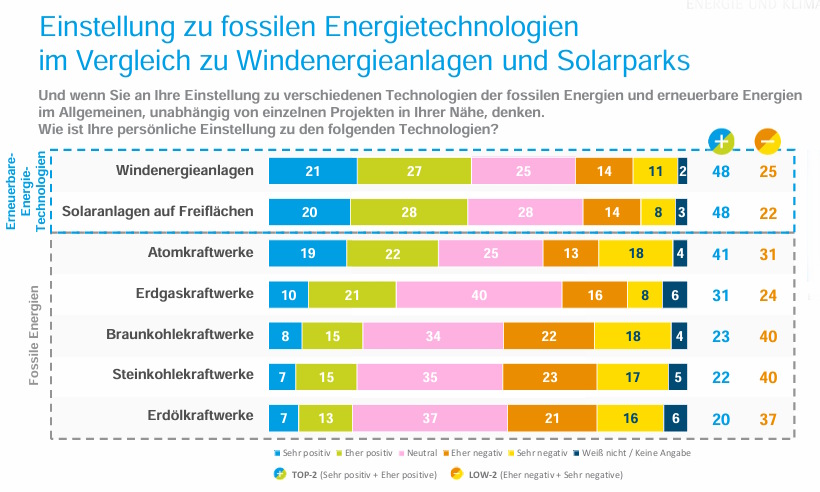
Comparison of support for renewable and fossil fuel energy technologies. Graphic: Free State of Saxony, SMWA
“The energy transition can only succeed if it is economically viable, regionally rooted and designed in a way that people can understand,” says Dirk Panter. “The results clearly show that we need to explain things better, involve people at an earlier stage and make the concrete benefits more visible.”
The Renewable Energy Revenue Sharing Act has also established binding framework conditions to ensure that local authorities benefit financially from wind and solar projects. The aim is to visibly anchor value creation locally and strengthen acceptance. In addition, the Saxon Energy Agency’s Renewable Energy Dialogue and Service Centre supports citizens, local authorities and businesses with advice and conflict mediation.
The results of the survey can be found here.
The online survey
To gauge the attitudes of the population of Saxony towards renewable energy in the Free State of Saxony, an online survey was conducted in October and November 2025 on behalf of the Saxon State Ministry for Economic Affairs, Labour, Energy and Climate Protection.
The survey was carried out by Innofact AG from Düsseldorf. A total of 1,500 net interviews were conducted. The sample comprised Saxony’s resident population aged between 18 and 79 and was selected to be representative in terms of age, gender and place of residence (urban or rural).
Empfohlen auf LZ


So können Sie die Berichterstattung der Leipziger Zeitung unterstützen:




There is one comment