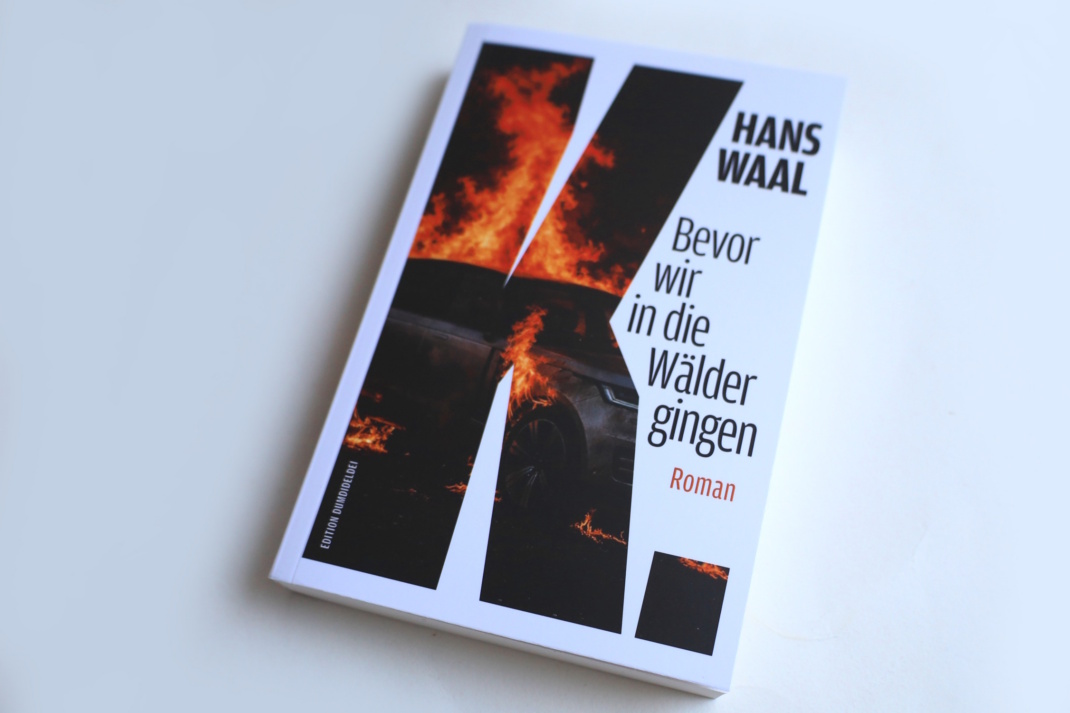
Some wounds do not simply heal with time. Especially when it comes to one’s own deeply wounded self-image. This is an experience that many East Germans went through after 1990. That deep-seated disappointment is now also finding expression in election results. Not everyone, however, takes to the woods to eliminate the people who have brought all these defeats upon them. Except for Michael K. He is, in fact, a legendary figure who has been part of East German collective memory since 1808, when Heinrich von Kleist published his famous novella.
Need we add that Kleist, too, suffered under the times in which he lived? Much like the young man who served as the model for the hero of his novella: Hans Kohlhase, who paid for his quest for redress with his life in 1540. Don’t take on the powerful. They always have the upper hand.
And Michael K., whom Hans Waal sends on a quest for justice in his novel, also belongs to this tradition. And whom he ultimately causes to fail, even if it is only a few heavily armed Saxon police officers who pin him to the pavement as he leaves St Nicholas’ Church. At a moment when he had actually been promised safe passage.
Just moments before, he had recounted everything that had befallen him to his old vicar. In the book, his name is Martin, and he is certainly reminiscent of one or two of Leipzig’s St Nicholas’s vicars who played a central role in the autumn of 1989.
Just as some of the characters Hans Waal brings to life are reminiscent of well-known figures from Leipzig’s recent history – from the dubious figures in the ‘Sachsensumpf’ scandal, through shady property speculators, to that West German Eulenspiegel who made a career for himself as a fake doctor.
Trigger warning
And actually, the book ought to carry a trigger warning too. For it is the frustrating 1990s that Hans Waal takes his readers back to. Like so many East Germans, Michael K. gave it a go: he tried to fit in, to become like his new West German superiors, who were hunting for lucrative bargains on the Leipzig property market and had no qualms about ripping off the previous owners in the process.
K. is actually familiar with these practices. But then he makes the mistake of his life: he allows himself to be persuaded by the two Frankfurt crooks to set up his own company, for which he is immediately given a few properties in Leipzig.
Only these are precisely the properties that are unsellable, yet burdened with heavy debts. The path to decline and insolvency is all too clear. A path on which K. also loses his wife, Lissi – not to mention his flat and income. Yet he has a talent that others discover much sooner than he does himself: he can put his frustration into words and inspire people.
Before long, he becomes a nationally renowned speaker who speaks from the heart to the battered East Germans. After all, almost all of them have experienced how various West Germans helped themselves to the spoils of East Germany’s windfall and then went on to secure positions in all manner of offices and posts. Despite all the scandals.
It is not just the much-cited transformation that has battered the East Germans. It is also the experience of utter powerlessness, whilst not only did their jobs disappear or be turned into ‘subsidised’ low-paid jobs, but their qualifications were also devalued, entire streets changed hands and whole factories were shipped off to the Far East. Something like that has consequences. Where does one channel that frustration? What does it do to a person if they don’t follow the example of the legendary Michael Kohlhaas?
Post-traumatic bitterness disorder
Though in the end the question is: is this K. actually following in Kohlhaas’s footsteps? Or did none of what he confesses to Martin during that long night actually happen at all? Did he merely imagine it? Was it merely a pipe dream that then coincided with all those unexpected deaths, which just so happened to befall all the people responsible for his downfall?
The question remains open. And Hans Waal – whom many still remember for his wonderfully scathing columns in *Stern*, which he published under his real name – lays another clue right at the very end by explaining a psychological condition that has so far received little attention: post-traumatic embitterment disorder. Not everyone is susceptible to it. Most people grit their teeth, pull themselves together and make the best of it.
But some people cannot do that. The trauma dominates their thinking. They develop fantasies of revenge and can no longer shake off the feeling of having been treated unjustly and betrayed.
And then? This K., at any rate, soon finds himself among a clearly well-organised group that has set itself up in an old country house in the woods and organises attacks and protest actions from there. And with this eloquent K., who’s a master at stirring people up, they can achieve a great deal. And they’re certainly capable of sending some of those strange characters – who helped themselves to a fortune during the boom of the early 1990s – to the afterlife.
Not criminally responsible
Although it’s never quite clear whether the deaths K. so eagerly confesses to are actually down to him. Martin, at any rate, doesn’t believe everything he says. But K. is not alone in his urge to confess at all costs; this becomes clear, at the latest, in the secure prison to which the West German judge sent him, after K. refused to settle for two ridiculous robberies in court, but instead wanted all his crimes to be named.
He is just as concerned with making a public impact as he is with that strange feeling that has constantly tormented him – that he didn’t really count. So at least take the blame properly, be recognised as the perpetrator.
Just not to appear so powerless any longer, so sidelined, as if his own fate didn’t matter at all. Seen in this light, Hans Waal’s new novel is also a very topical book at the moment. Precisely because it evokes all those frustrating feelings of the 1990s, that sense so many had: of suddenly finding themselves in the wrong film, cheated out of the fruits of the revolution, sidelined and exploited. And then, on top of that – as K. experienced – to be thoroughly fleeced.
And instead of actually sending him to prison, the judge accepts the assessment of the expert witness, who has declared K. not criminally responsible. So K. ends up in a psychiatric hospital – alongside other figures who have ended up there for very similar reasons. Even that policeman who once tried to get to the bottom of all the property scams in Leipzig.
A certain Mr W.
Perhaps K. shouldn’t have given in to the urge to have his story told in the newspaper at all costs. But the appearance of a Hamburg journalist named Witzel proved too tempting. Finally telling it all, finally being heard.
That Hans Waal then goes on to make this Witzel disappear too seems only logical. And for readers, of course, it is a nice allusion to the author’s earlier works, in which he once gave voice to the frustration of East Germans at arrogant and ignorant West Germans.
As we know, that didn’t change a thing. Certainly not the sense of powerlessness. And ultimately, Hans Waal’s novel is also a novel about the workings of power and powerlessness. And about the futility of feuds in a society that simply lets such matters disappear as a news item in the small print. But that society has absolutely no interest in publicly debating the motives of those who are frustrated. It simply doesn’t matter.
Even if K.’s decidedly militant comrades-in-arms see things differently and set fire to banks and luxury cars, bring rioting into the cities, and believe they can challenge state power with stones and Molotov cocktails. Or force a kind of justice when that is not possible in court.
On the pavement
And so the question remains: where is there redemption? For in a way, that is what K. had hoped for from Martin, though he isn’t quite sure whether Martin still stands by the old ideals or has simply gone along with the crowd and is playing the others’ game. Does forgiveness even help when the sense of injustice suffered runs so deep that it defines one’s entire personality?
In any case, in Waals’s novel, the eras intertwine: the protests of the 2000s (when people were protesting against the Hartz laws) with the later Pegida protests and the very headline-grabbing actions of left-wing groups, which, by setting fire to ‘bigwigs’s cars’, at least make the police reports more interesting.
It eventually becomes clear to K. that even the people who have built him up as a speaker are not quite what they seem to be. Which side are they actually on? And which side does he belong to? Or does that side not even exist? This, too – in the form of despair – lies somewhat behind his night-long conversation with Martin. Before the situation escalates one last time and K. finds himself lying on the cobblestones of the Nikolaikirchhof. Where it all began, and where – at least for him – his time of freedom in the woods now comes to an end. Inevitable, one might think.
And because the author’s search for a publisher ended in frustration without a commitment, he has now self-published the novel. For anyone who feels a little like Kohlhaas and suspects that they’re not alone in this.
Hans Waal *Before We Went into the Woods*
, Edition Dumdideldei, Leipzig 2026, 16.90 euros.
Empfohlen auf LZ


So können Sie die Berichterstattung der Leipziger Zeitung unterstützen:





There is one comment