Dieser Artikel ist auch in deutscher Sprache verfügbar: Zum deutschen Artikel.
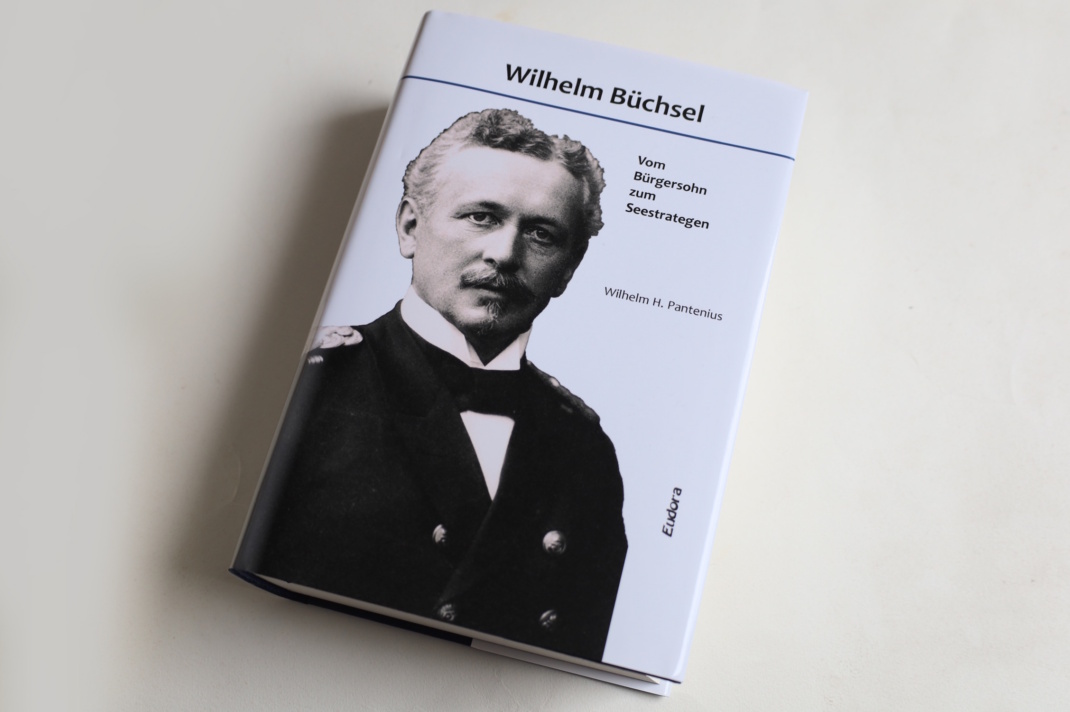
His friend and rival, Alfred von Tirpitz, is a figure in the history books. But what about Wilhelm Büchsel? No warship was named after him. He was not glorified in the same way as Tirpitz. And when he died of the Spanish flu in 1920, he had been all but forgotten. Yet he served as Chief of the Naval Staff of the Imperial Navy from 1902 to 1908. It was the high point of his career, until he was sent into retirement by the Emperor – a move he did not entirely choose for himself. Nevertheless, Wilhelm H. Pantenius felt that this man deserved a comprehensive biography.
A biography to which Wilhelm H. Pantenius, a military doctor who has long been retired and living on Usedom, devoted just as much time and effort as he did to his biography of Alfred von Schlieffen, the German Chief of the General Staff known for the Schlieffen Plan, which he published in 2016. His particular interests lie in Prussian military history and the Prussian-German General Staff. This is a thoroughly remarkable field of research, one that few of today’s German historians are exploring.
As if the military history of the 19th century were no longer so important. Ticked off, a thing of the past, done and dusted. But that is not how history works. Personal actions always have consequences. Sometimes fatal and catastrophic ones. Even if someone simply serves reliably throughout their life, as Wilhelm Büchsel did.
For unlike Alfred (von) Tirpitz, who was almost the same age, Wilhelm Büchsel – born in Stralsund in 1848 – was not drawn to politics; intrigue was far from his nature. Which ultimately cost him his post as Chief of the Admiralty Staff. And with it, perhaps, the chance to go down in history as a commanding figure in the First World War. For instance, as the actual instigator of the submarine war, which ultimately led the USA, of all nations, to enter the war and thus seal Germany’s defeat.
A fleet for the coming war
For he was not entirely blameless in the submarine war, even if he was not responsible for the strategic deployment of the fleet. But he was responsible for building up this war fleet. A task he had also overseen in his previous posts. And there he worked not only with determination on plans to build up the German fleet for a possible confrontation with the vastly superior fleets of England, France and Russia, but also on the ongoing modernisation of the warships. Right up to the establishment of a submarine fleet.
And so we find ourselves right in the thick of a chapter of German military history that is usually only briefly touched upon when discussing Emperor Wilhelm II’s naval policy and his legendary remark from 1898: ‘Our future lies on the water’.
As if Wilhelm’s naval ambitions had only begun in 1898 and the development of a powerful German fleet had not started much earlier, precisely in that politically momentous year of 1848, when Büchsel was born. For it was also the year in which the National Assembly in Frankfurt resolved to establish a German Imperial Fleet, whose first commander was the Leipzig-born Karl Rudolf Bromme.
Naturally, he is also mentioned in Pantenius’s book, for the author does not refer his readers to other, mostly out-of-print books on German naval history. He tells this story himself. This is also because it sheds light on key aspects of German politics in the late 19th century, when, following the Franco-Prussian War of 1870–1871, Germany emerged – from a British perspective – not only as an economic rival but also as a military adversary to be taken seriously. At sea, too.
For even though the Imperial Fleet envisaged by the National Assembly did not exist as such, Prussia in particular soon set about building its own fleet.
Coal powers Europe’s navies
What this fleet looked like, how it was armed and how it was operated – the reader learns all of this. And in doing so, you are immersed in an era of constant change at sea, when the dominant sailing ships were gradually replaced by armoured battleships and torpedo boats, whose engines were fuelled by coal. Pantenius even provides the figures for the immense coal consumption of these early armoured cruisers, demonstrating here just how comprehensively one can reconstruct not only an entire life from several personal estates, but also an era that was initially rather sceptical about having a naval fleet of its own. Only to end up frenetically celebrating the naval build-up.
And Büchsel’s life is a prime example of these changes. It began when the son of a merchant from Stralsund decided not to study theology – as his father wished – but to apply for cadet training with the Prussian Army. This was in the very same year, 1865, in which Tirpitz also began his naval career. And Pantenius is probably not wrong in assuming that there was a kind of friendship between the two men, which accompanied them as they rose through the ranks of a navy that was becoming increasingly professional in its organisation.
At least up until the years 1902 to 1908, during which Büchsel did, in a sense, appear to hold the highest office in the German Navy. But the actual decision-making power over the naval forces lay with the State Secretary of the Imperial Naval Office, a post held by Tirpitz since 1897. He was not to lose this post until 1916, in the midst of the First World War, when the dispute over submarine warfare between the naval leadership and the Reich leadership – and ultimately Wilhelm II himself – was escalating.
For, following the initial stages of the submarine warfare initiated by Germany, Wilhelm II and Reich Chancellor von Bethmann Hollweg rightly feared that continuing this war of aggression, including against merchant ships, would ultimately lead to the United States entering the war. That is precisely what happened when Germany resumed submarine warfare in 1917, in the deluded belief that it could thereby force Britain to surrender within six weeks.
A war with a long build-up
But that brings us to the end of the story. For it is precisely because Pantenius takes such a detailed and document-driven approach that a complete picture emerges of German naval armament and the war hysteria that was fuelled not only in Germany at the time, but also in France, England, Italy and Russia.
And the German fleet was, in fact, expanded precisely to keep pace with the other colonial powers. For even though Chancellor Bismarck was sceptical of all German colonial plans, German profiteers merrily pressed ahead with the conquest of German ‘protectorates’. The first heyday of imperialism was, after all, directly linked to the scramble for as many colonial territories as possible that could be plundered. This then led, by the 1890s at the latest, to the colonial powers getting in each other’s way in this race.
Suddenly, Germany, too, felt it urgently needed a modern fleet capable of standing up to the greatest naval power on the oceans. The reader naturally also learns that there was still resistance to this within German political circles. After all, Büchsel was repeatedly involved in the organisation and modernisation of the German navy and also commented quite officially in memoranda on the lengthy planning times for more modern ships and on the far too meagre funds that the Reichstag was prepared to make available for the expansion of the fleet.
A Fleet Under Construction
As a reader, one virtually switches sides, putting oneself in the mindset of a naval officer who, whilst on active duty at sea, worked his way up through the ranks step by step and ultimately became one of the most important organisers of the German fleet’s expansion. And who viewed his changing posts in a thoroughly military light: as the fulfilment of the expectations placed upon him to launch the ships needed for the naval strategies that were slowly taking shape. Initially, this involved ordering ships from England. For the construction of shipyards, the Kiel Canal – vital for fleet deployments – and the establishment of the major naval base in Kiel all took place only during Büchsel’s later years of service.
One can, in essence, observe closely how the fleet – initially Prussian, then operating on behalf of the North German Confederation, and from 1871 onwards established for the German Empire – came into being. And how the first maps were drawn up in the admiral’s staffs, showing how this fleet was to be deployed in the anticipated war with imperial rivals.
For it seemed clear to all those involved from the 1880s onwards that this war would come. Or rather, it was made clear to them. For there is psychology behind ‘enthusiasm for the fleet’ too. Those who have no enemies have no need for a war fleet. And so one can almost watch as the imperial warmongers of the late 19th century carved out their enemies and stoked public sentiment at home with increasingly grotesque enemy stereotypes, in order to secure majorities in parliament for unbridled rearmament.
The long run-up to the war
Anyone who reduces the outbreak of the First World War to the assassination in Sarajevo is blind to these long lead-ups. For plunging into such a highly technologised war required more than 20 years’ preparation simply to plan and build the modern war machines in the first place. Without a combat-ready high seas fleet, there could be no naval war either. Even though the decisive battle in the North Sea in 1915, which Tirpitz had anticipated, did not materialise, because, naturally, the British were also keeping a close eye on what the Germans were up to.
And right at the heart of it all was Wilhelm Büchsel, who dutifully rose through the ranks and eagerly familiarised himself with his new field of work each time, so that he could present his respective superiors with a thorough analysis. Or in memoranda worked out in minute detail, in which he described the necessary steps for building up the fleet, but in which he also dealt with battle plans for the anticipated conflict in the North Sea.
Much of what subsequently took place in the North Sea during the First World War had already been set out in Büchsel’s memoranda many years earlier, which reveal a level-headed planner who was thoroughly familiar with the latest developments in the fleets of potential adversaries and was also able to outline the most sensible naval operations in the North Sea should the German fleet find itself facing a direct confrontation with the British fleet.
This is why Büchsel ultimately became one of the key advocates of expanding the submarine fleet. He was not one of those warmongers who fuelled the war hysteria in Germany. Rather, he was a military man who acted with simplicity and competence, seeing it as his duty to do everything in his power to fulfil the expectations placed upon him in building a powerful navy. And in doing so, he always remained in the shadow of other figures who were then – like Tirpitz – able to take credit for the creation of the German naval fleet.
In the shadow of the schemers
Pantenius describes Büchsel as a “reserved and extremely loyal Chief of the Naval Staff with profound military expertise”. But it is precisely these individuals whom historical accounts often overlook, because they carry out, without much fanfare, the wishes of those figures – of whom Tirpitz was not the only one – who were drawn more by power and attention.
Incidentally, the book also sheds light on the famous German ‘intrigue circle’ surrounding the Emperor’s entourage – and the years of conflict over competing command structures, to which Büchsel ultimately had to yield, his attempt to establish the Admiralty Staff on the model of the General Staff having failed. Was bound to fail.
But just as Pantenius began the book with detailed descriptions of the origins of the German fleet, so he does not end it with the admiral’s death in 1920, but also describes the early years of the Weimar Republic, during which the dysfunctional relationship between the German elites and their military continued to have an impact, and figures such as Ludendorff and von Lüttwitz believed they had to continue shaping politics with their militaristic mindset.
Which, as is well known, contributed to the early destabilisation of the Weimar Republic. Meanwhile, the virulent enemy stereotypes were simply perpetuated and were soon to fuel the next senseless imperial war. In which, once again, an all-out submarine war was intended to ensure that the USA entered the war and helped to put an end to Germany’s dreams of becoming a great power.
And it is quite conceivable that a Wilhelm Büchsel would simply have fulfilled his role there as the architect of a formidable navy. Entirely without any political ambitions of his own. But it is precisely this seemingly neutral role that gives pause for thought. As no genuinely personal documents by Wilhelm Büchsel appear to have survived, the man himself – with his private concerns, hardships, dreams and desires – remains largely shrouded in mystery.
Even Pantenius can only speculate, particularly regarding the final years of his life, for which official documents and records are all the more scarce.
Wilhelm H. Pantenius, Wilhelm Büchsel: Vom Bürgersohn zum Seestrategen (Wilhelm Büchsel: From the Son of a Common Man to Naval Strategist), Eudora Verlag, Leipzig 2025, 79 euros.
Empfohlen auf LZ


So können Sie die Berichterstattung der Leipziger Zeitung unterstützen:





There is one comment