Dieser Artikel ist auch in deutscher Sprache verfügbar: Zum deutschen Artikel.
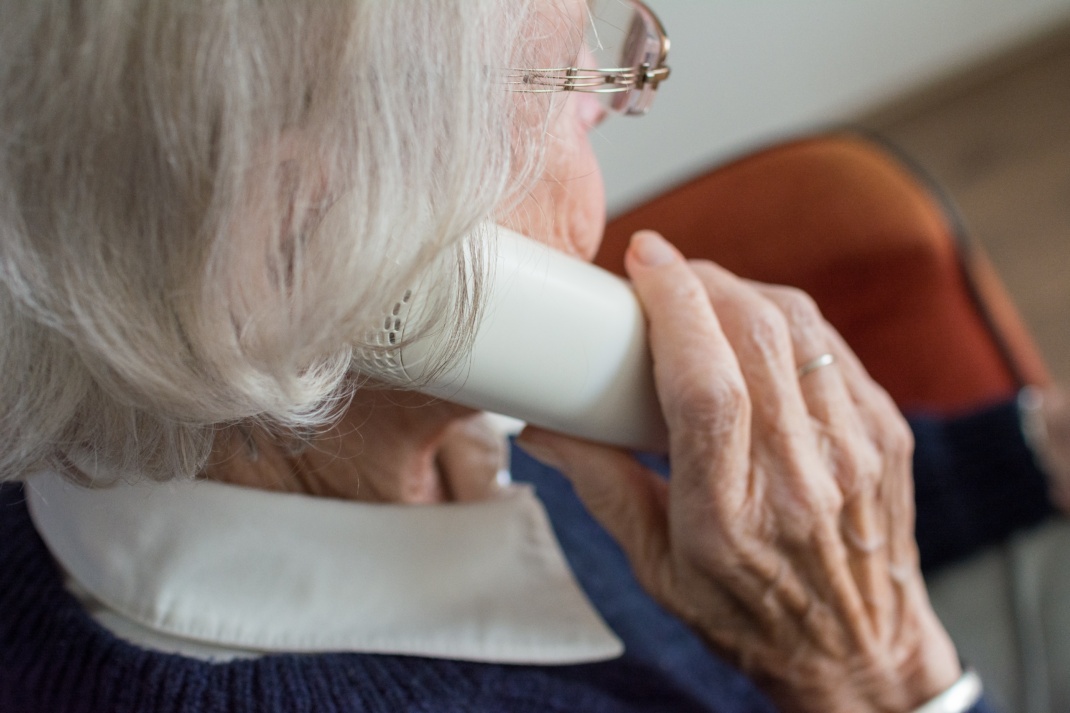
It often starts gradually. Children move to another city, friends become fewer, a partner passes away, or mobility declines. What remains are often long days with little social contact. For many older people, loneliness has now become part of everyday life. That’s how an email began that reached us after the MACHN Festival. The Leipzig-based start-up CareVoice and we had apparently missed each other, so they got in touch by email. Back in
October 2025, we spoke to Professor Riedel-Heller from Leipzig University Hospital about the challenges associated with loneliness – not just in old age – particularly the mental health and physical health issues it can cause, so the topic was not new to us.
What does CareVoice do, and how can AI help tackle loneliness in old age? We got in touch with Colin Grahm, one of the founders, and met up for a chat. Here is an extract from the email: “In Leipzig, the start-up CareVoice is working on just such a solution. The ‘hallo Helga’ telephone service is designed to ensure that older people receive regular calls and can have conversations with an AI-powered conversation partner. The aim is not to replace human contact, but to provide an additional means of conversation for times when relatives, friends or neighbours are unavailable. The idea behind it is simple: whilst smartphones, apps and video conferences present hurdles for many older people, the telephone remains a familiar medium. A phone call requires no new technology, no installation and no training.”

The Interview
Mr Grahm, you’re a web designer and co-founder of CareVoice GmbH. You offer the ‘hallo Helga’ service – who is Helga?
Helga was originally the grandmother of one of my co-founders. We’ve digitised her and made her available to older people.
Can you ring Helga if you’re feeling lonely?
The original idea was that you could ring her. However, this proved technically difficult. That’s why we now offer a service where Helga rings people. So, relatives of older people book this in advance via our online platform.
Let’s say I have a mum called Renate. I live a long way away from her and can’t visit her often; it’s also difficult to find the time to ring her, so I book through your service and say: ‘Renate should be called on x days at 6.00 pm.’ So Helga will ring, and if Renate doesn’t answer, will she try again later?
We’re currently working on that – the redial function – as it’s proved difficult with our current partners. That’s why it’s being integrated right now, but it’ll definitely be up and running within the next few weeks.
Helga is an AI, a large language model, so she calls Renate and says, ‘Hello Renate, it’s Helga here. How are you?’ Then a conversation develops as she responds to what Renate says. Is this meant to simulate personal contact?
It’s always very important to me to emphasise that we don’t want to replace anyone, either in private life or in care. We really just want to provide support and fill in the gaps that a family member is currently unable to cover due to work, children, where they live and other factors. Helga also states, when asked, that she is an AI.
Renate might well reveal a lot about herself during the conversation. She talks about what’s on her mind, what she’s doing, and a lot of data is generated, including personal data. What happens to that data?
We’re very keen to take data protection extremely seriously. Of course, you’re free to decide from the outset what you’re willing to disclose. We have this platform where the client can enter their hobbies and personal history. Naturally, everyone can decide for themselves what to include. All data then remains within the EU; we operate in compliance with the GDPR.
So the server is located in the EU; Helga is an AI chatbot based on an LLM. Is the data generated used to train an AI from OpenAI or another provider, or is it a local LLM?
It is a local model running on a server in Austria, i.e. within the EU.
Does the client receive a notification if a conversation gets out of hand – for example, if suicidal thoughts are expressed?
The original plan was for Helga to send information to the client’s relatives. However, this isn’t feasible for data protection reasons. What we’re working on now is ensuring that the client receives a WhatsApp message or text message, perhaps saying something like: ‘There’s a problem; please check on them in person.’
Have you already tested the system with potential participants?
Helga has already been tested by a number of older people. We’ve taken the testing to the extreme ourselves and simulated the craziest scenarios.
When is the whole thing due to launch?
We’re live and anyone can use Helga. However, the internal testing phase for our proof of concept is still ongoing. We’re testing how the product is being received by the market.
Naturally, the whole thing costs the client money – how is this billed?
It’s a flexible subscription model; you can book it daily, several times a week, weekly or at any other frequency. You can find the prices on our website.
Mr Grahm, thank you for the interview.
The question posed in the headline – ‘Can AI help with loneliness in old age?’ – still cannot be answered definitively, even after this conversation. The chatbot ‘hallo Helga’ is an attempt to make loneliness a little more bearable for older people. Used sparingly, with just a few conversations, when personal contact is truly impossible, the ‘virtual conversation partner’ can, in my view, be helpful. However, if ‘hello Helga’ is used to completely replace personal contact – which is not the intention of its founders – then I view this critically.
I will be contacting Professor Riedel-Heller on this matter, seeking her expert opinion, and reporting back.
Empfohlen auf LZ


So können Sie die Berichterstattung der Leipziger Zeitung unterstützen:




There is one comment