Dieser Artikel ist auch in deutscher Sprache verfügbar: Zum deutschen Artikel.
It’s actually high time that Leipzig’s waterworks finally stopped whingeing that the people of Leipzig use so little water – compared with the national average. In its latest annual report, however, the waterworks have done it again, even though they have posted a healthy profit, which has also secured the LVB’s support from the city holding company LVV. The term ‘climate change’ certainly plays a role in the annual report.
After all, waterworks have long had to respond to the consequences of changing climatic conditions and to refurbish and adapt their facilities, many of which are over 100 years old. And that is exactly what the waterworks are doing. For a few years now, the aim has been to replace at least 1 per cent of the old pipes (which, after all, stretch for 3,621 kilometres) every year or – in the case of the sewers – to refurbish them. Every year.
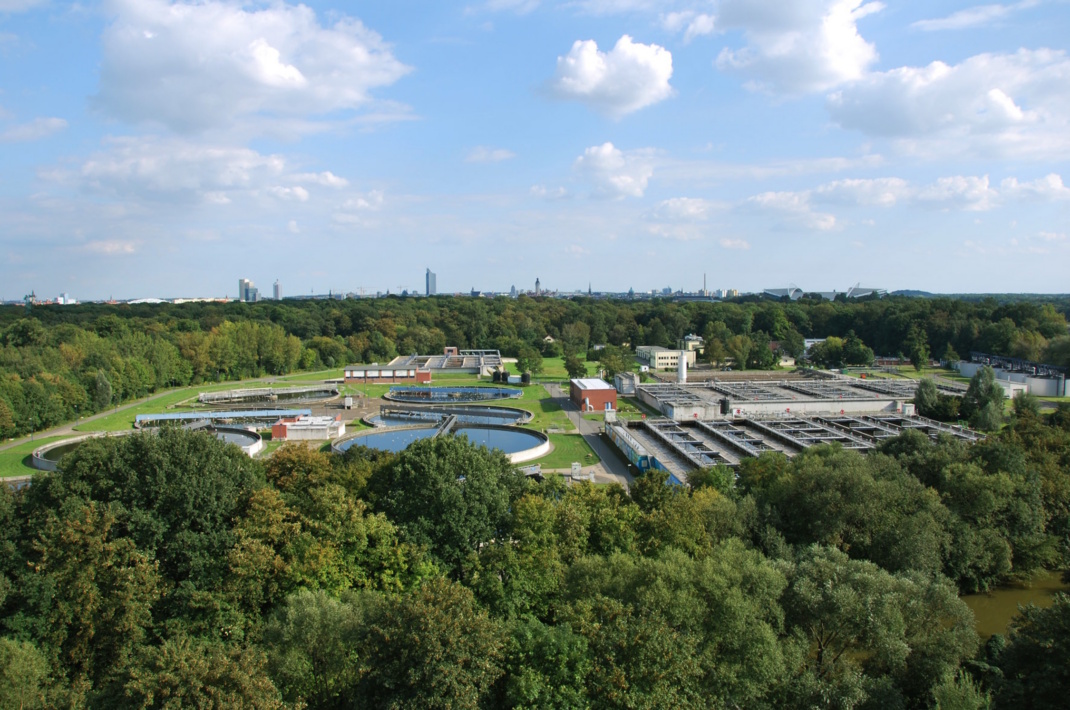
And that is not the only item of expenditure reflected in the company’s balance sheet: the sewage treatment works in Rosental are undergoing a major expansion to ensure they can continue to handle the wastewater from the still-growing city of Leipzig and its catchment area in the future, and to be prepared for heavy rainfall events.
Of the 124.7 million euros invested by the waterworks in 2025, 89.3 million euros alone were invested in the drinking water and sewerage networks. 28.7 million euros went towards plant facilities – of which 7 million went to the waterworks in Thallwitz and Canitz, which supply Leipzig’s drinking water from the Mulde region to Probstheida, €21.7 million went towards the sewage treatment works – the lion’s share of which was invested in the Rosental sewage treatment works.
Waterworks in the Face of Climate Change
But the topic of the ‘sponge city’ is also a concern for the waterworks. The report puts it as follows: “Climate change, and the associated increase in heatwaves and heavy rainfall events, are leading to an even greater focus on adapting water management infrastructure to these developments. The concept of the ‘sponge city’ as a response to these changing conditions will continue to gain in importance.”
These are the sort of statements that belong in the ‘sponge phrases’ section. Unfortunately, it doesn’t get any more specific than that. But the waterworks, too, must do their bit to retain more of the precious rainwater within the urban area. And at the same time, the sewers must be managed in such a way that they can cope with the volumes of water from heavy rainfall without the sewage treatment plant in Rosental being immediately flooded. This is a form of control that has never been necessary in the 120-year history of Leipzig’s waterworks. It is only today’s extreme weather conditions that are making it essential.
Increased drinking water consumption
But what about the drinking water consumption of Leipzig’s residents? Are they not washing enough?
Probably not. After all, Leipzig Waterworks supplied 33.3 million cubic metres of drinking water last year, 25 million cubic metres of which went to the general public and small businesses, and 4.3 million to industry and agriculture. The original forecast had been for just 32.8 million cubic metres. This means that, on average, the people of Leipzig have actually consumed even more drinking water.
From the company’s perspective, however, this is still somehow not enough: “In 1993, per capita daily consumption in the supply area was still 115 litres. Compared with the German national average of 123 litres per person per day for 2025, as determined by the Federal Association of the Energy and Water Industry (BDEW) (BDEW),
consumption in the waterworks’ supply area – at 96 litres per inhabitant per day – is 22 per cent lower than the national
average. Average consumption has risen for the second year running compared with the previous year. The increase amounts to three litres per person per day, although this figure is partly influenced by statistical effects.”
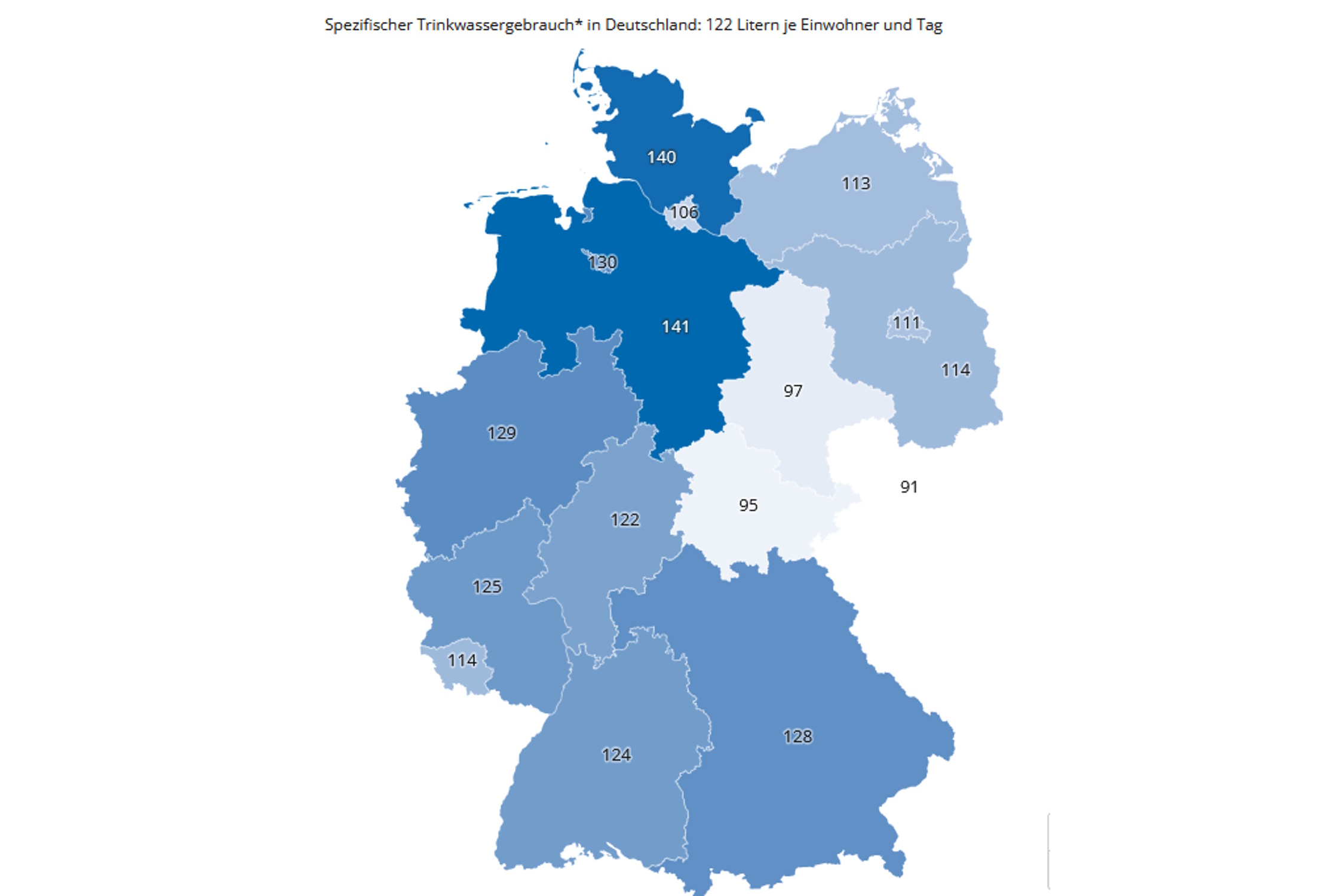
Average water consumption by federal state per capita per day in 2023. Map: BDEW
A look at the BDEW’s breakdown of water consumption by federal state, based on 2023 data, shows that Leipzig is no exception – at least within the federal states of Saxony, Thuringia and Saxony-Anhalt. All of them have per capita consumption well below 100 litres per day. Brandenburg, Berlin and Mecklenburg-Western Pomerania are also significantly below the national average. This at least suggests that drinking water consumption is simply a question of money and that most East Germans are, for good reasons, as economical as possible in their water use.
The impact of heat and drought
However, it is not just statistical effects that have caused water consumption in Leipzig to rise since 2020. The weather is now also making the work of the water utilities more difficult to predict. The annual report puts it as follows: “Over the past five years, the sharp increase in drought has also very clearly demonstrated just how heavily water supply actually depends on the weather. This fact, combined with rising peaks in consumption, is affecting the utilisation of the waterworks’ technical facilities.”
The increasing periods of heat and drought are therefore causing water consumption to rise significantly in Leipzig as well. And, logically, this also brings the waterworks higher turnover, as they are able to sell more drinking water. Although they had budgeted for 225 million euros, provisions of 25 million euros set aside to cover potential revenue risks have weighed on the result. Consequently, the figure stood at just 209 million euros, down from almost 214 million euros the previous year.
However, this does not alter the fact that Leipzig’s waterworks sold half a million cubic metres more drinking water than in the previous year. And that is the key factor which has ensured that the company’s profit also remained high – the forecast was for 32.2 million euros, but the actual figure came to 37.3 million. Admittedly, this is slightly less than in 2024, when the figure stood at 39.5 million euros.
But rising drinking water consumption simply means that the waterworks have to pump more water from the wells. It is a double-edged sword, as demonstrated not only in 2026 but also by the low water levels in rivers and the falling groundwater table. Water is becoming an increasingly scarce resource. Worldwide, as Mojib Latif describes in his latest book, *Water*. The only new development is that Central European regions, which had not previously experienced this problem, are now also increasingly affected by water scarcity.
It seems likely that Leipzig’s waterworks will eventually have to revise their assessment of what appears to be excessively low water consumption in Leipzig.
Empfohlen auf LZ


So können Sie die Berichterstattung der Leipziger Zeitung unterstützen:




There is one comment