Dieser Artikel ist auch in deutscher Sprache verfügbar: Zum deutschen Artikel.
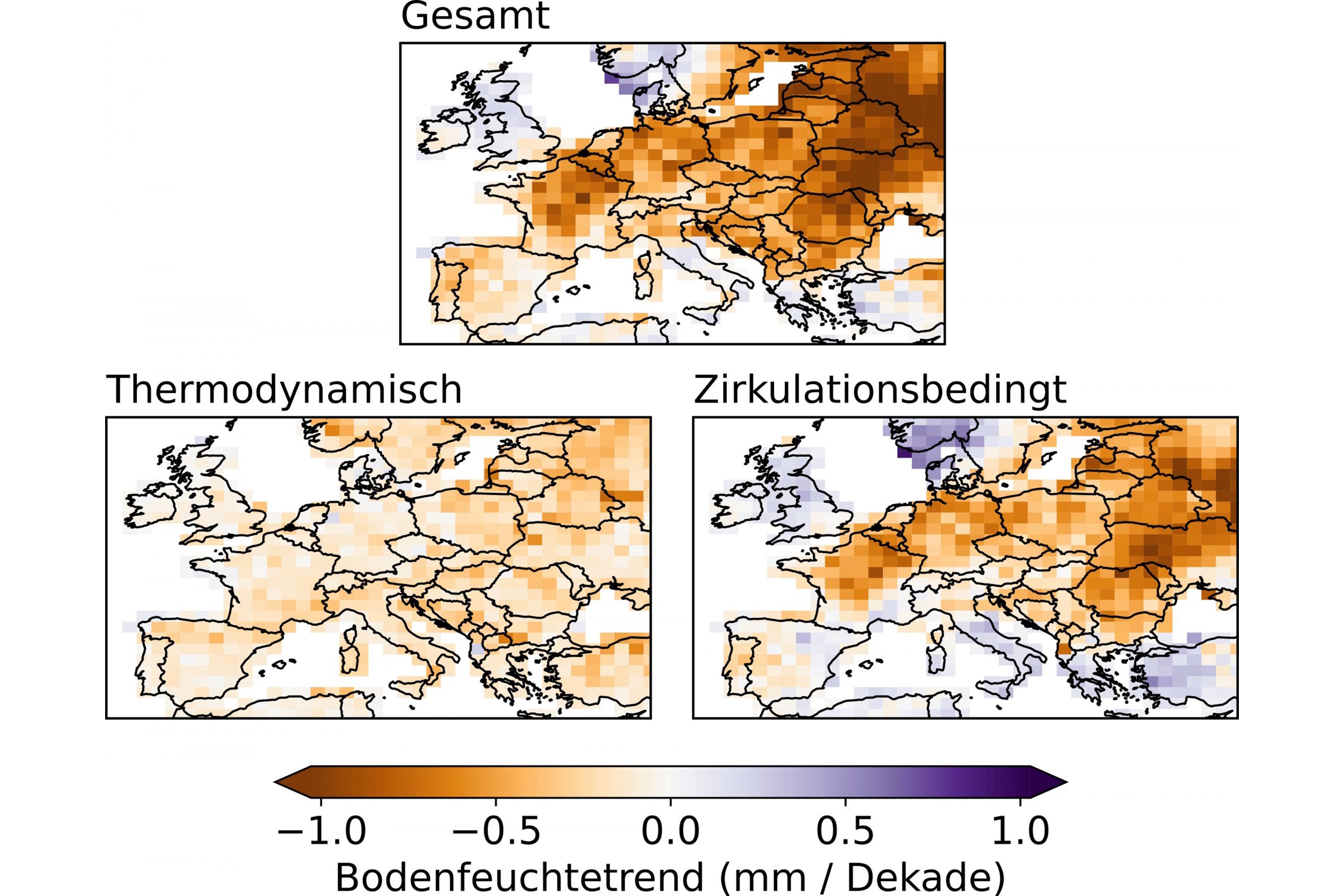
In a new study, researchers at the University of Leipzig have investigated the causes of the above-average summer soil drying and rising temperatures in Europe. They found that these are largely due to a change in circulation patterns: These are changes in typical weather patterns, which account for around 55 per cent of the summer drought trend. Specifically, they involve more frequent and persistent high-pressure systems, which have led to less rainfall due to dry weather.
Precisely because atmospheric circulation plays such a major role in this drying out, future developments are subject to a high degree of uncertainty, says the study’s lead author, Dr István Dunkl from the Institute of Meteorology at the University of Leipzig. The study has just been published in the specialist journal *Nature Geoscience*.
The Climate Attribution research group at the University of Leipzig investigates the extent to which climate change has influenced specific climate events.
“In this study, we focused on Europe, as this is one of the regions with the strongest observed warming trends. Among other things, the frequency and intensity of summer heatwaves and droughts have increased significantly in recent decades,” says Assistant Professor Dr Sebastian Sippel from the Institute of Meteorology, who also contributed to the study. This increasing soil dryness has, amongst other things, significant consequences for crop yields, water availability and energy production.
“We have also found that the impact of climate change on European soil moisture varies from year to year: particularly in summers with little rainfall, the reducing effect of climate change on soil moisture is especially pronounced,” explains Dunkl. This is because, whilst total rainfall is decreasing, extreme rainfall events are becoming more intense.
This somewhat offsets the drying out in generally wetter years, as a larger proportion of the rainfall comes from extreme events. Whether the drought will continue to worsen in the future or be temporarily reversed depends, according to Dunkl, on whether the change in circulation is driven by climate change or stems from natural climate variability. This remains largely unclear at present.
Causes of rising temperatures and drought not yet fully understood
According to the researchers, the causes of the above-average rise in summer temperatures and drought are not yet fully understood. On the one hand, they believe it is a direct consequence of climate change: the increased concentration of atmospheric carbon dioxide has altered the Earth’s energy balance, and the resulting rise in temperatures has led to greater soil desiccation.
On the other hand, wet or dry summers arise from variability in atmospheric circulation – that is, the large-scale interaction between areas of high and low pressure. Over the past few decades, this pattern has changed across Europe: There are more and longer-lasting summer high-pressure systems, which bring stable, dry and hot weather, and fewer low-pressure systems that bring rain.
“This change in atmospheric circulation contributes significantly to summer drought, as our study has shown. The associated scientific problem entails a very high degree of uncertainty regarding projections of drought in Europe: whilst the mechanisms behind the direct effects of global warming are understood, there is still considerable uncertainty about the causes of the change in circulation,” explains Dr Dunkl.
In their study, the researchers focused precisely on this point and quantified the extent to which the direct effects and the circulation are responsible for drought trends in Europe, and exactly how these two effects alter the water balance in Europe.
To date, observational studies have only been able to show that drought and altered weather patterns occur together, without proving the causal contribution of circulation, whilst climate models have been unable to reproduce the observed European circulation trends. The work by the Leipzig-based scientists now fills this gap by incorporating the observed changes in circulation into a climate model, thereby quantifying, for the first time, the causal link between changes in circulation and drought trends.
New studies on the link between climate change and the risk of forest fires
These new findings will help to better pinpoint the risk of drought, says Dunkl. Drought-related damage in Europe amounts to an average of around nine billion euros annually, and is significantly higher across the Mediterranean region as a whole. The study shows that dynamic and thermodynamic processes must be considered together in order to interpret past trends and assess future risk.
The new Leipzig study provides a basis for evaluating climate projections and assessing their uncertainty, as well as for developing robust adaptation strategies for an increasingly arid Europe.
However, another very important aspect of trends in heatwaves and drought has so far been little researched: the influence of various aspects of biodiversity on heat and drought, and their potential role as a buffer against climate change. The Leipzig-based scientists aim to investigate these aspects as part of a larger collaborative project for which a grant application has been submitted.
Meteorologists at the University of Leipzig are currently working on three studies examining the link between climate change and the risk of forest fires. Among other things, they are focusing on the fires in Spain and Portugal in the summer of 2025.
Publication in *Nature Geoscience*: “European summer drying largely driven by atmospheric circulation changes since the 1980s”
Empfohlen auf LZ


So können Sie die Berichterstattung der Leipziger Zeitung unterstützen:




There is one comment