Dieser Artikel ist auch in deutscher Sprache verfügbar: Zum deutschen Artikel.
Democracy does not thrive on everyone holding the same opinion. Democracy thrives on different opinions being tolerated, discussed and resolved peacefully. The debate over the right course of action is as much a part of democracy as the election itself.
But democracy is at risk when more and more people feel that politics no longer treats them honestly, that responsibility is being shirked, and that different standards apply to citizens than to those who hold power and office.
Taken on its own, each individual incident may be just a drop in the ocean. But every drop wears away the stone. And if enough drops accumulate over the years, mistrust can turn into dangerous alienation.
The greatest threat to our democracy therefore does not lie solely with those who vote for a party such as the AfD out of protest. The greater danger lies in the fact that people who were once staunch democrats are losing their connection to democratic parties due to disappointment, a loss of trust and a sense of being politically patronised.
Not every AfD voter has always been an AfD voter. Many people change their political stance not out of conviction for radical positions, but because they lose trust in their previous political representatives. This is precisely where democrats must take action.
When political credibility is lost
One example of damaged trust is the handling of the Jens Spahn affair. During his time as Federal Minister of Health, the procurement of COVID-19 protective masks attracted considerable criticism. During the pandemic, the federal government procured billions of masks, large quantities of which were later left unused. The investigation into these events continues to occupy politicians and the public to this day. Critics accuse Spahn and his ministry of errors in planning, oversight and procurement.
The debate surrounding Spahn’s personal decision to use a surrogate mother also highlights a problem that many citizens perceive as a double standard. The criticism is not directed at his personal life choice, but at the perceived contradiction between political positions he previously held and his own actions.
Politicians are allowed to change their minds. That is what democracy is all about. But they must explain why they are changing their stance. Credibility does not come from never making mistakes – credibility comes from honesty, accountability and transparency.
Three examples that have damaged trust
Every government must be able to admit to mistakes. Yet when citizens get the impression that problems are being downplayed or only addressed after massive public pressure, frustration arises.
First example: the procurement of coronavirus masks.
The pandemic was an exceptional situation. Decisions had to be made quickly. That explains some things, but it does not excuse everything. The subsequent debate about costs running into billions, surplus masks and the question of political accountability became, for many people, a symbol of the fact that the state does not always handle taxpayers’ money with sufficient care.
Second example: Dealing with political promises and decisions
Many citizens increasingly perceive politics as contradictory: clear statements are made before elections, but after elections these statements are qualified or altered. Change is part of politics, but it requires explanation. Anyone who gives the impression that promises are merely a means to an end loses trust.
Third example: Dealing with criticism and protest
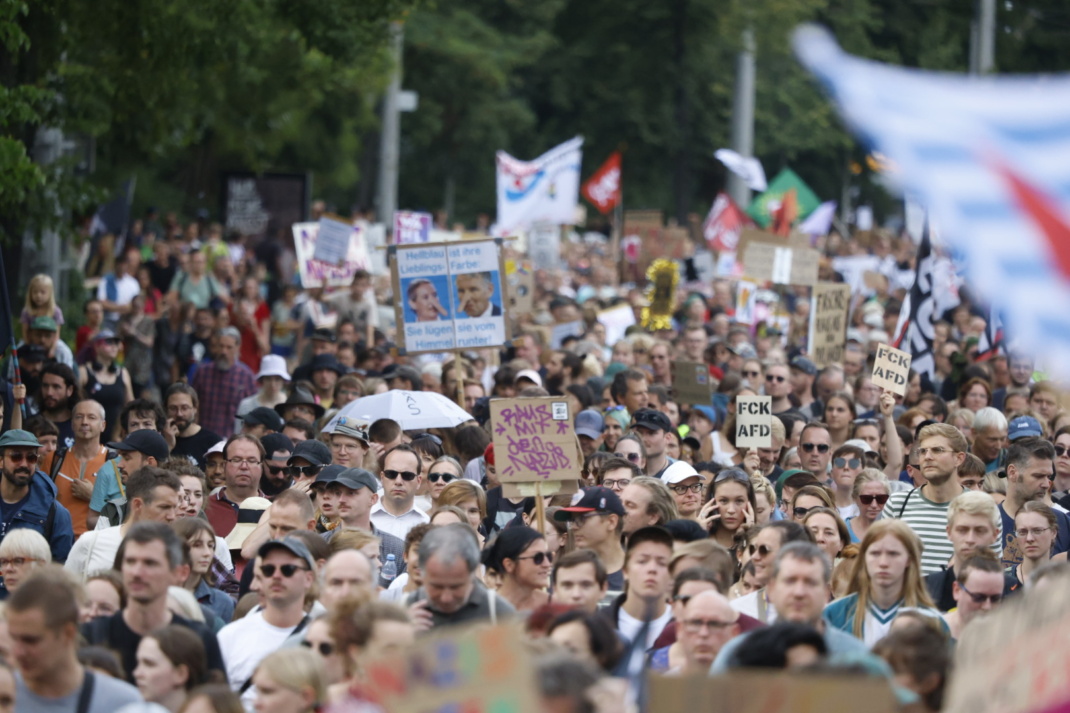
A democracy must be able to withstand demonstrations – even those that are uncomfortable. The fundamental right to peacefully express one’s views on the streets is a cornerstone of our liberal order.
The fountain in the courtyard of St Nicholas’ Church in Leipzig commemorates the Peaceful Revolution of 1989; with its overflowing granite basin, it symbolises the growing discontent among citizens, where ‘every drop made the barrel overflow’.
The Peaceful Revolution of 1989 in the GDR impressively demonstrated the power citizens can unleash when they raise their voices. At that time, people chanted ‘We are the people’ and demanded political change. A government that claimed everything was being done ‘for the good of the people’ ultimately lost the trust of those very people.
The lesson to be learnt from this must be: criticism of the government is not an attack on democracy. Criticism is an integral part of democracy.
Have we lost the ability to tolerate those who think differently?
The increasing harshness of political debates is a cause for concern for many people. Demonstrations are more readily viewed as a threat, political opponents are more readily vilified, and, increasingly, it seems that it is no longer the argument that counts, but rather which camp one belongs to.
Yet democracy does not mean that only one’s own opinion needs to be protected. Democracy means also tolerating the views of those who think differently.
This does not mean accepting hatred, violence or anti-constitutional behaviour.
But it does mean distinguishing between dangerous attacks on democracy and legitimate political criticism.
A society that expects nothing but agreement loses its democratic strength.
The ballot box must not become the final resting place of a lost democracy!
Today, democrats are right to say: Go and vote. Use your vote. Fight for democracy.
But elections alone are not enough. Democracy also thrives on the behaviour of those who are elected. Those who demand trust must earn it.
The ballot box can be a powerful tool for democratic renewal.
However, the ballot box must never become the last place where citizens try to express their frustration because they no longer felt their voices were being heard beforehand.
History shows that governments do not fail solely because of economic problems or external crises. They often fail because people no longer believe in them.
The GDR did not collapse because people suddenly turned against it. It collapsed because more and more people no longer believed the state’s promises.
And what of the Federal Republic of Germany today? Democracy therefore does not need perfect politicians. It needs honest politicians.
It needs people in positions of responsibility who admit their mistakes rather than hiding them. It needs politicians who do not just talk about the people, but listen to them.
Every citizen bears responsibility!
Because looking the other way is not an option!
Because every little bit counts.
Every loss of trust counts.
And every step that pushes people out of the heart of democracy can have consequences that no one can control any longer.
The best defence against the loss of democracy is not exclusion. The best defence is more democracy: more honesty, more responsibility and more respect for the citizen.
Empfohlen auf LZ


So können Sie die Berichterstattung der Leipziger Zeitung unterstützen:





There is one comment