Dieser Artikel ist auch in deutscher Sprache verfügbar: Zum deutschen Artikel.
It will be a masterstroke if the city and the city council actually manage to pass the new two-year budget for 2027/2028 on 17 December 2026. The city council itself has set this ambitious deadline. For if it doesn’t go to plan, the budget vote will fall right in the middle of the 2027 mayoral election campaign. And then, according to Torsten Bonew, the councillor responsible for finance, it could well be that there is no approved budget at all in 2027. Even so, the draft budget is no mean feat.
On Wednesday 2 September, Mayor Burkhard Jung, Finance Councillor Torsten Bonew and Administrative Councillor Ulrich Hörning presented it jointly. This is because the draft also involves drastic cost-cutting measures in the city budget, to ensure that Leipzig incurs as little debt as possible. This includes 500 posts that Ulrich Hörning intends to ‘cut’. He has already managed to cut 200 by simply scrapping that number of vacant posts. Tasks are being redistributed and job profiles redefined.
In the city’s own words, it sounds like this: “Even under the most difficult economic and fiscal conditions, the City of Leipzig will continue to invest heavily in infrastructure and education. The 2027/28 biennial budget provides for annual investments totalling more than 330 million euros.
At the same time, the city is launching a budget restructuring plan. However, the City of Leipzig has little influence over the largest item of expenditure – rapidly rising social expenditure (from 452 million in 2020 to 772 million euros in 2025). Without fundamental reforms at federal level, a structural recovery of local government finances in Germany is hardly realistic.”
How the federal government is overburdening local authorities
A clear statement. In Leipzig, it is well understood that the budget is not spiralling out of control due to recklessness, but because federal legislation is shifting more and more mandatory tasks onto local authorities without providing adequate funding for these services. The result: social expenditure in particular – from care costs to child-rearing support – is spiralling out of control.
And care costs are set to really hit local authorities hard. This is because the elderly people who now need a care place rarely have a pension that covers the monthly costs, which currently stand at 3,000 euros. This means that the social welfare office must then cover these costs. Burkhard Jung notes that between 2019 and 2025, this cost category alone has risen from 19 to 55 million euros.
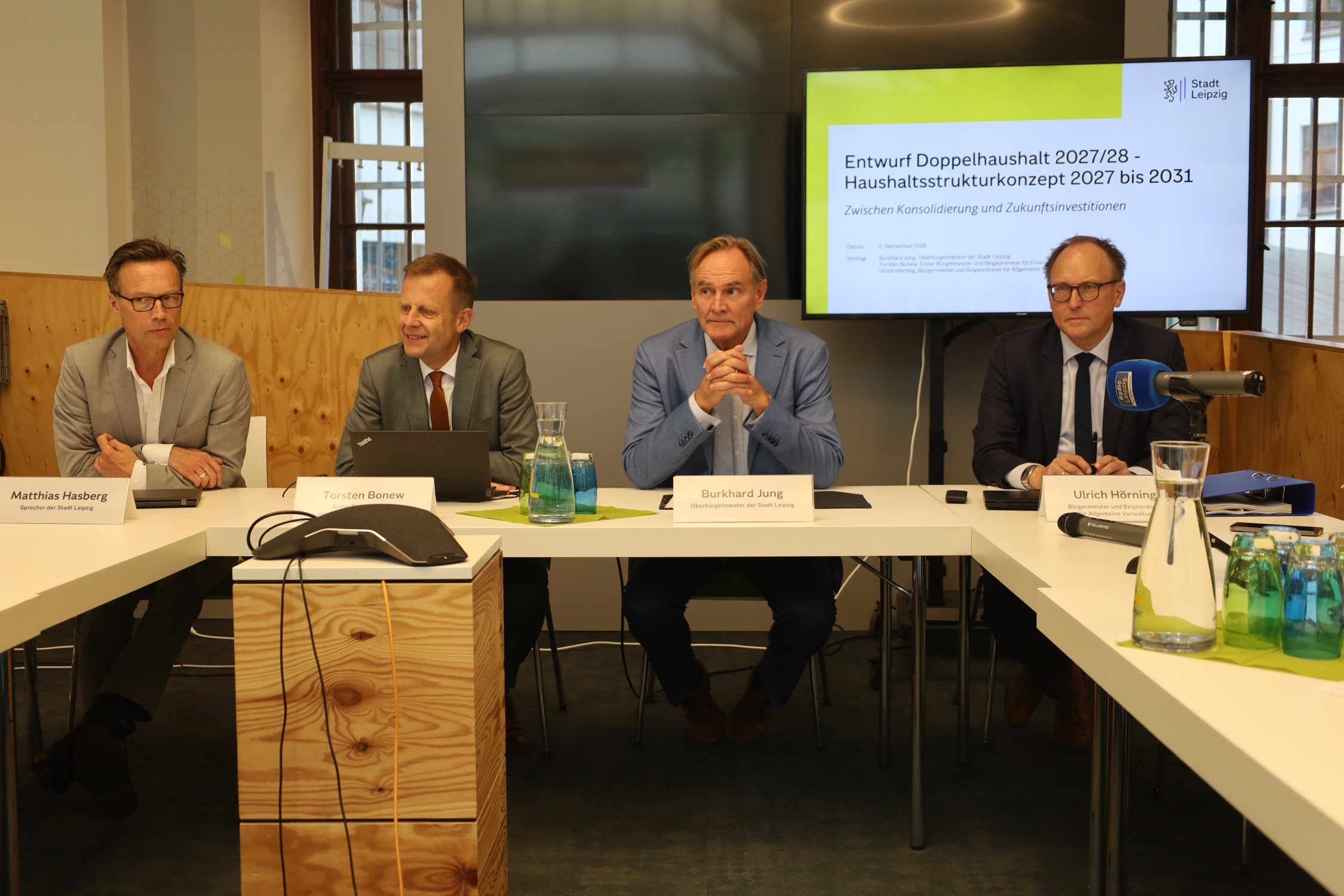
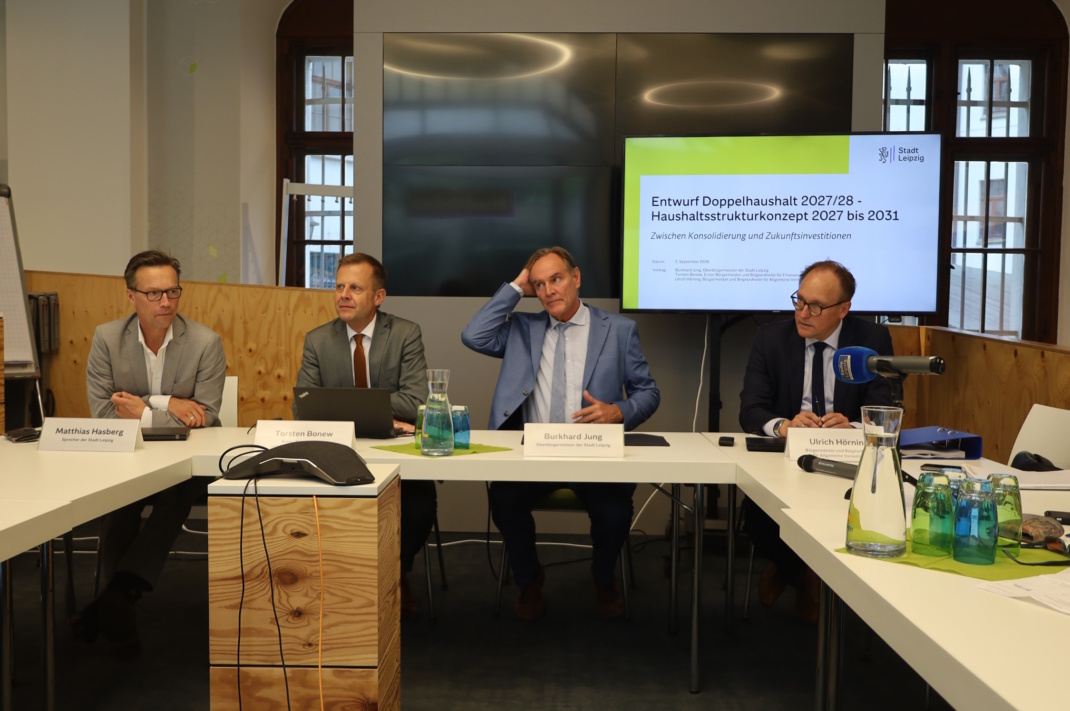
Press spokesperson Matthias Hasberg, Finance Mayor Torsten Bonew, Mayor Burkhard Jung and Administrative Mayor Ulrich Hörning on 2 September at the budget press conference. Photo: Ralf Julke
He also quotes, with good reason, Article 28 of the Basic Law
, which actually obliges the federal government to provide local authorities with sufficient funding to enable them to fulfil all their duties. In plain language, this means that the federal government’s legislation contravenes the Basic Law. According to Jung, several towns have therefore lodged appeals with the Federal Constitutional Court. The outcome is still uncertain.
New debt despite consolidation
The key figures: The city expects annual revenue of around 2.9 billion euros in the next two-year budget cycle, whilst expenditure is estimated at just over three billion euros. This results in a deficit of 148.3 (2027) and 183.7 million euros (2028). Despite strict budgetary consolidation amounting to 96.5 million euros next year and 105.9 million euros in 2028, the city’s debt will rise to 2.4 billion (2027) and 2.7 billion euros (2028).
Social expenditure has long been the largest item in Leipzig’s budget. “And we have no way of influencing this expenditure in any way,” says Jung. And it is precisely this trend that has led to Leipzig’s budgets slipping into deficit from 2024 onwards. In 2023, we still had a balanced budget, according to Jung.
Then the additional expenditure took its toll, which could no longer be offset by the city’s revenue. Leipzig’s debt rose to 1 billion euros, and has since reached 1.4 billion. Torsten Bonew calculates that by the end of 2026, it will likely be 2 billion. And in 2029, the 3-billion mark will probably be breached.
This is why the city has been working for the past two years to cut costs in some way and make savings across all departments. The aim is to save 100 million euros a year. “Which, of course, won’t be enough to make up the deficit,” says Burkhard Jung. After all, that now stands at 300 million euros.
Perhaps digitalisation will help
And so the two-year budget is also accompanied by a budget restructuring plan. “Among other things, this envisages lower expenditure on refugee support and continued stable funding for clubs and associations,” the city emphasises. “Advancing digitalisation offers opportunities for further savings – the next milestone is the expansion of the BundID into a digital wallet from 2027. A new ‘Property Tax C’ for undeveloped but buildable plots is expected to generate revenue of around seven million euros; the planned increase in parental contributions for childcare will ease the strain on the budget by a further nine million euros or so and create room for manoeuvre in the children and youth budget.”
Were it not for the desire of some council groups not to increase parental contributions to childcare centres in particular.
Jung and Bonew do assume that the draft budget will receive the approval of the council majority. However, some items are bound to be the subject of heated debate.
“We are tackling the budget deficit with determination; we are freezing grants, cutting operational expenditure and making savings on our staff costs,” says Lord Mayor Burkhard Jung. “Nevertheless, under the current circumstances, we will not be able to balance our budget but will have to take on new debt.
Like all German cities, we are being strangled by the social expenditure that the federal government imposes on us but does not pay for. Against this backdrop, we have nevertheless presented a budget proposal which we hope will be approved. I am counting on a constructive and cooperative city council that takes the interests of the whole city’s community into account and joins us on this painful path of consolidation.”
At least the Free State is helping
It was quite clear to see how pleased the Mayor and the Councillor for Finance were that something resembling a predictable budget had emerged at all. And this despite the fact that the federal government has no intention whatsoever of putting an end to the funding shortfall. The Chancellor and the Finance Minister do understand the cities’ concerns, says Jung, speaking as President of the German Association of Cities.
But whilst the local authorities are negotiating solutions with the federal government in the special commission, various ministers are constantly introducing new laws without consultation, which further increase the burden on local authorities.
According to Torsten Bonew, what has actually helped for the time being is the goodwill shown by the Free State, which was prepared for the first time to take on new debt of 1.5 billion euros in the next biennial budget, the majority of which will benefit the local authorities. Or, to put it more accurately: this helps to alleviate the burden of new debt somewhat. Only in this way will the expected new debt of over 300 million euros in 2027 and 2028 be reduced to 148.3 and 183.7 million euros respectively. At least according to the forecast. For the fiscal tightrope walk at federal level has now simply become unpredictable.
Hoping for an economic upturn
What gives Torsten Bonew a glimmer of hope is that the city’s revenue is not falling any further. Even trade tax revenue has stabilised at 500 million euros, a sign that Leipzig’s economy is quite robust.
“With this budget, we have managed to strike a difficult balance: on the one hand, to limit the rapidly growing debt whilst still keeping the future of our city in sight,” says Torsten Bonew, Lord Mayor and Councillor for Finance. “Despite the difficult financial situation, investment remains at the same high level. The trick in drawing up this budget was to make the painful cuts whilst still prioritising in line with the Leipzig Strategy, so that we ultimately emerge from the crisis stronger, just as we did after the Covid-19 pandemic.
We are setting clear priorities in education, infrastructure and digitalisation. We want to invest today where it is necessary, so that Leipzig remains capable of action and a great place to live tomorrow. At the same time, we are modernising the administration and also see the crisis as an opportunity.”
Now the Finance Councillor and the Mayor are hoping that the positive signs from the economy will multiply and that rising local tax revenues will help to further reduce the deficit.
But at the same time, Leipzig’s expenditure on interest is also rising – interest the city must pay on the short-term loans that Bonew has to take out to cover ever-increasing expenditure. In 2025, Leipzig spent 33 million euros on interest; by 2027, this figure will have risen to almost 72 million euros, and by 2029 to almost 90 million. So the next problem is looming: interest payments are eating up an ever-larger share of the budget, thereby creating even more debt.
And as President of the Association of German Cities, Burkhard Jung knows that almost all German local authorities are in the same boat. Leipzig is no exception. And if the federal government is not prepared to put an end to this strain on the cities, it will have dramatic consequences, as he is also well aware. For if local authorities can no longer function, democracy erodes. For it is within their local authorities that people experience democracy – or, indeed, its gradual erosion beneath mountains of debt that are slowly but surely crushing them.
Empfohlen auf LZ


So können Sie die Berichterstattung der Leipziger Zeitung unterstützen:





There is one comment