
Dieser Artikel ist auch in deutscher Sprache verfügbar: Zum deutschen Artikel.
On 28 October, the council meeting also saw that very strange CDU question regarding the appeal, in which the fact that some homeless people were spending the night in tents in Leipzig’s parks was simply described as ‘wild camping’, and fantasies of clearing them away were raised. However, following the comprehensive response from the Department for Social Affairs, the CDU group had no further questions.
Other groups, however, did. After all, there are indeed still unresolved issues regarding how to deal with homelessness in the vicinity of the city centre.
After all, the issue of homelessness – particularly near the railway station – has only really come to public attention since the very makeshift accommodation on the east side of the main station was no longer available, as a new urban development is now being built there. The city had intended to meet part of this newly apparent need by converting a former hostel on the adjacent Kurt-Schumacher-Straße into an emergency shelter for the homeless.
A project that should have been completed long ago – had the construction workers not discovered increasingly serious damage whilst inspecting the building, which is making the conversion ever more expensive and now means completion is not expected until the third quarter of 2027.
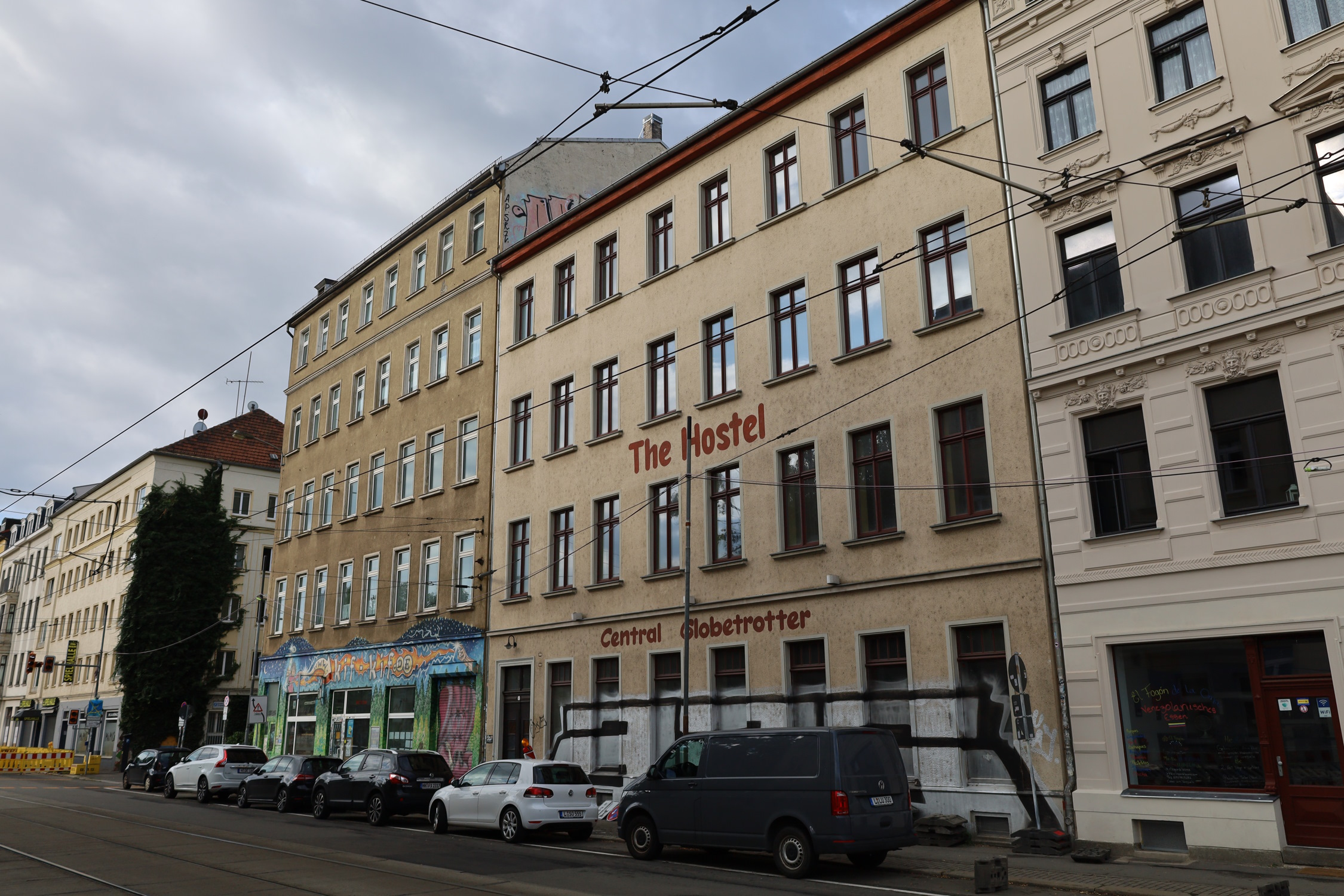
A view of the former hostel on Kurt-Schumacher-Straße, where an emergency night shelter is to be built. Photo: Ralf Julke
This is an issue raised by Green Party city councillor Katharina Krefft. And it seems it will not be an emergency shelter, as originally planned, but a regular night shelter. But where will the people go who are already avoiding the night-shelter centres? What will the city do when it gets really freezing cold outside?
And Dr Martina Münch, the councillor responsible for social affairs, also admitted: “You can freeze to death even in a tent.” Nevertheless, the city is doing everything it can to reach out to those people who are determined to spend the night in tents. That was also the question posed by Thomas Kumbernuß (Die PARTEI): Has the city taken any action since the tents appeared in the parks?
This was, admittedly, already mentioned in the response from the Social Affairs Department.
But on 28 October, Martina Münch also addressed the underlying problem. Street workers are out and about, approaching the people in the tents. However, a solution will only be possible if these people are also willing to cooperate. Only then can the city actually help to get those affected back into warm accommodation.
But the tents also reveal that some of those affected are not (or no longer) willing to return to the system. They do not make use of the city’s overnight accommodation either, according to Münch. She emphasised that there have always been vacant places in the night shelters recently.
From the city’s point of view, no one needs to sleep rough.
Invisible homelessness
But it is precisely those people now camping outdoors who also reveal a breakdown in the system. Some are no longer reachable, even by experienced street workers. They have simply become more visible. After all, they were there before, too. It’s just that they used to seek shelter mainly in derelict houses and sheds, which are disappearing more and more as the city becomes denser. This means these people have already been displaced – into public spaces, where they are now visible to everyone.
Sometimes their tents are already being cleared away, as Martina Münch explained. As happened recently in Thekla. But the street workers at least ensure that their belongings are kept safe, because that is really all they have left.
The brief Q&A session then made it clear that Leipzig is, in fact, only now beginning to see a part of homelessness that was completely invisible in previous years. And – according to Martina Münch – there is probably an even larger proportion of hidden homelessness that is not captured by the city’s official homelessness figures either.
Empfohlen auf LZ


So können Sie die Berichterstattung der Leipziger Zeitung unterstützen:





There is one comment