The whole country is facing enormous challenges and really ought to be investing heavily in climate and heat protection to make it sustainable for its people. Yet the very body that could shoulder this investment is being effectively sidelined by a fiscal policy at federal and state level that has gone completely off the rails: the local authorities. This is precisely why Saxony’s funding pot for heatwave protection is hardly being used at all. And this is now also causing concern amongst the Left Party group on Leipzig City Council. What can the city possibly still invest in heat protection?
“In recent weeks and months, people across Germany have felt the effects of climate change very keenly. Persistent drought, tropical nights and heatwaves are causing river levels to fall, forests to go up in flames and crop failures to be expected,” says the Left Party faction, describing a problem that is now obvious to everyone. The summer of 2026 clearly demonstrated the severe impact that heat and drought can have in Germany too.
“High temperatures also have a significant impact on health. Protective measures in people’s immediate living environment, such as the installation of drinking fountains or the greening of roofs and building façades, are therefore essential.”
When local authorities have no money for funding applications
And in fact, the Free State of Saxony also has a funding pot from which local authorities can draw funds for heat protection – provided they can raise their own share of the financing. It was only on 11 August that the Saxon State Ministry for Economic Affairs, Labour, Energy and Climate Protection called on local authorities to apply for the available funding for heat protection in towns and municipalities.
“This appeal is not without a certain air of irony,” says Susanne Scheidereiter, spokesperson for the environment and climate for The Left parliamentary group on Leipzig City Council. “Months ago, numerous German local authorities drew attention to their difficult financial situation. Many local authorities in Saxony cannot access the available funding because they simply lack the necessary own funds. It is unacceptable that people should suffer in the heat whilst this money ‘sits idle’ in the coffers. We urgently need reliable protection against the heat, and we need it now. We can expect the situation to worsen in the coming years – towns and local authorities must be prepared for this.”
The Left Party parliamentary group has therefore submitted a question: “How much money has been earmarked in the city’s 2027/2028 two-year budget for heat protection and climate adaptation? Are specific posts being allocated for these tasks? Which state and federal funding could not be accessed this year due to a lack of own funds?”
The answers to these and other questions must be available in time for the council meeting on 2–3 September.
1.7 million euros scraped together
In a sense, there is already an answer: The Office for Environmental Protection has submitted a proposal to the council concerning the ‘Funding of climate adaptation measures for 2026 – Specification of the budget for climate adaptation measures (VIII-HP-10223)’. A mere 1.7 million euros has been set aside for this in the budget. A drop in the ocean.
“The majority of the proposed measures relate to coping with heat,” says the Office for Environmental Protection. “In particular, schools, childcare centres and social services facilities have expressed a need for heat protection measures in view of the increasing number of hot days.
Heat protection measures are being implemented through active measures such as the purchase of shading elements – for example, sun sails and green pergolas – as well as through building-related measures such as solar control film, awnings and green facades. In addition, an awareness-raising and multiplier project is being funded for 46 local authority childcare centres.
In total, the catalogue of measures comprises 15 diverse heat protection measures funded from the budget. The implementation of these measures will better protect the following vulnerable groups against the effects of climate change: young children, schoolchildren, homeless people, people in shared accommodation and older people.”
Drinking fountains, hand-operated pumps, pilot project
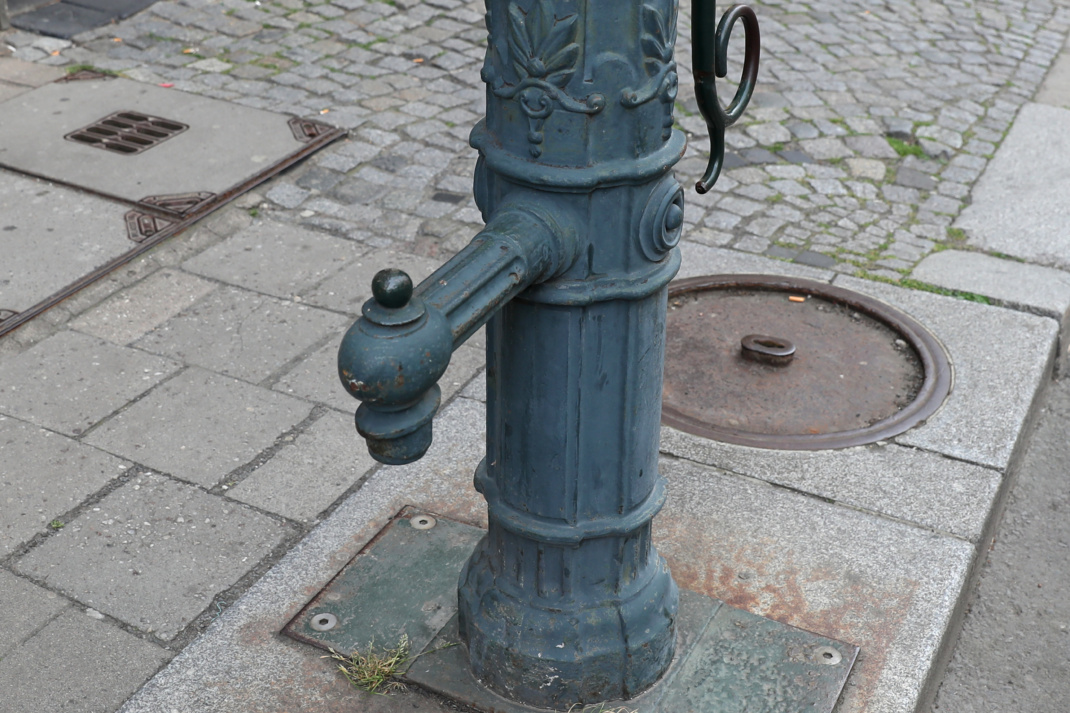
The budget also includes funding for further drinking fountains within the city limits. In addition, one historic hand-operated pump each in Gohlis and Sellerhausen is to be refurbished and restored, “so that residents can water the surrounding street trees during dry spells.”
A project on Schreberstraße will be a truly new initiative: “As part of the Schreberstraße pilot project, which is intended to serve as a showcase for the city, additional ‘sponge city’ structures based on the Stockholm model – which enable the future-proof and sustainable integration of urban trees into the street environment – are to be installed to promote climate-resilient urban design (M 9). According to the cost estimate (LPH 2), the total cost of the measure amounts to €1.18 million. Funding has already been secured. The necessary own funds will be financed proportionately from the budgets of the implementing departments and via the budget for climate adaptation measures.”
Emergency programme with limited funding
In theory, all measures are due to be implemented by 2026, but the Department for Environmental Protection anticipates that some individual measures will likely be carried over into 2027. All measures stem from the 2024 Emergency Programme for Climate Adaptation Measures and the budget-related measures of the Heat Action Plan. The list was finalised as early as May 2025, primarily with a view to feasibility and, ultimately, financial viability.
The whole initiative stems from a budget motion tabled by the Bündnis 90/Die Grünen parliamentary group in February 2025, which was adopted in March 2025. However, the necessary funds first had to be scraped together: “Following a vote in the extended Finance Committee, the city administration will have EUR 1,700,000 available in 2026 to fund climate adaptation measures. It was decided in the budget motion that the available funds should be used to finance the measures set out in the climate adaptation concept – or, as it is now known, the climate adaptation programme – in light of the considerable challenges posed by climate change.
The Climate Adaptation Programme will not be submitted to the City Council for approval until the third quarter of 2026. It would no longer be possible to implement the measures within the budget at that point, which is why this separate proposal is being put forward.”
It will be interesting to see what sums the Climate Adaptation Programme will ultimately require to prepare Leipzig for the coming heatwave. The total is likely to be significantly higher than the 1.7 million euros currently proposed.
Empfohlen auf LZ


So können Sie die Berichterstattung der Leipziger Zeitung unterstützen:





There is one comment