
Dieser Artikel ist auch in deutscher Sprache verfügbar: Zum deutschen Artikel.
The start of July brings with it a number of changes: the citizen’s income is becoming basic income support, and from today refugees no longer need a treatment voucher but will be issued with a standard health card. The City Council is holding its final session before the summer recess – and is also addressing the city’s most pressing concern: how did the mess surrounding the tram network come about…
Trams still in the stranglehold of the ‘bitumen beast’
Even on the fifth day of the tram shutdown, progress towards resuming tram services is slow. Although work to repair the damage is now being carried out round the clock with support from the public, today’s persistent rain is not making the task any easier for those on the ground. On Saturday, Leipzig’s public transport authority was forced to suspend operations on the rail network because, across the entire 150-kilometre stretch of track, a bitumen-based joint sealant had swelled due to the extreme, prolonged heat, causing the rails, points and tram undercarriages to stick together.
For days now, they have been trying to gradually rid the network of this devilish stuff – which was actually intended to prevent everyday dirt build-up – using grinders, high-pressure washers and a dry-ice process that freezes the sticky mass, causing it to crack and break away. Yet despite all the technology, the vast majority of the work is being done with scrapers, wire brushes and shovels – first in sweltering heat, and today in constant rain. The company is unwilling and unable to provide reliable forecasts.
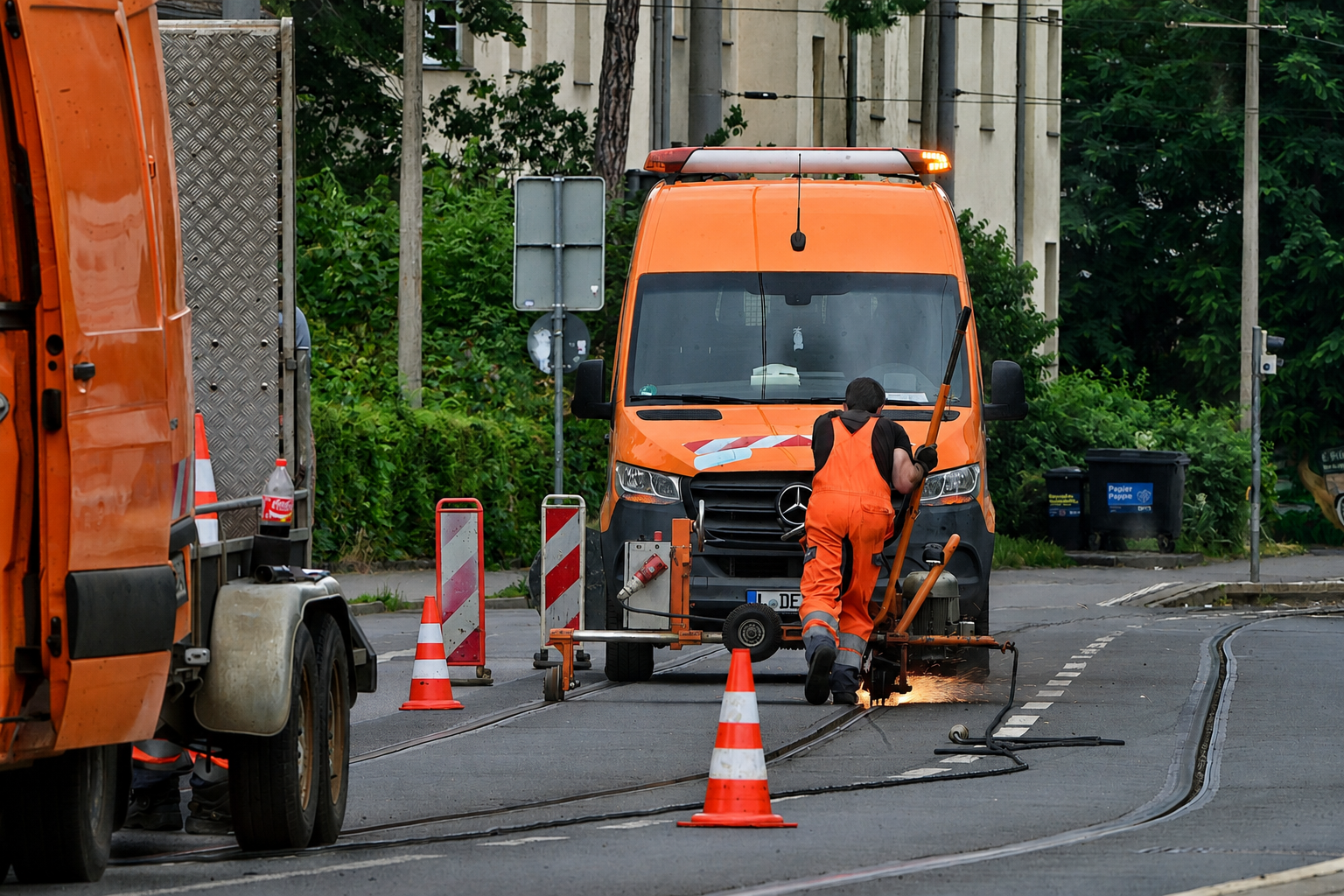
The number 11 only runs as far as Klemmstraße. Beyond that, the tracks are not yet clear. Photo: Benjamin Weinkauf
In response to an enquiry from LZ, LVB spokesperson Marc Backhaus said they hope to be able to put sections of lines 7 and 15 into service next. However, the pace of work depends not least on the capacity of staff and equipment, as well as changing weather conditions. At least the cleaning of the stuck-together running gear was completed yesterday. Experts are now to investigate why the joint sealant, after many years of reliable service, turned into a nightmare this summer. And to look for alternative solutions. According to the company, engineers are in contact with local authorities facing similar problems – and with those that have been spared such a fate.
“In any case, we must realise that climate change will have an increasingly negative impact on all infrastructure. Incidents are on the rise, even outside the rail network,” said Backhaus. Sections of lines 1 and 11 were able to resume service yesterday and the day before. Should any further sections be added, the transport authority
will announce this on its website
, via its social media channels, on the LeipzigMOVE app and on the information displays at stops.
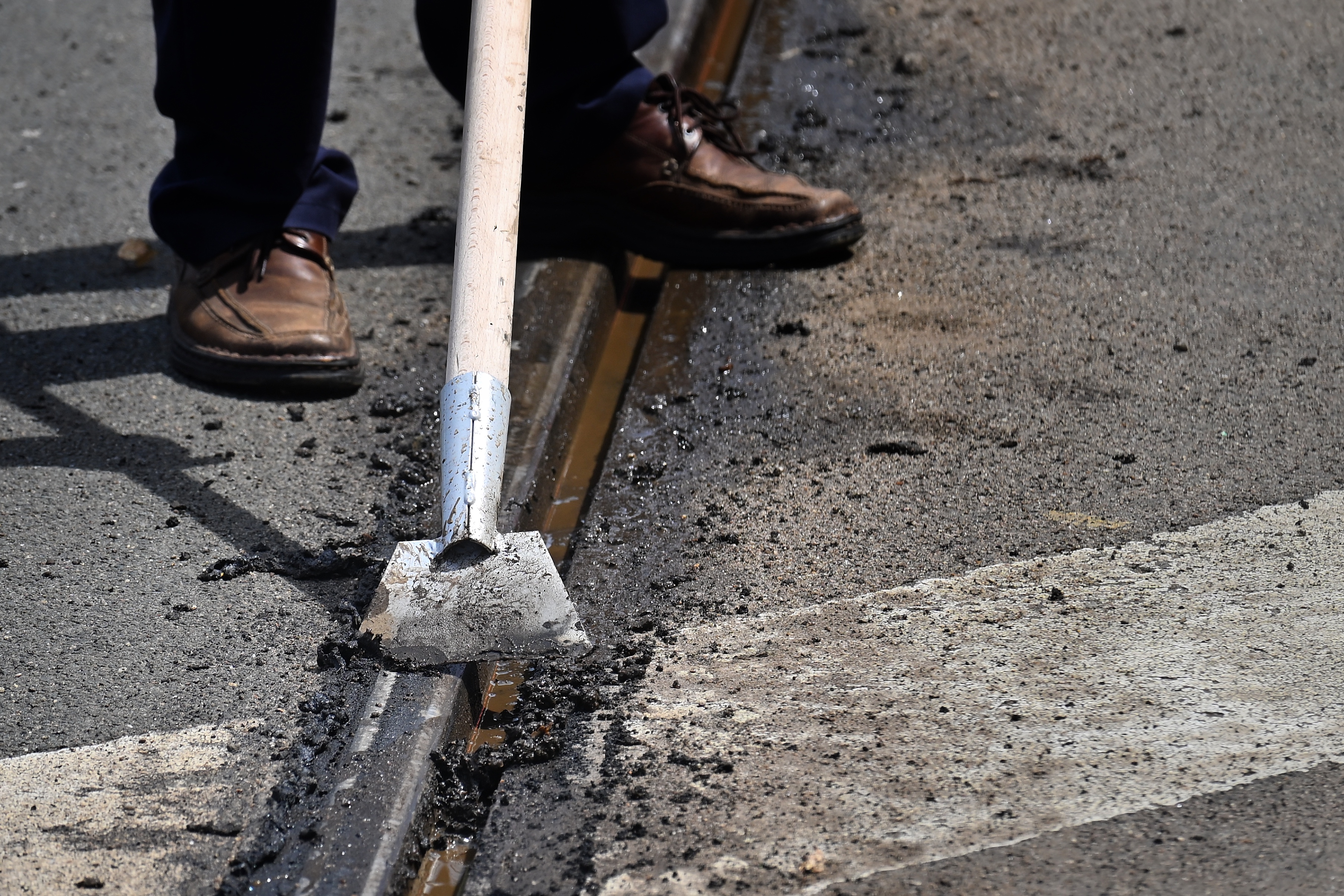
Using trowels and sheer muscle, helpers are tackling the ‘bitumen beast’. Photo: Benjamin Weinkauf
City Council meeting before the summer recess
With today’s meeting, the Leipzig City Council is taking its summer break. The City Council’s last regular meeting before the recess begins at 2 pm in the council chamber of the New Town Hall. If the deliberations cannot be concluded, the summer recess will be postponed by one day, and the meeting will then resume on Thursday 2 July 2026.
The agenda includes several proposals of significance for urban development and local government. Among other things, the City Council will discuss a motion by the CDU group to transfer vehicle registration to the citizens’ service centres. The relevant proposal states: “By gradually integrating the services of the vehicle registration office into the citizen service centres, access to these services and the efficiency with which they are provided can be significantly improved. Residents will be able to deal with their matters in one go at locations close to where they live, whilst making greater use of the existing infrastructure, appointment booking systems and staffing structures of the citizen services.”
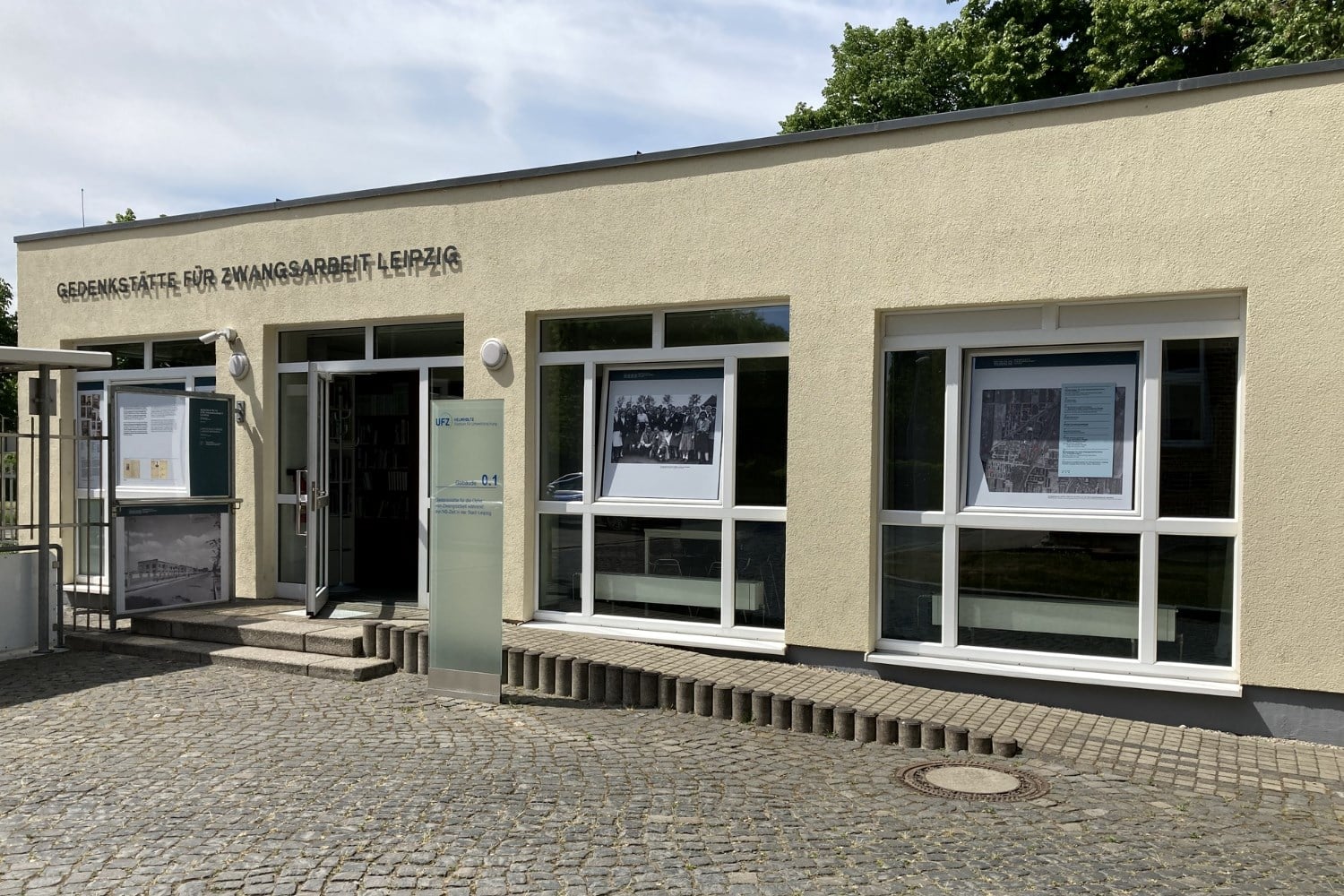
Also up for decision is a policy resolution, tabled by the Bündnis 90/Die Grünen parliamentary group, on expanding the physical capacity of the Memorial to Forced Labour in Leipzig. This is currently situated on the former HASAG site at the start of Permoserstraße and requires more space for research, education and exhibitions. The planned vote on commencing sales negotiations for the Capa-Wäldchen has been postponed until the autumn (as reported by the LZ).
Three current questions from the CDU/CSU and the BSW will address the causes and costs of the LVB chaos, supplemented by a question tabled at short notice by the Greens regarding the city’s heatwave planning.
Basic Income Support replaces Citizens’ Income today
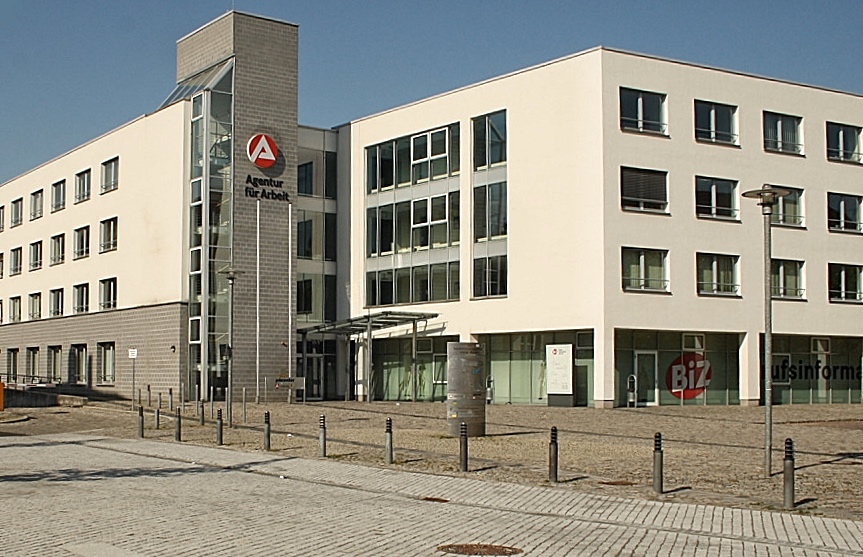
Against the backdrop of the nationwide reform of basic income support, benefit recipients in Leipzig must also adapt to new rules from today. The previous ‘Bürgergeld’ is now being replaced by basic income support for jobseekers or the basic income support allowance. For people already receiving benefits, nothing will change in the short term. No new application is required due to the changeover; existing approvals remain valid and payments will be made automatically. Only when the approval period ends will an application for renewal need to be submitted, as before.
At the same time, the consequences of breaching obligations are being tightened. Anyone who repeatedly misses agreed appointments at the jobcentre without a valid reason, or who fails to fulfil their obligations to cooperate, must expect significantly stricter benefit cuts in future. The previous grace period regarding assets has also been abolished, meaning that asset limits will be taken into account sooner. The respective Jobcentres remain responsible. The Greens and The Left have criticised the new regulations as anti-social. The AfD, on the other hand, believes they do not go far enough. A corresponding amendment tabled by the party was rejected in the Bundestag.
Those affected can obtain help and advice in Leipzig from the Leipzig Jobcentre and, in the surrounding district, from the Leipzig District Municipal Jobcentre. In addition, social welfare organisations such as the VdK offer support with questions regarding the new legal situation. Appointments for advice at the Leipzig branch (Prager Straße) can be booked online via this link or by telephone on Mondays, Tuesdays and Thursdays from 9 am to 12 noon and from 1 pm to 4 pm on 0341 6991313.
Health card instead of treatment voucher for refugees
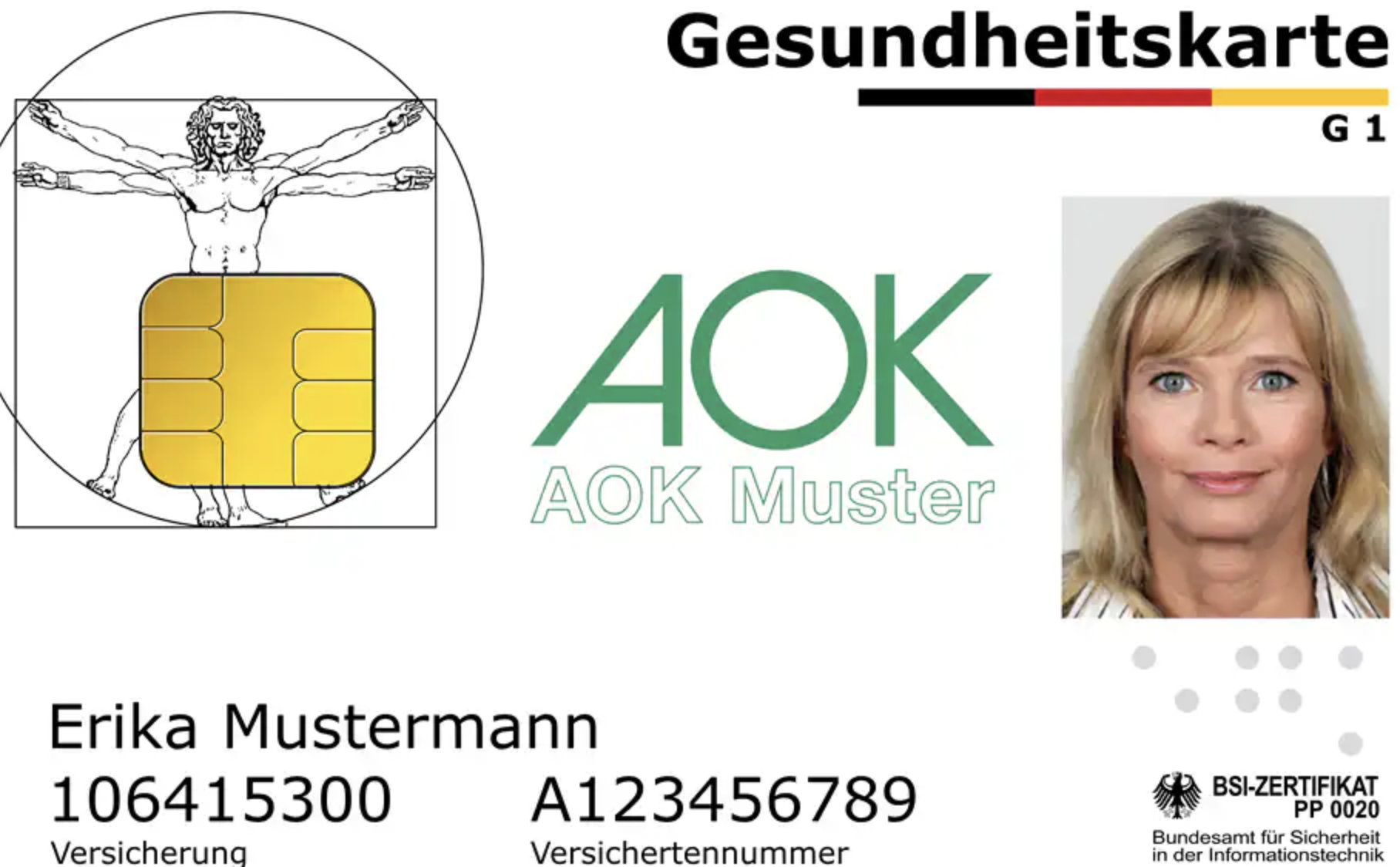
From today, refugees in Leipzig who receive benefits under the Asylum Seekers’ Benefits Act (AsylbLG) and have not yet been in Germany for 36 months will be issued with an electronic health card (eGK). The cards are issued on behalf of the local authority by the health insurance providers AOK PLUS and DAK-Gesundheit. This means that those affected will no longer need to apply for a treatment voucher from the social welfare office before seeing a doctor, as was previously required. In future, doctors’ surgeries will be able to scan the eGK just like a regular health card and bill for the treatment directly.
According to the city’s assessment, this will simplify both access to medical care and administrative procedures for those affected and for medical practices. The introduction of the card does not alter the statutory entitlement to benefits. During the first 36 months, entitlement to benefits under Sections 4 and 6 of the Asylum Seekers’ Benefits Act continues to apply. This includes, in particular, the treatment of acute illnesses and pain, services relating to pregnancy and childbirth, vaccinations in accordance with STIKO recommendations, preventive health checks for children, and certain early-detection screening tests. The eGK is not visibly identifiable as a card for refugees.
With this introduction, Leipzig is implementing a project that was first initiated in 2015/2016 but failed at the time due to legal and organisational hurdles between the local authority, the State of Saxony and the health insurance funds. According to estimates, the change affects around 1,800 refugees in Leipzig. Applications for the health card are made at the social welfare office; the required passport photo can be uploaded online via this help page.
Empfohlen auf LZ


So können Sie die Berichterstattung der Leipziger Zeitung unterstützen:




There is one comment