Dieser Artikel ist auch in deutscher Sprache verfügbar: Zum deutschen Artikel.
The scorching summer of 2026 will increasingly influence decisions taken by Leipzig City Council. For one thing is already certain: it won’t get any cooler, as SPD city councillor Marius Wittwer said when he tabled an SPD motion to include the issue of heat protection in two school-building proposals. The two proposals are, in fact, very much a long way off, as the Brüder-Grimm-Schule on Goldsternstraße and the Hans-Kroch-Schule on Jörg-Schmidtchen-Weg are due to undergo comprehensive refurbishment between 2030 and 2032.
Both are prefabricated buildings from the 1970s, which have not yet been renovated or have only been partially renovated. The renovation of the Brüder-Grimm-Schule
is expected to cost 17 million euros, and that of the
21.7 million euros.
Pupils will move to temporary premises whilst the work is underway. And it is not just the lack of accessibility that is already causing problems. The proposals at least suggest that the issue of climate protection will also play a role here.
In the case of the Brüder-Grimm-Schule, for example, it reads as follows: “Furthermore, climate protection measures will be taken into account during the preparation of the preliminary design. In particular, the measures adopted as part of the immediate action programme on the climate emergency, which can actively contribute to climate protection, will be examined. Possible options include, for example, green facades, green roofs and photovoltaic systems. The planning results will be presented in the proposal for the building resolution.
The school building will also be made accessible. The installation of a lift, as well as the inclusion of a necessary connecting passageway in the plans, will enable barrier-free access to the site. Furthermore, accessibility standards (wayfinding systems, disabled toilets) etc. will be implemented in the planning.
The building standards for school buildings in the City of Leipzig are routinely taken into account in the planning. In addition to the energy-efficiency upgrades to the building envelope (windows, external sun protection, façade, roof) and the building services (heating, ventilation, plumbing), the school will be fitted with modern technical equipment. This includes a building alarm system with burglar and fire detection, as well as the installation of a locking system and a public address and alarm system with bells for breaks and lessons.”
And where is the active heat protection?
But Marius Wittwer left out one word that, following the heatwave of summer 2026, really ought to feature in such proposals: heat protection.
After all, the weeks of temperatures above 30 degrees and the peak readings of 40 degrees – recorded for the first time in Leipzig in June 2026 – caused problems even in newly built schools. Passive heat protection – blinds on the windows and insulation on the walls – did not help to keep the extreme temperatures out.
Teachers and parents reported that learning conditions for the children were extremely hot, and some parents are said to have even taken portable air-conditioners into the schools to ensure slightly more bearable temperatures in the classrooms.

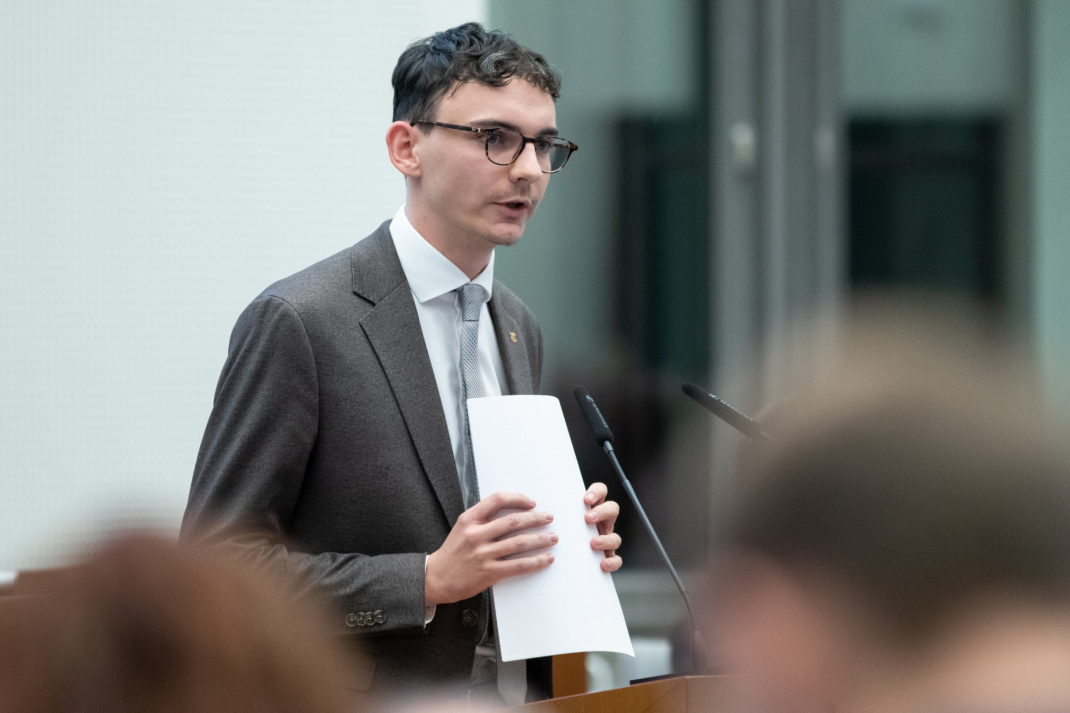
Vicki Felthaus (Alliance 90/The Greens), Councillor for Youth, Schools and Democracy, at Leipzig City Council on 28 October 2026. Photo: Jan Kaefer
According to Marius Wittwer, there is therefore an urgent need for active heat protection. And whether and how this can be implemented in schools should now be assessed as part of the two school complex refurbishment projects.
Review promised
The SPD parliamentary group’s amendment regarding the Brüder-Grimm-Schule therefore stated: “As part of the planning process, an in-depth assessment will be carried out to determine how heat protection measures can be integrated through active cooling. In particular, a two-way heat pump is to be examined as a possible addition to the heating and cooling system.
A functioning heating system is important. In future, however, the option of active cooling will become increasingly important, particularly for social institutions catering for particularly vulnerable groups. In some schools, lessons on hot days in the summer of 2026 were already put to the test; this is likely to affect more and more schools with increasing frequency.
Passive cooling, for example through insulation and shading, naturally also plays an important role. However, if temperatures remain persistently high for several days or weeks and the building cannot cool down even at night, it becomes impossible to use the premises for teaching when temperatures exceed 30°C.
As school buildings must remain in use for several decades after new construction or refurbishment, it is important to make appropriate provisions and to incorporate the option of active cooling. Retrofitting at a later date could, under certain circumstances, cost many times more than the costs incurred during a refurbishment that is already planned.”
However, according to Vicki Felthaus, the councillor responsible for schools, a heat pump would not be the solution for either school, as both are connected to the district heating network.
Solutions sought
This then boils down to air-conditioning systems in the classrooms. This raises the question, which BSW City Councillor Sascha Jecht then addressed, of whether this would not, after all, be counterproductive to climate protection. After all, it would increase electricity consumption and involve the installation of more technology.

Thomas Dienberg (Alliance 90/The Greens), Deputy Mayor for Urban Development and Construction, at the Leipzig City Council on 28 October 2026. Photo: Jan Kaefer
A valid question, as Vicki Felthaus, the councillor responsible for schools, also confirmed. But at the same time, the city administration is also in the process of considering such solutions for heat protection. After all, as a result of global warming, more and more schools are being affected by heat stress, which is also starting earlier and earlier in the year.
On the other hand, according to Thomas Dienberg, the councillor responsible for building projects, this need not place an additional burden on the climate if the systems are powered, for example, by solar panels on the roof. This is why he welcomed the proposal to have the SPD parliamentary group’s amendments examined across the board by his own Office for Building Management.
After all, if this is a way of making learning in Leipzig’s schools bearable even during heatwaves, it could well become standard practice in all refurbishment projects. He agreed to the review even without a council resolution.
So the SPD parliamentary group has, in fact, achieved its objective – even though both amendments were rejected. Perhaps it will already take effect at the two schools that received the city council’s unanimous vote on 28 October. Dienberg intends to report on this to the relevant city council committees.
Empfohlen auf LZ


So können Sie die Berichterstattung der Leipziger Zeitung unterstützen:





There is one comment