Dieser Artikel ist auch in deutscher Sprache verfügbar: Zum deutschen Artikel.
This sends an important message, and not just at a time of rising anti-Semitism: from 21 to 28 June, Leipzig will be celebrating its 17th Jewish Week, which in 2026 will be particularly marked by the ‘Tacheles’ theme year. Here, we take a look at some of the highlights of the 133 events in total, which pay tribute to Leipzig’s rich Jewish heritage.
And this community can indeed look back on a rich history, albeit one marked by disruptions: Jews were probably already living here as early as the 13th century; in the area of today’s main fire station on Goerdelerring, outside the city walls of that time, there must have been a ‘Judengasse’ (Jewish Lane).
Leipzig and the Jews: A rollercoaster ride through the city’s history
It is assumed that Jews were expelled from Leipzig in the late Middle Ages, a development which conferred a special status upon the city: for the next 250 years or more, there were effectively no Jews living in Leipzig, though they would flock through the city gates three times a year from all directions during the fair season. They were welcome or tolerated for business purposes, but their permanent settlement remained unwelcome.
This did not change until 1710, when, under a concession granted by Augustus the Strong, a Jewish family was once again permitted to live permanently in Leipzig. Even after that, a few Jews remained resident here throughout the 18th century – people, neighbours, women, men and children, about whose lives and daily routines we know almost nothing to this day. The fact remains, however, that: What was probably not a particularly noteworthy issue at the time marks, from today’s perspective, a turning point through which Jews inexorably became part of urban society. In 1814, the first Jewish cemetery opened in Johannistal, and in 1847 an officially recognised community was finally established.
Echoing Jewish names such as Ariowitsch, Harmelin and Eitingon are associated with the eastern part of the Brühl (known in the vernacular at the time as ‘Judenbrühl’), which became synonymous with the international fur trade. Leipzig’s economic standing would be almost inconceivable here without the contribution of Jewish merchants.
A varied programme awaits
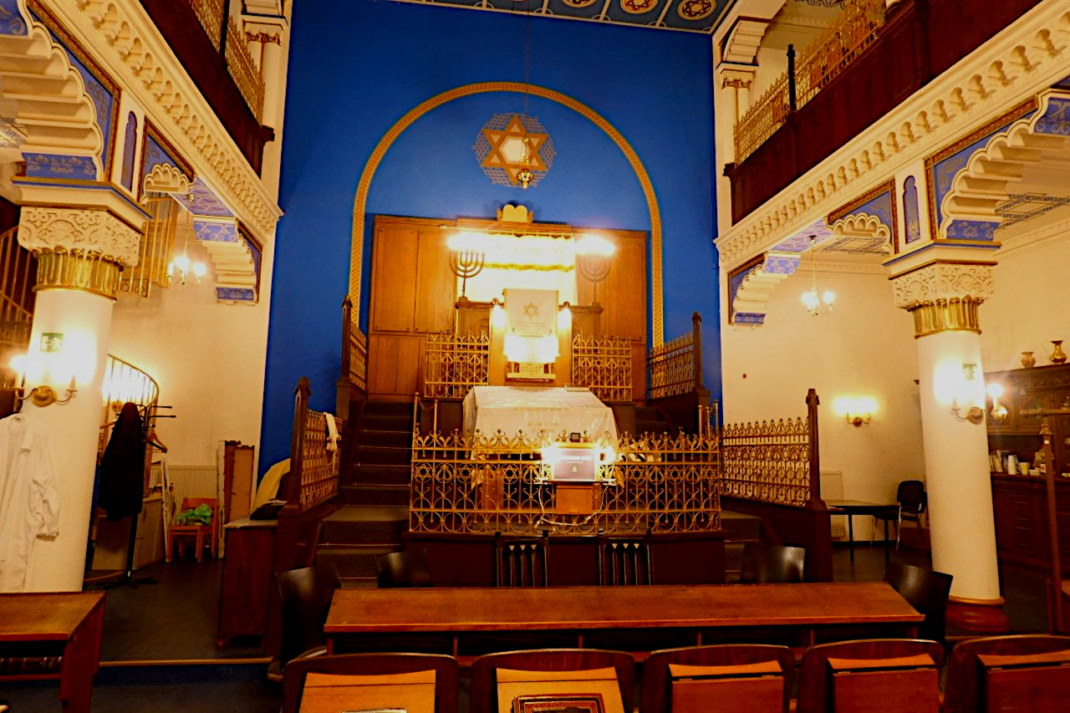
For those wishing to find out more, a guided tour is available, providing information about Jewish trade fair visitors and fur traders. History enthusiasts will also find plenty to enjoy, for example with a guided tour of the Brody Synagogue, the only Jewish place of worship in Leipzig to have survived the ‘Night of Broken Glass’ in 1938. Alternatively, you can take a guided tour of the Old Jewish Cemetery, search for traces of Jewish history at the South Cemetery, or explore the New Jewish Cemetery.
Perhaps you might even opt for an interactive escape game that playfully explores the life of the Jewish women’s rights activist and school founder Henriette Goldschmidt (1825–1920); a talk on Jewish identity in the GDR – which, by its own account, was strictly anti-fascist; or a tour of the Waldstraßenviertel, which until 1933 was home to the highest proportion of Jewish people in Leipzig. In short: a wide range of events – including exhibitions, readings, lectures, guided tours, discussions, concerts, and film, dance and theatre performances – will soon invite visitors to (re)discover Jewish (urban) history.
Under the banner of ‘Tacheles’
More than 70 institutions and associations are taking part this year; the programme comprises 133 events. Jewish Week is once again being organised jointly by the City of Leipzig’s Cultural Office and the Ariowitsch-Haus, although, in view of the current themed year ‘Tacheles. Year of Jewish Culture in Saxony’, the usual biennial cycle will be skipped in 2026: so 2025 will be followed directly by the 17th edition of Jewish Week.
It will open on 21 June at 3.00 pm in the Upper Foyer of the New Town Hall with Dr Skadi Jennicke (Die Linke), Councillor for Culture, and Küf Kaufmann, Chair of the Israelite Religious Community (IRGL). Artists from the IRGL and Israeli students from the ‘Felix Mendelssohn Bartholdy’ University of Music and Theatre will provide the musical accompaniment.
Closing ceremony at a symbolic location
The closing ceremony of Jewish Week on 28 June will then take place at a symbolic location: where, in 1938, Naziminions set fire to the Gottschedstraße Synagogue – which had opened in 1855 – and later blew up the ruins, the ‘Memorial to the Marginalised, Persecuted and Murdered Jewish Citizens’ was inaugurated in June 2001.
Here, 25 years later, the Leipzig Synagogue Choir and the Leipzig brass quintet emBRASSment, conducted by Philipp Goldmann, will provide the musical framework for the closing programme, which also demonstrates that: Leipzig’s rich Jewish heritage, which has experienced a renaissance since the 1990s following the crimes of the Shoah and the collapse of the GDR, can never be erased.
Empfohlen auf LZ


So können Sie die Berichterstattung der Leipziger Zeitung unterstützen:



There is one comment