Dieser Artikel ist auch in deutscher Sprache verfügbar: Zum deutschen Artikel.
Who, in fact, has manoeuvred the city into such a quandary that there is suddenly a heated public debate not only about whether the small wood that has grown up on Capastraße over the last 30 years may be cleared to provide RB Leipzig with new training grounds? It is a question that remains entirely open. Just as open is the question of whether the copse may be cleared at all. At the council meeting on 1 July, there were no fewer than three questions from residents regarding this matter.
These came mainly from Leipzig’s nature conservation organisations, which had already organised a successful protest at the Kleinmesse exhibition grounds on 25 June. However, the responses from the Department of Economic Affairs – which oversees the Property Office that had drafted the policy decision on the possible sale of the Capa Wood to RB Leipzig – failed to provide any definitive clarity.
A policy decision which the City Council is not yet in a position to adopt at all. This had already been discussed in various City Council committee meetings, which is why Mayor Burkhard Jung withdrew the proposal from the City Council’s agenda on 1 July. It may now not be discussed until the September or October meeting. For one thing became clear following the fierce criticism: without expert reports on species protection, noise protection, climate impact, compensation options and so on, the City Council cannot make any decision at all regarding the disposal of the Capa-Wäldchen.
27 sites for the Kleinmesse were assessed
There is a reason why the proposal entered the process so swiftly: the Property Office had carried out an assessment to identify an alternative site for the Kleinmesse within the city limits. Twenty-seven sites were examined, and two made it onto the shortlist because they were available and large enough. In both cases, however, a noise protection assessment led the city to rule out these two alternatives as well, as Clemens Schülke, the councillor responsible for economic affairs, explained on 1 July.
The full list of assessment criteria is to be made available to councillors. It remains to be seen whether this truly rules out all alternative sites. The SPD parliamentary group certainly considers a ‘Kleinmesse’ at the Old Exhibition Grounds to be a viable option.
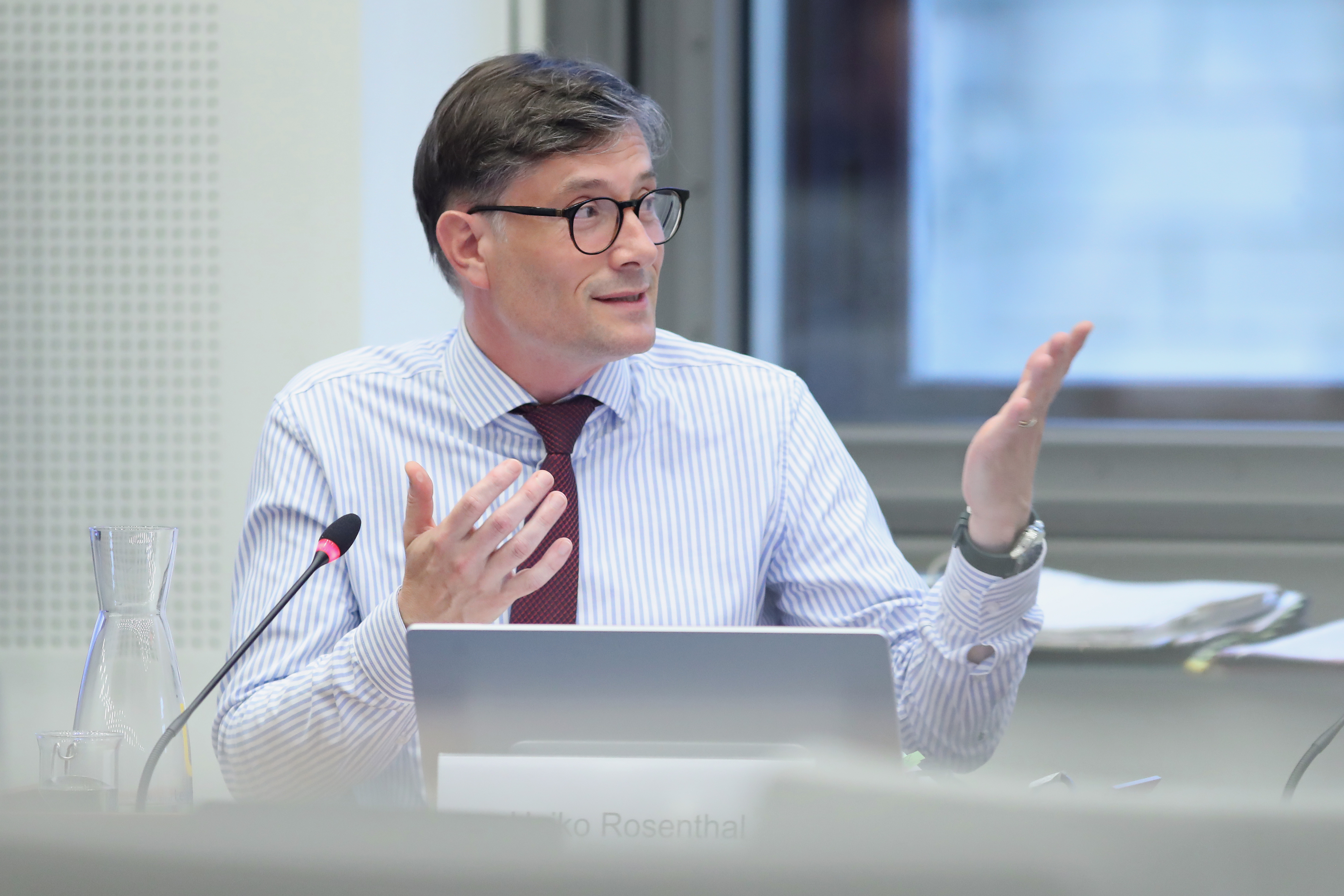
From the perspective of the Department of Economic Affairs, however, the sale of the Capa-Wäldchen is now on the agenda. The problem is that this constitutes such a massive breach of species protection and the preservation of green spaces in the city that, on 1 July, Jürgen Kasek and Elke Thiess, representing nature conservation organisations, pressed for more detailed answers. Even though the responses from Heiko Rosenthal, the councillor responsible for the environment, and Clemens Schülke remained evasive. Mayor Burkhard Jung, however, confirmed that the proposal for the sale is in fact more than just an expression of interest: it is a fundamental policy decision, he said. Which essentially means: the city wants to persuade the city council to pass a resolution to sell the plot, including the small wood, to RB Leipzig.
Lack of valuations
And this is happening without a single expert report on the value of the copse being available. The copse’s ‘misfortune’ is that it lies outside the landscape conservation area. So, as Heiko Rosenthal sees it, the city at least has some leeway here to submit an application for forest conversion. A euphemism for the clearing of the copse. But the decision on whether the copse may be ‘converted’ lies with the higher Saxon forestry authority, Sachsenforst.
One of the responses to residents’ enquiries puts it this way: “Due to a lack of suitable land, compensation for the forest conversion cannot take place directly at the site of the intervention, but must be directed towards potential sites within the urban area. Furthermore, the Higher Forestry Authority at the state-run enterprise Sachsenforst decides on the type, extent and permissible spatial distance of the forest compensation from the lost woodland area. Compensation areas to replace the forest’s cooling and ecosystem services would be sought primarily within Leipzig.”
However, even Sachsenforst cannot make any decisions if Leipzig has not even commissioned the necessary expert reports. This was only supposed to happen during the urban land-use planning process, after the city council had decided on the sale. An absurdity. Even Mayor Burkhard Jung has recognised this.
The expert reports are likely to be quite substantial. For the Department of Economic Affairs itself states: “Issues relating to species protection can be avoided as early as the urban land-use planning process. To this end, sufficient compensation measures must be established at an early stage. These measures must be implemented before the development begins and must have a lasting effect. The aim is to preserve the ecological function of the habitats concerned. This means that animals or plants must not lose their essential habitats as a result of the planning without suitable replacements being created in good time.”
Compensation in the immediate vicinity is simply not possible
At the same time, however, the city notes that there are no compensation areas in the immediate vicinity. Nor is it likely that space for even a similarly sized copse can be found elsewhere within the urban area. In fact, much more compensation is actually required, as stated in one of the responses: “Should – as in the present case – an already established compensation area be converted to another use, the compensation measure must be carried out elsewhere – in addition to the compensation requirement that continues to apply. As a general rule, the use (for construction or other purposes) of established compensation areas should be avoided.”
In doing so, the administration does not even shy away from passing the buck to the city council, as can be seen from the third response to a resident’s enquiry: “The issues raised in the question are in conflict with one another. Leipzig as a city of sport and the preservation of the Kleinmesse are also demands that the city council has set as policy. As the city council has defined these objectives, only it can resolve this conflict. The administration can outline options for action, always bearing in mind that not all objectives can be fully guaranteed, at least not at the same location. Should the City Council indicate a willingness to enter into negotiations at all, the city administration will endeavour to achieve the municipal objectives as far as possible, for example through compensation for encroachment on the forest, soil sealing and species protection. Key elements of these compensatory measures are, in any case, prescribed by law and are not subject to the local authority’s discretion (forest compensation, species protection).”
Passing the buck to the City Council
The fact that the City Council is essentially faced with an impossible decision becomes even clearer when the Department of Economic Affairs writes: “Only following time-consuming, costly and labour-intensive assessments as part of a town planning procedure will it become clear whether the site can actually be used as planned. In addition, the terms of the contract with RB still need to be negotiated (see point 8 of the proposal). Consequently, the City Council will have to deal with this issue at least three more times.
The proposal initiates this review process but does not conclusively resolve it. This is ruled out for legal reasons alone. Answering questions regarding the location and scope of mitigation and compensation measures is an essential part of the forthcoming reviews.
Nor is the proposal without alternatives. However, a rejection would also have consequences: in this case, most likely the closure or severe curtailment of the Kleinmesse. This is a fundamental political decision that the elected City Council can and must take.”
That certainly sounds like: “If the city council does not approve the sale, the Kleinmesse will be history.”
At the very least, Tobias Peter, the chair of the Green Party group, seems to have a well-founded hunch that this debate in the city council is set to become heated. The skirmish on 1 July was merely a foretaste.
Empfohlen auf LZ


So können Sie die Berichterstattung der Leipziger Zeitung unterstützen:





There is one comment