Dieser Artikel ist auch in deutscher Sprache verfügbar: Zum deutschen Artikel.
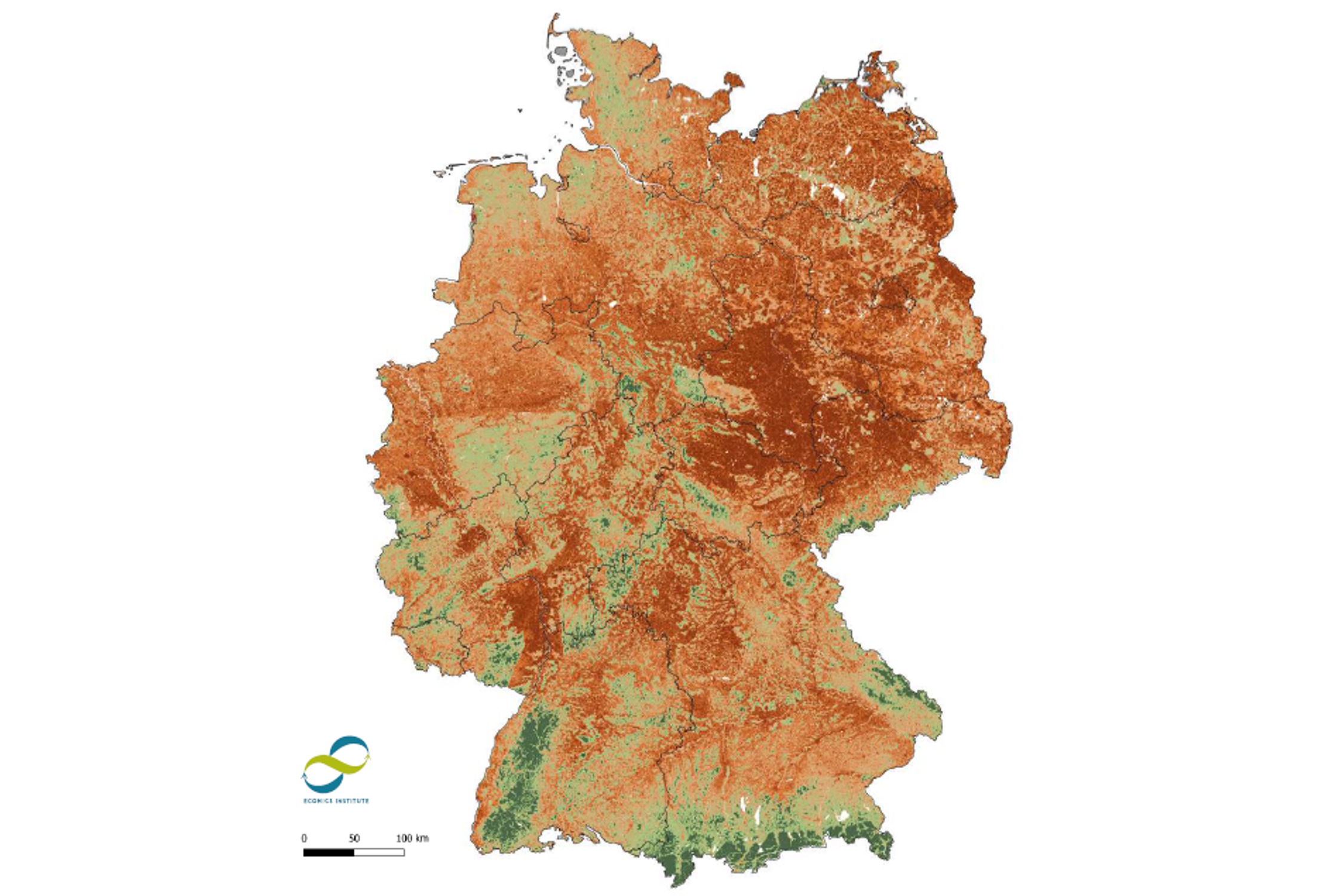
It is not just global warming that is causing problems for Germany. It is bringing into sharp relief just how devastated our native landscapes have long since become. They now offer hardly any protective functions against extreme weather events. A new ECONICS study highlights this in stark terms. Germany is losing the natural protective function of its landscapes: The ECONICS Green-Wet-Cool Index (GFKI) 2026, presented on Wednesday 25 July by NABU and the ECONICS Institute in Berlin, shows across the country just how effective nature is at cooling, water retention and climate adaptation. The findings are alarming.
Many regions are losing their ability to mitigate heat, retain water within the landscape and cushion the effects of the climate crisis.
In Saxony, it is evident how changes to the landscape resulting from intensive farming, soil sealing and fragmentation are impairing the natural infrastructure, according to NABU Saxony, which commissioned the ECONICS study. Only a few areas, such as the Düben and Dresden heathlands, the Moritzburg pond landscape or the Ore Mountains, show good or even very good potential. They represent a stable and well-connected natural infrastructure that delivers its ecosystem services on a large scale.
However, these regions stand out as isolated pockets. It is striking that there are hardly any functioning networked systems. Saxony’s major river landscapes are barely recognisable, despite the fact that their floodplains play a pivotal role not only in every biotope network but also in natural climate protection. Even the FFH sites protected under European law consistently show critical damage or, at best, moderate service potential.
“The ECONICS Green-Wet-Cool Index makes it clear: nature is not merely a backdrop, but our natural infrastructure. Intact forests, moors, floodplains and green spaces store water, cool their surroundings and make our landscapes more resilient to the consequences of the climate crisis,” says NABU President Jörg-Andreas Krüger.
The GFKI assesses landscapes based on three factors: green, wet and cool. Agricultural regions subject to particularly intensive use, heavily sealed-off towns and developed water bodies often show deficits. The nationwide trend is negative.
Research using high-resolution satellite data
“The results of the ‘ECONICS Green-Wet-Cool Index’ and its trend over time are not based on expert assessments, but are measured. Above all, large volumes of high-resolution satellite data are used. Another new aspect is that we make very specific recommendations as to which areas must be protected, stabilised or restored as a matter of high priority,” says the study’s author, Prof. Dr Pierre Ibisch.
“The data confirm what we have been observing for years,” says Maria Vlaic, regional chair of NABU Saxony. Every spring, NABU volunteers across Saxony maintain amphibian protection fences in wetlands. This reveals that the number of amphibians migrating to their spawning habitats is steadily declining. At some sites, protective fences are no longer being erected because hardly any animals migrate to their spawning grounds anymore. NABU volunteers can now only document that suitable habitats have been lost.
At the same time, the index shows that renaturation works. Where natural processes are allowed to take their course and damaged ecosystems are restored, landscapes can regain their functions – for example, through regenerative agriculture with catch-crop rotations, the rewetting of moors, the restoration of rivers and floodplains, or more green spaces in cities.
Leipzig: A Hotspot
If you look for Leipzig on a map showing infrastructure, you will find it in the middle of a deep-red area stretching from the Magdeburg Plain in the north and the Thuringian Basin in the south all the way to Dresden. A landscape almost devoid of woodland, characterised instead by intensive agriculture with vast fields lacking any structures for water retention. In between lie industrialised regions where large, sealed surfaces actively contribute to the build-up of heat during hot summers.
A small patch of green north-east of Leipzig is the Dübener Heide, by far the only area still reasonably intact with high ecological resilience.
Leipzig falls into the highest – and therefore worst – category: ‘Very severely damaged and at risk; very high priority for protection and restoration measures.’
And even the course of the White Elster is barely discernible on the map, although in Leipzig it is characterised by the ‘Leipzig Floodplain System’ Natura 2000 site. Or at least it should be. For the past 100 years, Leipzig’s floodplain forest has been cut off from the river; consequently, it suffers from drought itself, whilst the floodplain is unable to fulfil its role in cooling the city. The floodplain development plan, which has been called for for years and has now been under discussion for years, is not due to be in place until 2027.
This does not yet mean that work on revitalising the floodplain will actually begin by then. The dykes are not expected to be opened until 2029 at the earliest.
Government processes have long been far too slow and are failing to keep pace with the speed of climate change. Whether they will ultimately be sufficient – as in the case of the Leipzig floodplain system – to improve climate resilience in Leipzig remains to be seen. A glance at the map shows that resilient ecosystems are also lacking in the wider surrounding area. Even the floodplain systems along the Saale and Mulde rivers are far too narrow to have any real impact on the climate resilience of the Central German region.
Clear result of a 2025 survey
A representative survey conducted by the opinion research institute Civey on behalf of NABU also shows that the public supports this approach: over 80 per cent of people in Saxony are in favour of the EU Nature Restoration Law. The results underline the broad public support for the restoration of damaged ecosystems and for renaturation measures as an effective contribution to climate, nature and flood protection.
NABU calls on the federal and state governments to consistently strengthen natural infrastructure. Even in the current budgetary climate, nature must not be sidelined, as only intact ecosystems can safeguard our livelihoods and our prosperity. Against this backdrop, the announced budget cuts to nature conservation funding in Saxony are incomprehensible.
Empfohlen auf LZ


So können Sie die Berichterstattung der Leipziger Zeitung unterstützen:





There is one comment