Dieser Artikel ist auch in deutscher Sprache verfügbar: Zum deutschen Artikel.
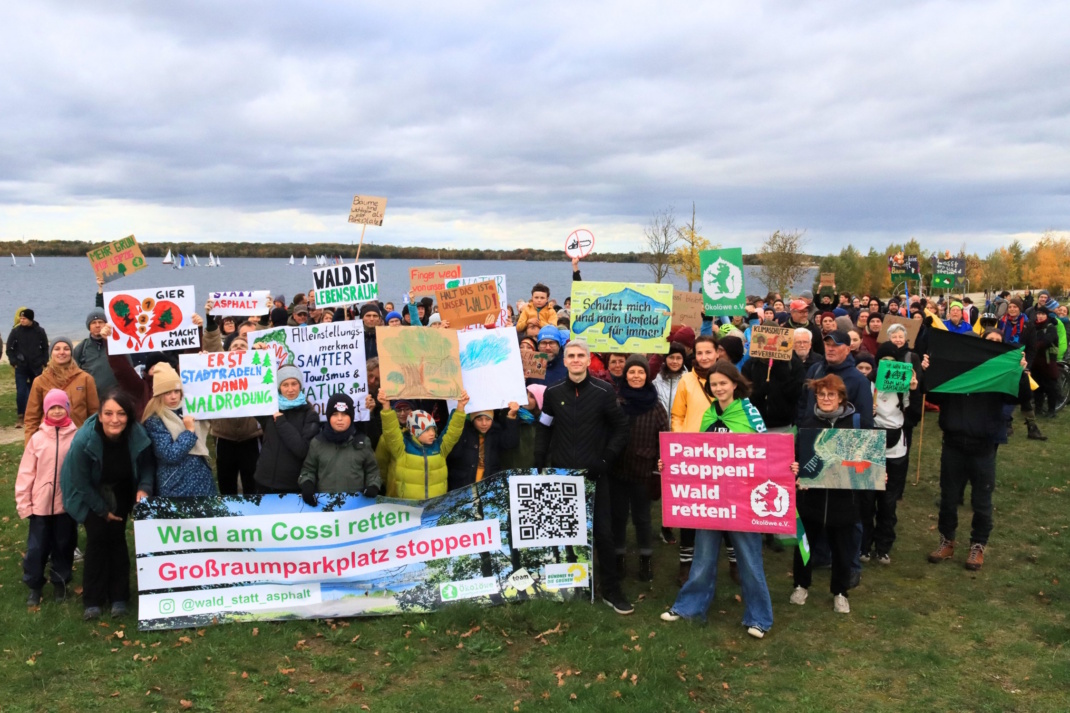
Last week, the Leipzig-based environmental group ‘Ökolöwe’ achieved a small victory in the battle to save the woodland at Zöbigker Harbour on Lake Cospuden. It was a sort of compromise. This week, Markkleeberg Town Council approved the development plan for Zöbigker Harbour on Lake Cospuden. This still includes the clearing of 1.3 hectares of woodland to make way for a large car park, even though the existing car parks near the popular Pier 1 are far from being fully utilised.
The Ökolöwe criticises the fact that the Markkleeberg administrative bodies drew up the development plan behind closed doors over the past few weeks. The town council was then expected to approve the plan very quickly. This is despite the fact that plans to clear woodland here for an even larger car park have already sparked protests on several occasions.
The town of Markkleeberg intends to fell woodland here in the future to build 220 new parking spaces right by Lake Cospuden. Presumably with the aim of attracting even more visitors to the lake.
“It is disregarding the will of the citizens and stubbornly pressing ahead with plans that will lead to the over-exploitation of the lake. This is a slap in the face for everyone who seeks peace and quiet and local recreation at the Cossi,” criticises the Ökolöwe.
“We can at least celebrate one small success: as a result of our protest, the town council has decided to carry out the car park expansion in stages, rather than clearing everything at once. Before each stage, they will assess whether the car park should be expanded further. So we can still prevent the worst from happening.”
Ökolöwe is considering legal action
This is why Ökolöwe has no intention of giving up now: “We are now examining the plans in detail, submitting comments and clarifying what legal action is possible.”
But that takes energy, time and money. Even Ökolöwe is now feeling the strain of having to fight for the environment in and around Leipzig on many fronts simultaneously with a fairly small team, whilst the environment – particularly in the Neuseenland – is increasingly being used as a bargaining chip, pushed aside sometimes by navigability plans, sometimes by oversized tourism projects designed to place multi-million-euro developments right in the middle of this sensitive landscape. Not to mention the planners’ far-fetched ideas for attracting hundreds of thousands of paying visitors to the lakes.
And the Ökolöwe is not alone in facing this problem. The other environmental organisations in Leipzig are in exactly the same boat. Whilst local authorities have tax revenue at their disposal and can press ahead with their oversized plans unchallenged for years on end, environmental organisations often lack the funds and manpower to draft submissions, lodge objections or take legal action against the authorities’ often opaque plans.
Time and again, the environmentalists’ justified objections are rebuffed by political bodies and local authorities; their involvement is stifled as much as possible and, in the end – in the name of threatened natural resources – the only option left is the costly legal route.
“Far too many people are still clicking away, whilst too few are helping with a donation. This is pushing us to our limits, both financially and in terms of staff,” says Ökolöwe, describing the dilemma and appealing to potential supporters: “Even just 10 euros a month helps us to cover the costs of expert reports, legal advice and a protracted legal battle. Only with significantly more regular support can we continue to work effectively and professionally.”
Ultimately, it is the region’s own residents who can make a difference here through voluntary action, when local authorities shut themselves off and even the elected political bodies prefer to support large-scale tourism projects rather than see themselves as guardians of the region’s threatened natural environment. In the words of the Ökolöwe: “Ökolöwe e. V. funds its political work exclusively through donations from people who share our goals: protecting the Cossi, saving the floodplain forest and halting species extinction. This is the only way we can remain independent.”
Empfohlen auf LZ


So können Sie die Berichterstattung der Leipziger Zeitung unterstützen:





There is one comment