Dieser Artikel ist auch in deutscher Sprache verfügbar: Zum deutschen Artikel.
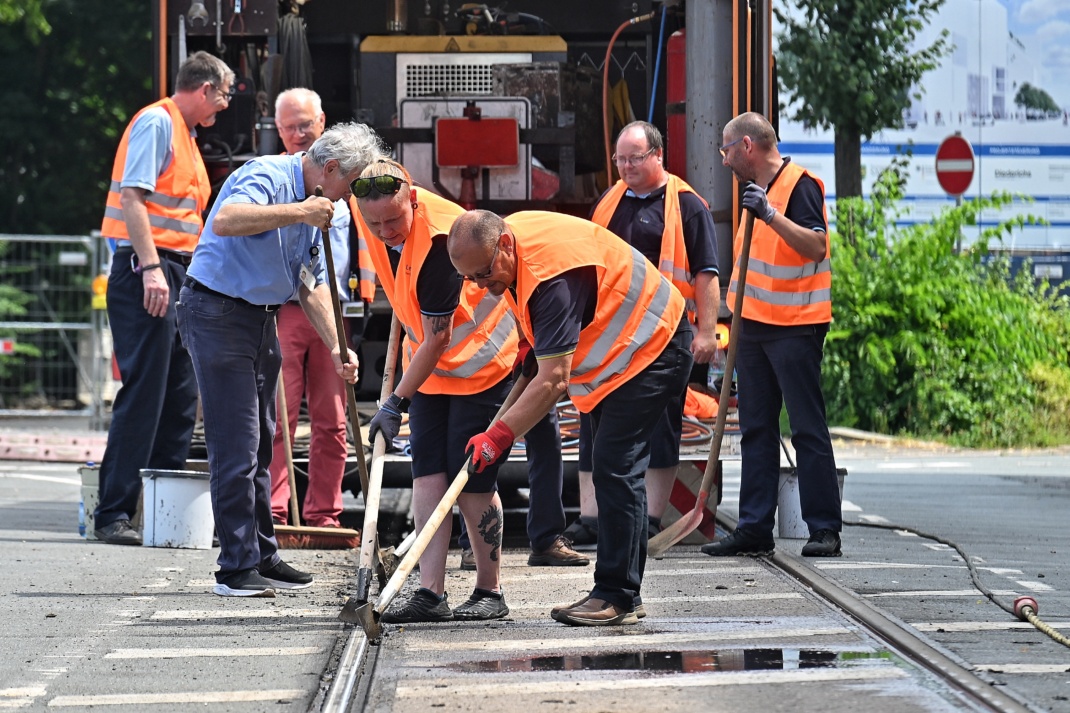
In June, the joint sealant melted along 36 kilometres of the Leipzig Public Transport Authority (LVB) track network. Tram services came to a complete standstill for days, and 2,000 Leipzig residents rushed to help when the LVB sought volunteers to scrape away the overflowing joint sealant. In some cases, they did so even when temperatures were well over 30 degrees. For the first time, the LVB also experienced what the new ‘record temperatures’ mean for Leipzig. And, naturally, a great many passengers wondered: Will lessons be learnt from this? Will anything change now?
On Monday 14 September, TÜV SÜD Rail and the LVB presented a final report on these instances of liquefaction in the track network. The aim, of course, is to prevent such damage in future and to make the infrastructure more climate-resilient for the future. The latter, however, remains a completely open question even after this presentation.
The first warning shot
At the end of June, around 36 kilometres of the LVB’s track network were contaminated by bitumen in the joints that had liquefied, forcing services to be suspended. And somehow, the heat was to blame. And it was. It was a warning sign, as peak temperatures of 40 degrees and above will characterise future summers in Leipzig. However, the tram track network is not designed to cope with this.
The German Weather Service recorded the second-hottest summer since records began, including a doubling of the number of hot days with tropical nights. In Leipzig, the hottest day on record – with temperatures exceeding 40 degrees – was recorded on 27 June 2026. And that was precisely the day when the bitumen problem brought Leipzig’s trams to a standstill. Although the problem did not start with the bitumen. On the tracks and joints alone, the LVB recorded temperatures of more than 70 degrees.
The sections where the bitumen liquefied were generally located on large, open stretches of road without any shade, mainly around the ring road, where – in addition to unobstructed sunlight – heat also tends to build up particularly.
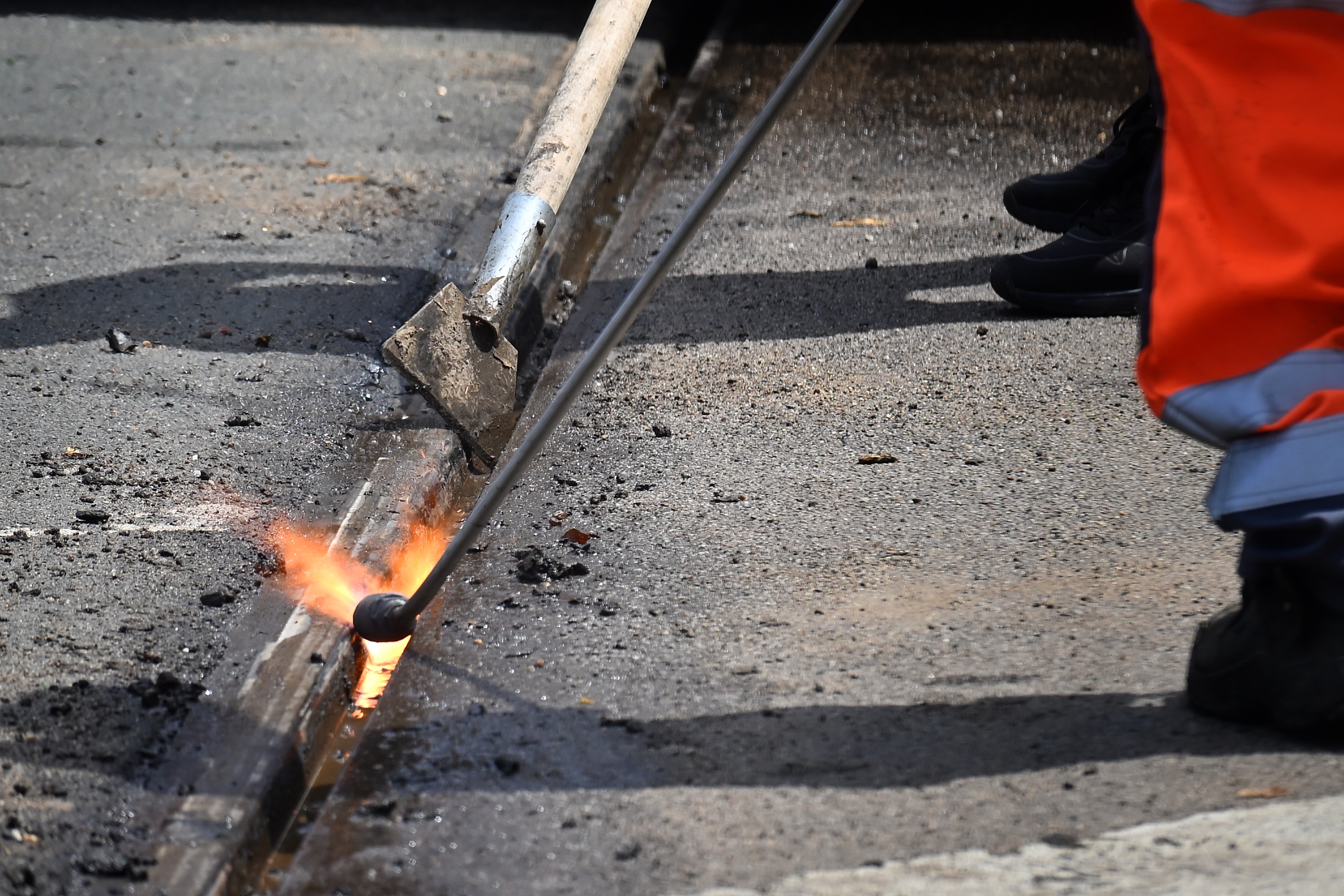
Elsewhere, the mass must be reheated and then scraped off the tracks. Photo: Benjamin Weinkauf
It is precisely the vast traffic areas that were cleared around the Ring back in GDR times that form the most intense heat hotspots in the city centre. Anyone who waited at a tram stop there during the hot weeks knows what that meant. And what a shock it was to then board trams where the air conditioning was completely overwhelmed. Sweat-inducing temperatures both inside and out.
4.5 million euros in damage
According to the LVB, this caused damage to infrastructure and trams in Leipzig amounting to up to 4.5 million euros. Other European cities, such as Budapest, Nuremberg and Essen, also suffered significant damage and disruption for passengers. We were not alone in this predicament.
Gradually, thanks to the efforts of nearly 2,000 people who cleaned the tracks, the full service schedule was restored in July. A provisional heat plan was also drawn up straight away to ensure that a similar collapse would not occur again during the next hot weeks.
“With this TÜV report, we now want to further underpin the LVB heat plan we have developed in order to prevent future damage and continue to operate a climate-resilient infrastructure going forward. In view of the predicted climate changes, this is a task for society as a whole,” said Toralf Müller, Managing Director of Technology and Operations at Leipziger Verkehrsbetriebe, on Monday.
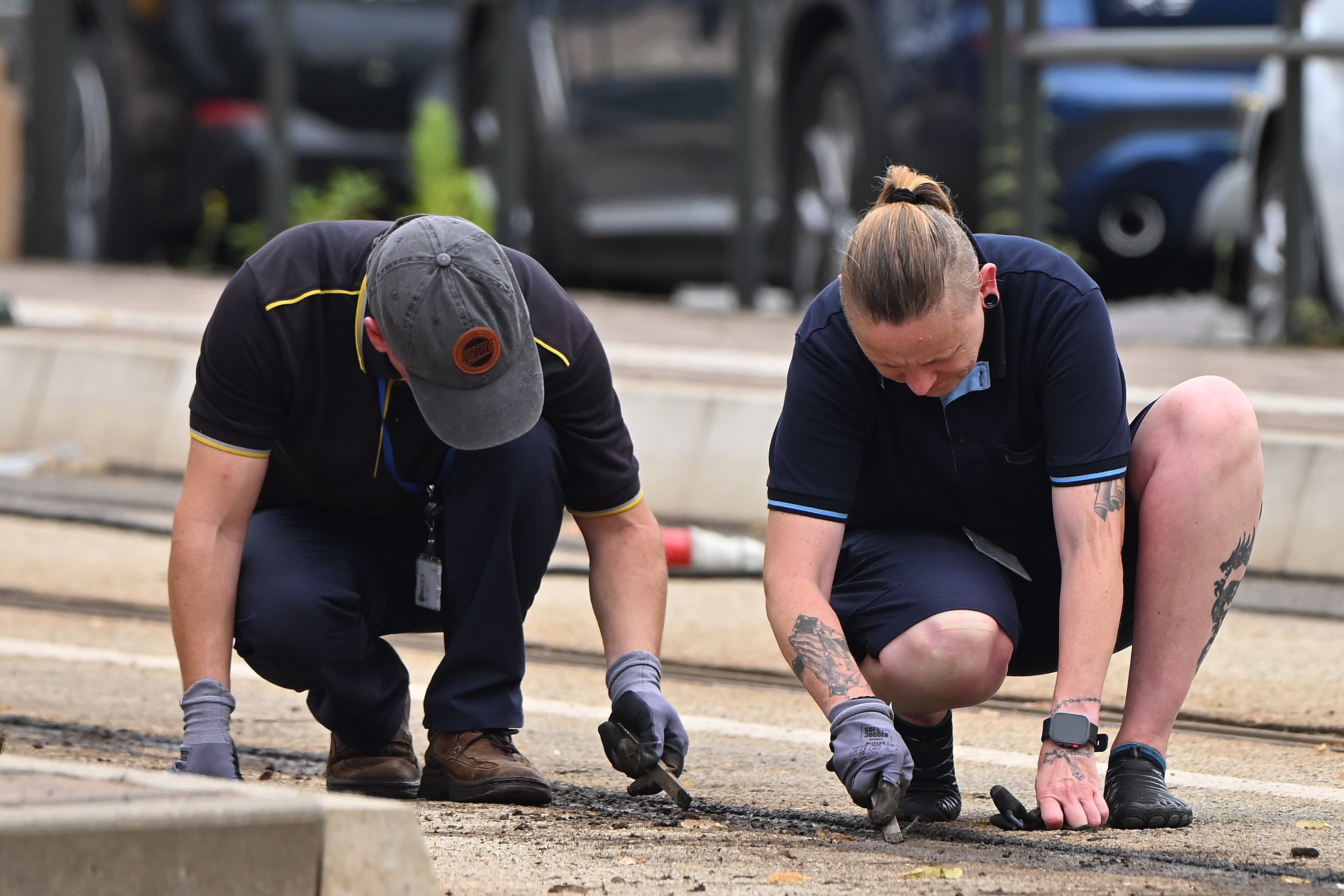
They’ve cleared the snow so services can resume. Line 1 marks the start of the phased reopening of the rail network. Photo: Benjamin Weinkauf
The inspection results
TÜV SÜD Rail carried out investigations on behalf of LVB and, amongst other things, conducted a visual survey of the current condition and damage to joints dating from various decades and constructed by different building contractors. The affected track sections were inspected and samples of the joint compound were taken.
This was because it was not entirely clear why the compound had liquefied in some sections but remained unaffected in others. In addition, documents from the planning and construction files were examined, and the bituminous joint compound used was analysed in the laboratory.
The final report now shows – unsurprisingly – that there was no single cause of the heat damage, but rather that a combination of various factors played a part. LVB summarises it as follows: “The record-breaking heat, with consistently tropical temperatures over several days, combined with the strain on the tracks caused by car, lorry and bus traffic, resulted in significant damage that led to the suspension of services.”
The buses pulling into bus stops during the record-breaking temperatures dislodged the already molten material from the joints with their tyres. Similar effects were observed at major junctions, which were baking in the heat.
The planning failures of the last century
It’s clear that the city, too, must finally change its approach. For years, Leipzig’s environmental organisations have been calling for a reduction in the number of lanes around the ring road and a downsizing of the completely oversized junctions, such as the one at Goerdelerring. The fact that this could also be important in the face of increasingly frequent heatwaves became apparent for the first time in this way this year. The liquefaction of the joint sealant is the result of such flawed road planning from the last century.
And what can be done about it now?
With regard to the requirements for longitudinal track joints, TÜV SÜD Rail continues to recommend the use of bituminous joint sealant, as well as quality assurance through close monitoring during construction and installation, and adjustments to ensure a climate-resilient infrastructure. For example, the joints should be installed lower beneath the rail head.
The addition of plastic granules to the joint compound to prevent adhesion to tyres and wheels is currently still being investigated. This is because it is significantly more expensive. A real problem in times of tight budgets.
“No single contributing factor could be identified as the cause of the damage observed. The findings suggest a combination of various factors. The prolonged heatwave is considered a key contributing factor. At the same time, there is scope for further improvement in the installation documentation,” said Ian Veigl, Inspector and Lead Auditor at TÜV Süd Rail.
The heat problem caused by vast sealed surfaces
Of course, the LVB cannot change the ‘historical’ framework created by the generous road cross-sections. But it also became clear that the joint sealant problem is linked to the continuous sealing of the track beds. The LVB should really also be considering extensive unsealing of the paved sections – particularly wherever buses do not need to use the track. Green tracks on the Ring would actually be a logical conclusion.
In other words: the LVB really needs to rethink its approach, particularly around the Ring.
At present, there is very little they can do. The findings of the TÜV investigation are now being incorporated into the LVB’s principles for climate-resilient construction and infrastructure design, as well as into the LVB’s heat plan. The two-stage plan provides for various measures at 33 and 38 degrees respectively, covering monitoring, cooling and, if necessary, the closure of individual routes. The heat plan was already put into action in July and proved its worth, according to the LVB. Cooling can be achieved – as was even practised in GDR times – using water sprinkler lorries.
“It was only thanks to the tremendous commitment of the people of Leipzig, our colleagues at the transport company and the Leipzig Group that we were able to gradually resume services. A heartfelt thank you to everyone who helped. We will continue to systematically address the effects of climate change on our infrastructure, exchange ideas within the industry and work with experts from universities, planning offices and construction firms to develop solutions that meet our requirements,” emphasised Stefan Röll, Head of Infrastructure at Leipziger Verkehrsbetriebe.
The majority of the damaged joints on the LVB network are due to be repaired by the end of the year. According to the LVB, this may result in further short-term closures.
Empfohlen auf LZ


So können Sie die Berichterstattung der Leipziger Zeitung unterstützen:





There is one comment