Dieser Artikel ist auch in deutscher Sprache verfügbar: Zum deutschen Artikel.
The debate over a ship railway between Lake Cospuden and Lake Zwenkau has taken a new turn: Whilst the Grüner Ring Leipzig is pressing ahead with the project – costing around 93 million euros – as a potential building block for the development of tourism in the Leipzig Neuseenland, all the major nature conservation organisations in the region unanimously state that they were not involved in the planning to date.
This is by no means just about infrastructure. The feasibility study anticipates around 400,000 additional visitors annually. And here, in addition to the infrastructural requirements, the visitor flows themselves will place a strain on natural areas – the study anticipates up to 10,000 visitors on peak days.
At the same time, the feasibility study explicitly defers key issues relating to species conservation and nature conservation to later planning consent procedures. Conflicts are already anticipated, particularly in the southern tip of Lake Cospuden, an area of high conservation sensitivity. The Leipziger Zeitung therefore asked NABU, BUND, Ökolöwe and Grüne Liga whether they were already providing technical support for the project or had been involved in the planning process.
BUND, Grüne Liga and NuKLA: no involvement and other priorities at present
BUND’s assessment was brief but unequivocal: “We would spend the money on completely different things there,” wrote Heiko Rudolf, spokesperson for BUND’s Floodplain Forest & Water Working Group. Nor did the subsequent discussion reveal any indication of involvement in the planning of the ship railway to date. He and BUND have been working for years on concepts for the revitalisation of Leipzig’s floodplain forest. At present, they are focusing intensively on the planned interventions, in particular the controversial tree-felling plans for a central link between the northern and southern parts of Leipzig’s floodplain forest.
Wolfgang Stoiber, chair of the Grüne Liga and NuKLA e.V., also stated that he had neither been involved in the planning nor submitted any comments. Instead, he points to the criticism – publicly documented for years – of the tourist development of the Leipzig Neuseenland and to several position papers opposing the update of the Water Tourism Utilisation Concept (WTNK). Damage to the Leipzig floodplain forest is also one of NuKLA’s current priorities. In the association’s view, this damage is also caused by forestry work.
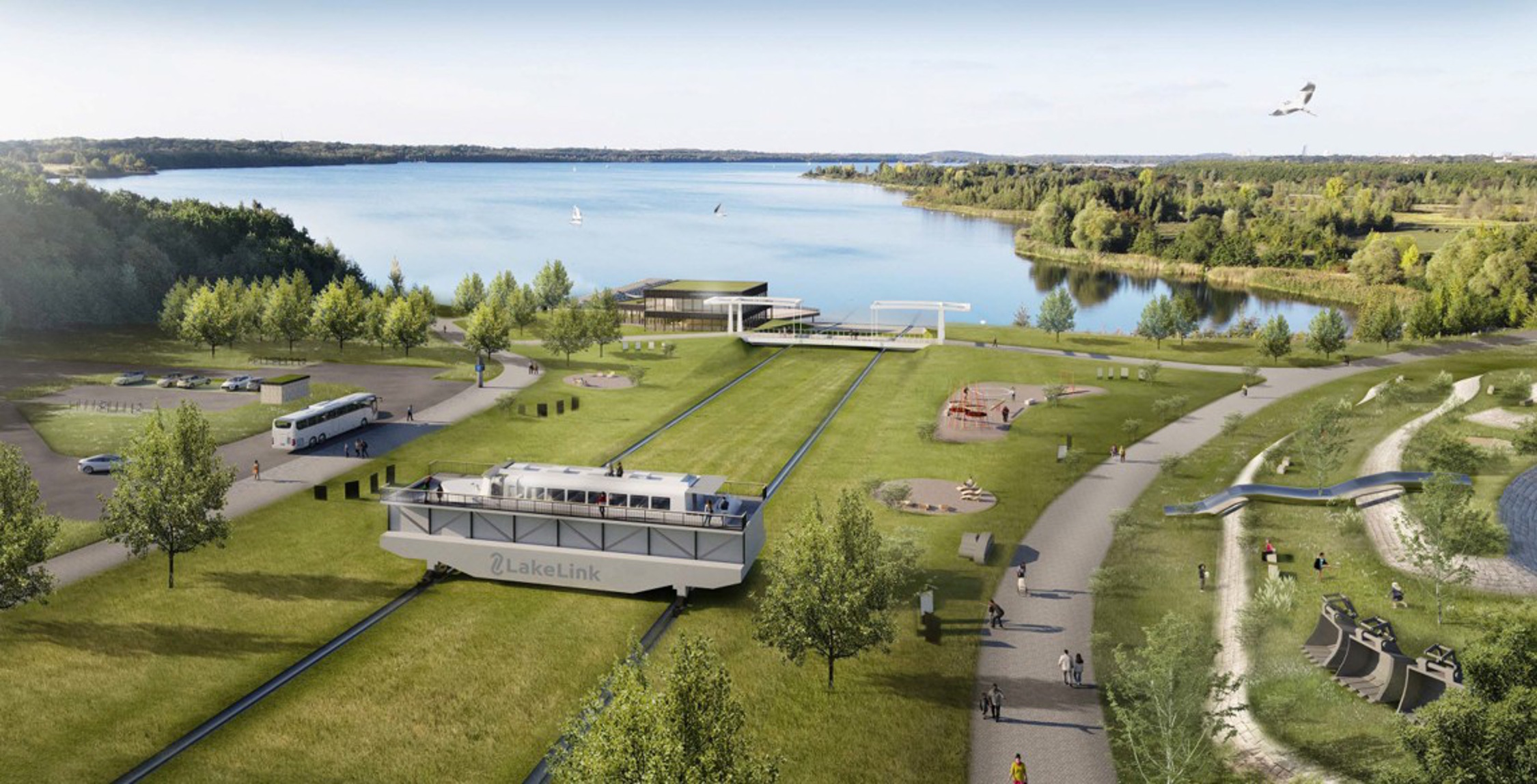
This is what the preferred option for the ship railway between Lake Zwenkau and Lake Cospuden is expected to look like. Visualisation: ICL Ingenieur Consult GmbH
Ökolöwe: “If there are ongoing discussions, they’re certainly not with us”
The Leipzig-based environmental organisation’s response is equally unequivocal. When asked whether the organisation was in direct contact with the ‘Grüner Ring’ regarding the water railway, spokesperson Bozena Nawka replied: “If there are ‘ongoing discussions’, they are certainly not with us, the Ökolöwen. Nor has there yet been an opportunity to provide expert input.”
They also made it clear that environmental organisations are currently faced with a multitude of complex projects. This makes it all the more important to divide up the tasks effectively and make sensible use of available resources. Civil society engagement is very important and welcome. They are continuing to keep an eye on developments regarding the ship railway.
NABU: “NABU was not involved in the planning or the feasibility study.”
Dirk Sievert, chair of the NABU Leipzig regional association, put it most clearly: “NABU was not involved in the planning or the feasibility study. We were not aware of the plans until your enquiry, which is why we have not yet commented on them from a technical perspective.”
Should a formal planning permission process begin, the association will, of course, get involved. However, NABU does not harbour high hopes in this regard. “Regrettably, conflicts under nature conservation law are generally not a reason why a planned project cannot go ahead anyway. We see this all the time. Land-use and regional planning schemes can be amended – and, as a rule, this is done to the detriment of nature conservation. What matters is the political will to either preserve intact nature or not.”
The criticism of the tourist development of the Leipzig Neuseenland is even more fundamental: “It is indeed particularly worrying that there are ever more new tourism plans for the Neuseenland. […] In our view, the Neuseenland should be dedicated solely to nature-friendly local recreation, not to tourism. What was promised was the restoration of the post-mining landscape, not a commercial conversion of the landscape.”
Whilst NABU confirms that it is in regular contact with the Grüner Ring, it clearly distinguishes this from the specific project. “Of course, we are in contact with the Grüner Ring and discussions are indeed taking place in this regard, but so far these have not specifically concerned the ship-railway project.”
Grüner Ring refers to internal discussions
Faced with the consistent feedback from the nature conservation organisations, the Leipziger Zeitung asked the Grüner Ring which organisations the “ongoing discussions” mentioned in the initial exchange specifically related to the ship railway.
The secretariat subsequently clarified: “The statement ‘Discussions are, of course, taking place’ meant that the issues of nature conservation and environmental impact have already been and are being discussed internally as part of the planning process.”
The office did not initially provide any further details regarding discussions with nature conservation organisations. The enquiry would be forwarded to the City of Leipzig’s Department for Urban Greenery and Waterways, which has been involved in the project from the outset.
An old conflict
This development is not entirely new. As early as 2019, NABU, BUND, Ökolöwe and other stakeholders withdrew from the round table on updating the Water Tourism Utilisation Concept (WTNK). The Grüne Liga had already withdrawn prior to that. At the time, the environmental organisations justified their withdrawal by citing fundamental differences over the direction of development in the Leipzig Neuseenland. In their view, interests in tourism expansion were taking precedence, whilst ecological concerns were increasingly being sidelined.
The latest feedback ties in with the criticism already voiced by the environmental organisations back in 2019.
It is precisely this point that raises questions. This is because the feasibility study for the ship railway itself identifies numerous uncertainties relating to nature conservation. Statements on species protection, compliance with the Habitats Directive or specific mitigation measures are largely deferred to later planning consent procedures.
The sequence of events is noteworthy: first, the feasibility of a major tourism project was investigated. The nature conservation assessment, by contrast, is only to take place during the subsequent planning consent process. At the same time, the region’s leading nature conservation organisations unanimously state that they were not involved in the feasibility study and that, in some cases, they only learnt of the project through the Leipziger Zeitung’s investigation.
How this is ultimately supposed to result in a project that is eligible for approval and widely accepted remains unclear at this stage.
Empfohlen auf LZ


So können Sie die Berichterstattung der Leipziger Zeitung unterstützen:




There is one comment