Dieser Artikel ist auch in deutscher Sprache verfügbar: Zum deutschen Artikel.
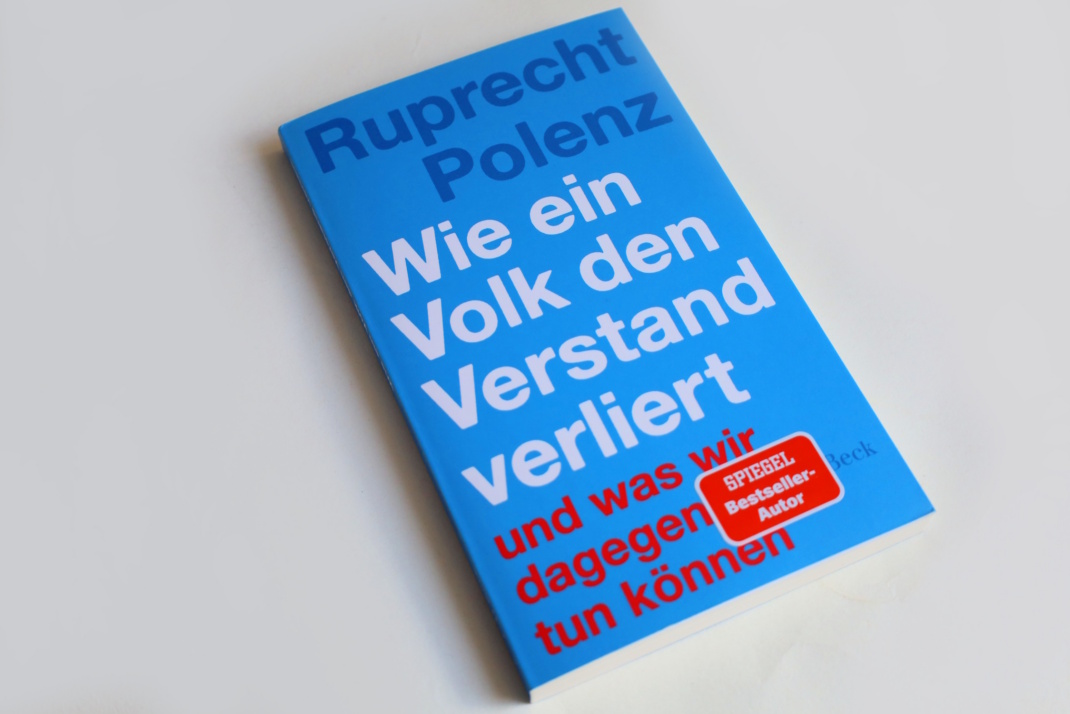
The title says it all. Nations can lose their minds. Just as individual people can. History is full of examples of this. And they all relate to the same phenomenon: the destruction of truth. For our coexistence as a society only works if we can agree on the same reliable facts. But what if that is not the case, if fake news and lies are allowed to flood into democracy as a matter of course? Then what we are seeing unfold before our very eyes is bound to happen.
‘A democracy does not lose its mind in a single day,’ writes Ruprecht Polenz in this book, in which he uncovers the mechanism by which the truth is systematically destroyed. ‘It loses it when too many people become accustomed to the idea that truth no longer matters.’
Many people are completely unaware of just how central truth is to democracy. They also tend to confuse truth with opinion. After all, they say, you’re allowed to say anything. Freedom of expression reigns in a democracy.
That is true. But it only works if everyone can repeatedly agree on the fundamental truths – on what is actually the case. That said, Polenz is well aware that there are, of course, no ‘eternal truths’. Grasping the truth requires hard work, patience and rules – rules developed by the thinkers of the Enlightenment.
In philosophy, science and the media. It was also a message to future generations when Immanuel Kant called on his readers to use their own reason. For the quest for truth is a shared endeavour. Nations flourish when they make this their priority, internalise it and institutionalise it.
Attack on the institutions of truth
And that is precisely why far-right extremists and populists attack the institutions dedicated to the pursuit of truth first and foremost. Systematically. Mistrust is sown, research is discredited, and thousands of completely different media outlets are simply lumped together under the label ‘lying press’. Or American billionaires simply buy up critical media outlets and tame them, just as Elon Musk has done with Twitter and the *Washington Post*.
‘When a people begins to live in different realities, it becomes schizophrenic and loses its mind,’ writes Polenz. He then goes on to discuss the role of ‘social media’. Social media has long since become a Pandora’s box, with an attention economy that primarily fuels hatred, violence, division, lies and conspiracy theories. All of which distract from critical thinking and instead stoke raw emotions. And this plays right into the hands of those who use such emotions to pursue politics, who incite people and repeatedly play on their fears.
Which is why far-right parties focus above all on spreading fear and painting a grim picture of the present. Because it works: if you see it posted on your feed, in your bubble, more and more often, and you’re surrounded only by people (and bots) who paint a bleak picture of the world, then at some point you start to believe it.
How this works has even been the subject of scientific research. People want to belong and find it very hard to cope when they’re alone with their opinion. Even if they know something is true. When the vast majority around them constantly claim otherwise, they become wavering; they do not doubt the majority, but themselves. And this happens all the time on ‘social media’ with its algorithms. They prioritise excitement, fear and disaster.
The attack on independent media
Admittedly, the big tech companies are not prepared to disclose their algorithms. But the effect is impossible to overlook. Anything that promotes calm dialogue, fact-based discussions or respectful coexistence is devalued and replaced in people’s personal timelines by constant sensationalism and scaremongering. This plays right into the hands of populists and the far right. For in this way, they create grim images of the present – images of decline and ruin.
And that is why right-wing populists are also attacking the traditional and independent media, where thousands of journalists strive every day to convey as realistic a picture of the world as possible to their readers, listeners and viewers. “It leads to social division and radicalisation when the foundation of shared facts is deliberately called into question,” writes Polenz. “Trust in institutions, politics and the media is dwindling. Groups are becoming radicalised.”
And: “The attacks on the press, academia, the arts and historical memory are neither coincidental nor overreactions. They follow a logic. Anyone who wishes to secure power without facing criticism must weaken the institutions that make criticism possible. Anyone who can no longer justify political decisions must discredit doubt. Anyone who cannot explain their policies must reinterpret reality.”
And that is precisely what they are managing to do, bit by bit, by discrediting all professional bodies in the fields of media and academia, repeatedly denigrating them and claiming they are ‘manipulated’ by a sinister elite pulling the strings from behind the scenes.
Authoritarian strategies
At some point, people start to believe it. Especially when they are repeatedly inundated with the same rubbish on their ‘social media’ accounts. And this happens on a scale and with a persistence that would have been unthinkable in the days before the founding of Facebook, Twitter and the like. And it was the far right, above all, who were the first to recognise the effectiveness of these platforms.
The attention economy of these platforms plays right into their hands. After all, anyone who does not strive for truth and veracity – because they profit from noise and lies – has no need for calm discussion. They can immediately turn shouting and denunciation into a media strategy.
The only thing getting in the way then is the traditional media out there, with their investigations and critiques. So: ‘That is why authoritarian strategies are not directed primarily against parliaments, but against knowledge. Not against elections, but against critical thinking. Not against individual opinions, but against the system that distinguishes truth from power. The aim is not persuasion, but disorientation.”
We must therefore discuss the tools being used to systematically undermine the foundations of our shared understanding. And this brings us – not only in Germany – to the brute force of the huge, unregulated platforms. “The greatest virtue of democracy is finding fair compromises,” writes Polenz. “Social media runs diametrically counter to this, because it reinforces populism, which thrives on confrontation and has no interest in reaching agreements.”
What can be done?
There’s really nothing more to add. All of this is also backed up by scientific research. The increased use of ‘social media’ is driving people’s radicalisation and opening the floodgates to precisely those parties that make politics out of radicalisation.
What can be done?
Polenz has also asked himself this question. Towards the end, he makes a few suggestions as to how the flood of radical nonsense might be stemmed. He outlines these suggestions briefly – ranging from a dedicated European platform that would also allow for democratic oversight – such as the Broadcasting Council in the German public service broadcasting system – through to complete transparency regarding algorithms, support for independent quality journalism, and the very personal opportunities parents have to empower their children from an early age.
After all, they can teach their children to think critically and analytically from an early age simply by reading to them, thereby opening up the world of books and imagination to them. That’s how small it all begins. But ultimately, everyone must start with themselves: how does one cultivate one’s own critical thinking in a media landscape that has gone haywire? How do you learn to distinguish reliable sources from purveyors of fake news? And this won’t get any easier in future, because ‘artificial intelligence’ will only serve to amplify the lies and disinformation campaigns on the internet. Until they become indistinguishable from real news.
How can we keep a clear head?
“Keeping a clear head doesn’t mean knowing everything,” Polenz concludes. “It means not letting yourself be fobbed off. It means checking sources, tolerating contradiction, allowing for doubt – even about one’s own convictions. It means not letting oneself be swept away by outrage, but pausing when it becomes too loud.”
In his book, Ruprecht Polenz demonstrates just how fundamental the constant search for truth is, particularly for a democratic society. And how vital the institutions dedicated to the search for truth are for peace in our society. Anyone who abandons them strips democracy of its foundations. They throw open the floodgates to the manipulation of our thinking. Until those being led can no longer distinguish between truth and fiction.
There is work to be done. Polenz makes this abundantly clear. The question now is rather whether his message will actually be understood.
Ruprecht Polenz, *How a People Loses Its Mind* , C. H. Beck, Munich 2026, 18 euros.
Empfohlen auf LZ


So können Sie die Berichterstattung der Leipziger Zeitung unterstützen:



There is one comment