Dieser Artikel ist auch in deutscher Sprache verfügbar: Zum deutschen Artikel.
It’s always the same old trouble with money. Alongside all the other local authorities in Germany, Leipzig is now also putting pressure on the federal government. And when it comes to upgrading the railway line between Leipzig and Chemnitz, funds are only sufficient for an austerity programme – a situation that has caused outrage amongst the Greens. But where to get the money, if not by stealing it? Two robbers in Grünau couldn’t answer that question either. They are now being sought by the police, with descriptions of their appearance in circulation. The LZ summarises the key events in Leipzig and beyond on Wednesday, 17 June 2026.
The City of Leipzig has had enough
Local authorities are struggling financially. Leipzig is no exception. For this reason, a nationwide campaign by towns and municipalities is intended to finally shake the federal government into action. In Leipzig alone, the city administration reported that the funding requirement for social services has risen by 256 to a total of 634 million euros since 2020. Whilst Leipzig was still able to achieve a net budget surplus of 50 million euros in 2020, the city is now forecasting a deficit of 279 million euros for 2025.
“Local authorities in Germany are in debt to the tune of more than 30 billion euros,” Mayor Burkhard Jung (SPD) is quoted as saying. “We are responsible for a quarter of public spending in Germany, but receive only a seventh of tax revenue – that cannot work. But I fear that the disastrous situation facing Germany’s cities has still not sunk in in Berlin. That is why we need this day of action – across the whole of Germany: the danger is real; the cities are on the brink of bankruptcy!”
“This situation cannot continue! Whoever orders must pay – or cancel the order!” summarises Torsten Bonew (CDU), the city’s finance mayor. They are calling for a significantly broader funding base, which could be achieved, for example, through a higher share of VAT revenue. In addition, calls are being made for a reduction in red tape and regulatory burdens, as well as greater local autonomy.
On the upcoming ‘Action Monday’, posters and leaflets will therefore be displayed in numerous Leipzig council offices to highlight that the city has its back against the wall financially, with social costs spiralling out of control on the one hand and tax revenues plummeting on the other.
Mixed feelings about the Chemnitz–Leipzig rail extension
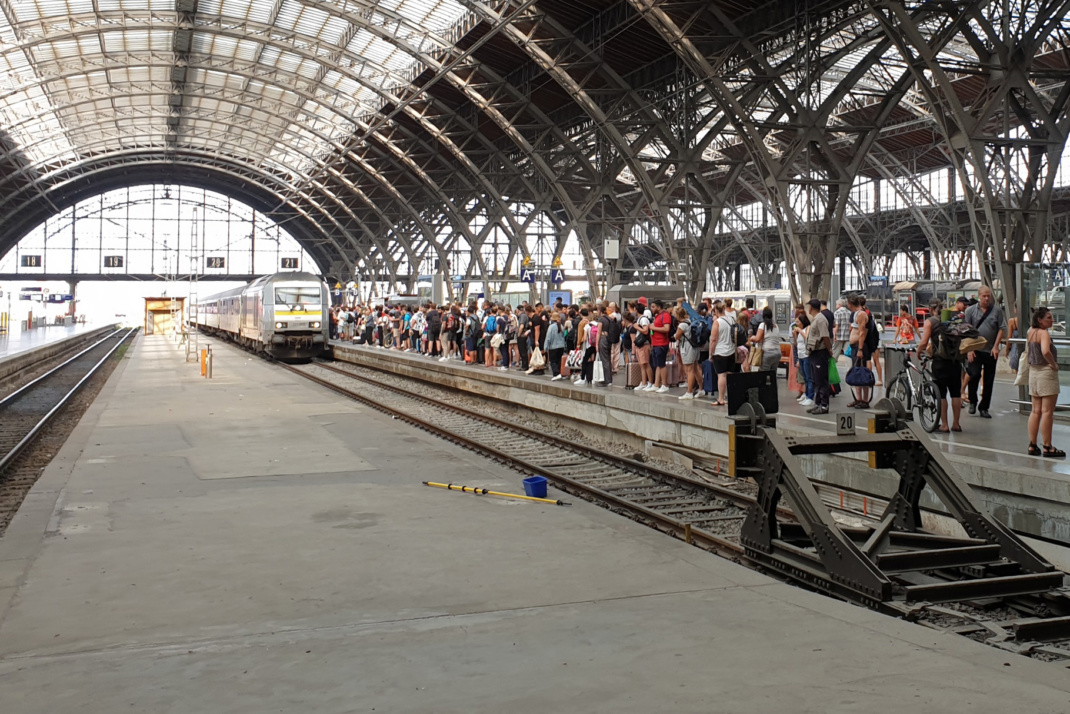
The Free State of Saxony has had it assessed: it is feasible. With compromises, of course. This refers to the upgrade of the northern section of the Chemnitz–Leipzig railway line. This was originally intended to be upgraded to double track along its entire 44-kilometre length. However, that would have cost a tidy 1.32 billion euros. But Saxony’s coffers do not hold that much money. A feasibility study was therefore commissioned to find out what could actually be achieved with the available funds.
The surprising answer: far less! For a feasible cost of 531 million euros, only 24 kilometres of double track can now be built. On top of that, a further 149 million euros or so is needed for the full electrification of the line. “The Free State of Saxony has done its homework: we have discussed at length with our partners what a solution might look like, we have had this solution assessed, and we have found a viable way forward, including in terms of funding,” says Regina Kraushaar (CDU), Minister of State for Infrastructure, jubilantly.
Chemnitz’s Mayor Sven Schulze (SPD) also expressed his relief: “We are finally on our way. The feasibility study provides us with a solid basis for sustainably improving the rail link between Chemnitz and Leipzig. Even if not all our dreams and wishes can be fulfilled, the double-tracking of the line where it makes sense, electrification and increased train frequency are key building blocks. It was important to me that we find solutions which will bring about tangible improvements for rail users in the foreseeable future.”
The Saxon Greens, however, are far from happy. “This is not a forward-looking expansion, but an admission of failure in transport policy,” criticises their transport policy spokesperson, Katja Meier. This vital rail link needs more capacity, greater reliability and a genuine prospect for growth. Instead, the double-track expansion is being scaled back and planned as a bare-bones programme: half-hourly services on regional routes only during peak hours, with hourly services at other times. “Capacity utilisation is already at 140 per cent. Building now without a buffer will perpetuate today’s shortages for decades to come,” says Meier, clearly exasperated. She calls on Minister-President Kretschmer (CDU) to make the expansion a top priority.
Suspect description from the Grünau robbery
Have you recently seen a young man with protruding ears walking along whilst whistling? Be on your guard – he could be one of the two perpetrators who robbed a woman in Leipzig-Grünau on 6 June. Leipzig Police Headquarters has today published a detailed description of the suspects and is once again appealing to the public for information.
At the time, a 34-year-old woman had been sitting on a park bench on the street An der Kotsche – opposite number 53 – shortly before midnight. Two men then approached her. One tried to snatch her handbag, whilst the other subsequently injured her forearm so severely that the woman had to be treated in hospital.
Both are believed to have been around 30 years old and well-groomed. The tall, thin one of the two even smelled of perfume. The police have published details of any further distinguishing features observed in the two robbers via this link.
What the LZ reported on today:
Leipzig Eco-Festival 2026: Popular environmental fair met with criticism
Sale of the Capa Wood: Left-wing faction could give its approval – subject to two conditions
Trial over fraudulent cyber trading: Prosecution estimates losses at 40 million euros
It’s like a nursery: Zoo delighted with rare new arrivals
Hello Leipzig: How Wednesday 17 June 2026 begins
Berlin–Linda–Berlin: How Franziska Mascheck from the Leipzig district made it into the Bundestag
Genghis Khan: How a feared Mongol prince also changed the course of European history
The Saxon State Constitution is now also available in easy-to-read language
Other important news today:
As part of the German-Polish Forum, the German government has returned several cultural artefacts looted during the Nazi occupation to Poland. These include, for example, a 16th-century gold ring set with a diamond and a medieval manuscript on parchment dating from the 14th century.
The European Parliament has adopted more relaxed regulations on the use of genetic engineering. This means that products derived from certain genetically modified plants may now be sold without special labelling.
The Bavarian Administrative Court ruled today that the AfD in Bavaria may continue to be monitored by the Office for the Protection of the Constitution. The party had sought a court injunction to prevent this. However, the court sees genuine evidence of anti-constitutional activities within the AfD.
Empfohlen auf LZ


So können Sie die Berichterstattung der Leipziger Zeitung unterstützen:





There is one comment