
Dieser Artikel ist auch in deutscher Sprache verfügbar: Zum deutschen Artikel.
The scorching heat is putting a damper on many event ideas. LZ lists what has been cancelled. In Machern, the hockey club is defying the heat and a lack of funding: ground-breaking ceremony for the new hockey hall! Another new development is the Karl Bridge, which, after three years of construction, is replacing its predecessor. There’s a chilling tale with a sombre backdrop at the former GDR execution site, which is rarely open to the public.
Bridge on Industriestraße finally complete
It’s done. After more than three years of construction, the Karl Bridge is reopening today. It spans the White Elster and, as part of Industriestraße, connects the districts of Plagwitz and Schleußig. The replacement project necessitated a full closure and had become essential due to the poor structural condition of the approximately 34-metre-long and 11-metre-wide crossing.
According to the planners’ assessment, repair work was not economically viable due to the considerable damage and severe wear and tear on the materials. Furthermore, the existing three-span brick arch, with two intermediate supports and deep vaults in the floodplain, no longer met the requirements for effective floodwater discharge. A new, pierless structure was therefore built in the form of a two-part steel arch with a concrete deck, allowing the Weiße Elster to flow unhindered under the bridge in future.
During the construction work, Industriestraße remained closed to through traffic. Thanks to a temporary bridge, pedestrians and cyclists were still able to cross the river throughout the construction period. Public transport was also affected by the construction work.

We will find out today whether the new Karlbrücke has turned out as planned. Visualisation: City of Leipzig
Heatwave brings events to a standstill
The extreme heatwave is affecting numerous events in Leipzig and the surrounding region today and over the weekend. Already today, the ‘Picnic Against Loneliness’, originally planned for Lene-Voigt-Park, is being moved to the Grüne Quartier (Heinrichstraße 9) and will take place from 3 pm to 4 pm as ‘Ice Cream Against Loneliness’. There are numerous cancellations or changes scheduled for Saturday.
For instance, the Gohlis Summer Festival has been cancelled and, according to the Gohlis Citizens’ Association, is to be postponed until late summer. Also cancelled are the Abtnaundorf Park Festival, the ‘Lauf & Schenke’ charity run in Clara Zetkin Park, the parades at the Liebertwolkwitz and Schkeuditz town festivals, the classic car meet in Grimma, and the summer festival organised by the ‘Gesundheitspflege’ allotment association. The Christopher Street Day (CSD), scheduled for Saturday in Torgau, has now been added to the list of cancellations.
Leipzig Jewish Week has also been affected by the weather forecasts. The concert planned for Saturday at the memorial site of the Great Community Synagogue (Gottschedstraße) has been cancelled, whilst the closing event on Sunday will be moved to the air-conditioned Museum of Fine Arts.
The heatwave is also having an impact on sport. The Leipzig Cup for youth football has been cancelled. Similarly, the friendly match between 1. FC Lokomotive and VfB Zwenkau will not go ahead; the fixture has been cancelled by mutual agreement. In addition, the Saxon Football Association has cancelled all league and competitive matches at state level in the boys’ and girls’ junior divisions, as well as the State Talent Day for the weekend.
The 25th Dieter Lehmann Tournament in Bennewitz, scheduled for Saturday and Sunday, has also been cancelled. The club will provide further information on a rescheduled date at a later stage. Furthermore, the greyhound race in Borsdorf has been postponed and the children’s festival in Markranstädt has been rescheduled for September.
The summer concert in the courtyard of the Lützschena Auwaldstation on Sunday might even have gone ahead, given the cool weather. But no – this event has also had to be cancelled. Not because of the heat, but because the oak processionary moth currently makes it impossible to stay on the site.
Deutsche Bahn advises against travelling
In view of the ongoing heatwave, Deutsche Bahn is warning of significant disruption to train services and is advising travellers to avoid non-essential journeys. For the first time, the company is responding with a special heatwave goodwill measure: Passengers who have booked their ticket by 23 June for a journey taking place by 30 June at the latest can cancel their journey free of charge and will be refunded the ticket price. Deutsche Bahn
advises all customers who can postpone their journey to make use of this scheme.
However, unlike previous goodwill offers, it is not possible to use the ticket at a later date. Anyone wishing to postpone their journey must first cancel their ticket and then purchase a new one. All the key information on Deutsche Bahn’s heatwave initiative is available online here: https://www.bahn.de/service/fahrplaene/aktuell
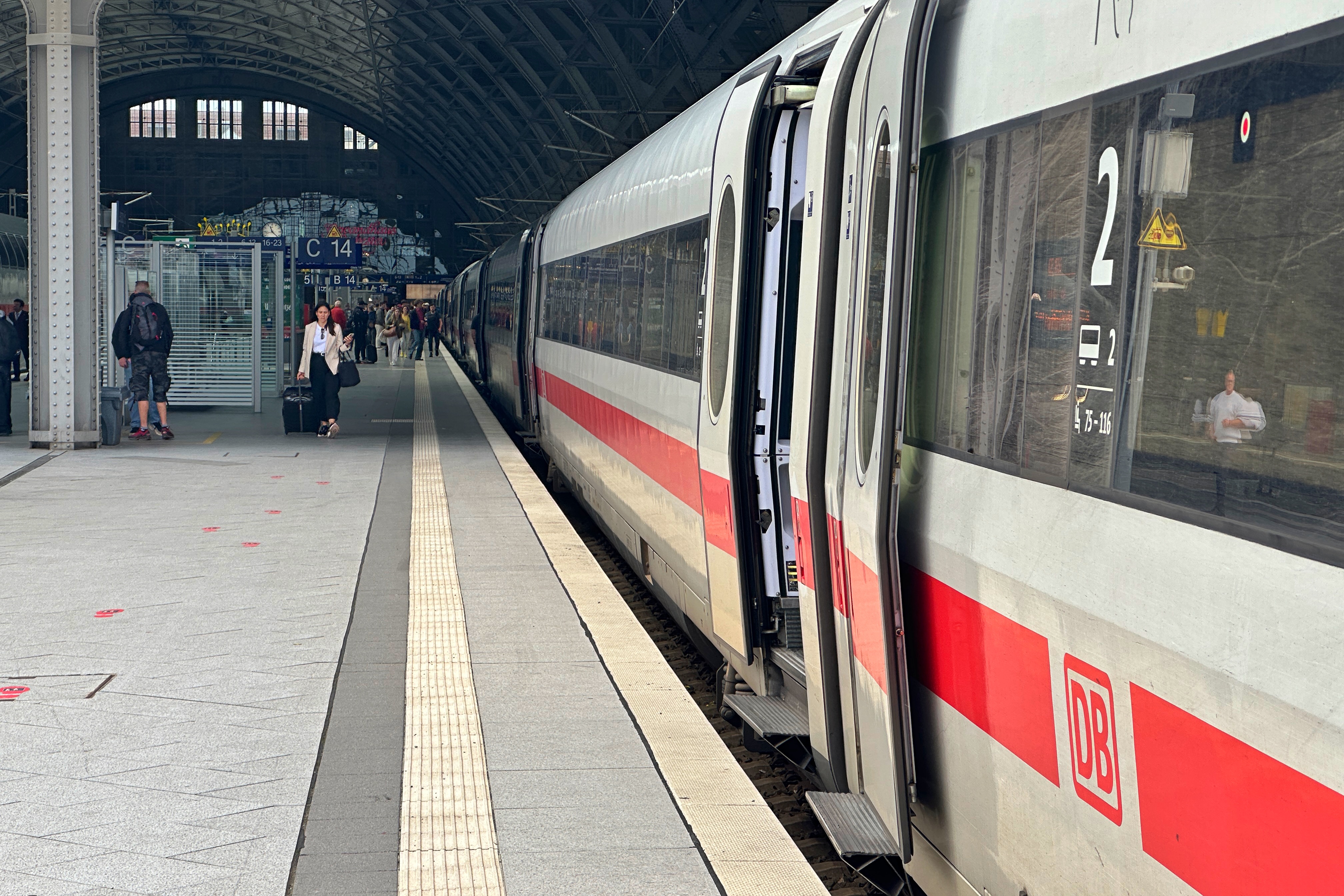
Anyone who does not absolutely have to travel should avoid travelling by train. Photo: Benjamin Weinkauf
Machern defies the heat (and the cost)
They’re really keen on their new hockey hall! When asked, the Tresenwalder Hockeyclub e.V. confirmed that the date for the ceremonial ground-breaking ceremony on Sunday at 3 pm at the Sportpark (Gartenallee 8) remains unchanged. The hall, which will meet international tournament standards, is scheduled for completion in October 2026.
After the Free State of Saxony refused to provide funding, the Machern-based club is financing the new build – costing around one million euros – entirely from its own resources and internal loans. The new hall is set to significantly improve training conditions for the THC’s players and ensure the long-term development of competitive sport in Machern.
Also on Sunday, at 2 pm, the THC’s first men’s team will play their final league match against Leipziger SC. According to the club, the team is highly likely to celebrate promotion to the Regionalliga afterwards. Interested visitors are invited to both events.

Former execution site open to the public
It is one of the darkest places in the history of the GDR’s justice system and remains hidden behind closed doors for most of the year: Today, however, the former central execution site of the GDR on Leipzig’s Alfred-Kästner-Straße can be visited from 4 pm to 8 pm as part of guided tours led by experts. Visitors can enter the rooms, which have been preserved in their original state, where, according to current knowledge, 64 death sentences were carried out between 1960 and 1981. The opening marks the 45th anniversary of the last known execution in the GDR. On 26 June 1981, the centuries-long history of the death penalty on German soil came to an end at this site.
At 10.10 am, the former Stasi officer Dr Werner Teske was executed by what was described as an ‘unexpected point-blank shot to the back of the head’. It was not until six years later, in December 1987, that the GDR removed the death penalty from its criminal code. Teske was initially regarded as a model functionary of the GDR. A doctor of economics, he worked for the foreign intelligence service of the State Security. However, personal crises, alcohol problems and dissatisfaction with his career progression began to undermine him. He toyed with the idea of fleeing to the West, but never put this plan into action. Although he stole secret documents, he did not make contact with Western intelligence services. Nevertheless, a secret trial at the GDR’s Supreme Court sentenced him to death for espionage and attempted desertion.
Historians today regard the trial as a political judicial murder. Following his rehabilitation in 1993, those responsible were also prosecuted. In 1998, the Berlin Regional Court sentenced Karl-Heinz Knoche, the presiding military judge of the 1st Military Criminal Division of the GDR Supreme Court, to four years’ imprisonment for manslaughter and perversion of justice. The then Chief Military Public Prosecutor, Heinz Kadgien, was also sentenced to four years’ imprisonment for aiding and abetting manslaughter and perverting the course of justice. The court found that the death penalty had not been permissible even under the GDR law of the time.
As Teske never carried out his plans to flee or commit treason, a prison sentence of up to twelve years would, at most, have been appropriate under the case law of the time. The judges characterised the death sentence as “arbitrary killing under the guise of a judicial process”. The Leipzig Citizens’ Committee has been campaigning for years to preserve the former execution site permanently as a memorial to judicial history, featuring an exhibition on the death penalty in the GDR.
No booking is required for the guided tours, which take place one after the other. The admission fee is intended as a contribution towards the preservation of the memorial and amounts to 7.50 euros, or 6 euros for concessions.

Empfohlen auf LZ


So können Sie die Berichterstattung der Leipziger Zeitung unterstützen:





There is one comment